
How Much Paint Do I Need? Litres and 4 L Tins in Australia
Wall area in square metres, what the spread rate on an Australian tin means, sealer on new plasterboard, and buying 15, 10, 4 and 1 litre tins without waste.
By Redbison Dev · · 9 min read
Australia edition. Square metres and litres for Australian homes, the 15, 10, 4 and 1 litre tins sold here, the spread rate in m² per litre, sealer undercoat on new plasterboard, prices in A$, and lead paint and asbestos advice for houses built before 1970 and 1990. US edition
For a 4 by 3.6 metre bedroom with 2.4 metre ceilings, one door and one window, two coats on the walls take about 4.1 litres at a spread rate of 16 m² per litre, which is a 4 litre tin and a 1 litre tin. Add about 1.8 litres for two coats on the ceiling. Australian paint comes in 15, 10, 4 and 1 litre tins rather than the 2.5 and 5 litre sizes sold in Europe, and that changes which tins make the cheapest combination. This guide shows how to measure, how to read the spread rate, when plasterboard needs a sealer, and how to buy, using the Paint Calculator (Australia).
Measure the walls in metres
Paint quantities follow the walls, not the floor. Measure the room's length, width and ceiling height in metres; the four walls together are one strip as long as the perimeter.
wall area    = 2 x (length + width) x height
ceiling area = length x width
The bedroom has a perimeter of 15.2 m and 36.48 m² of wall. A standard internal door of about 820 x 2040 mm is roughly 1.7 m², and a 1.8 x 1.2 m window is 2.16 m², which leaves 32.62 m² to paint. The ceiling adds 14.4 m².
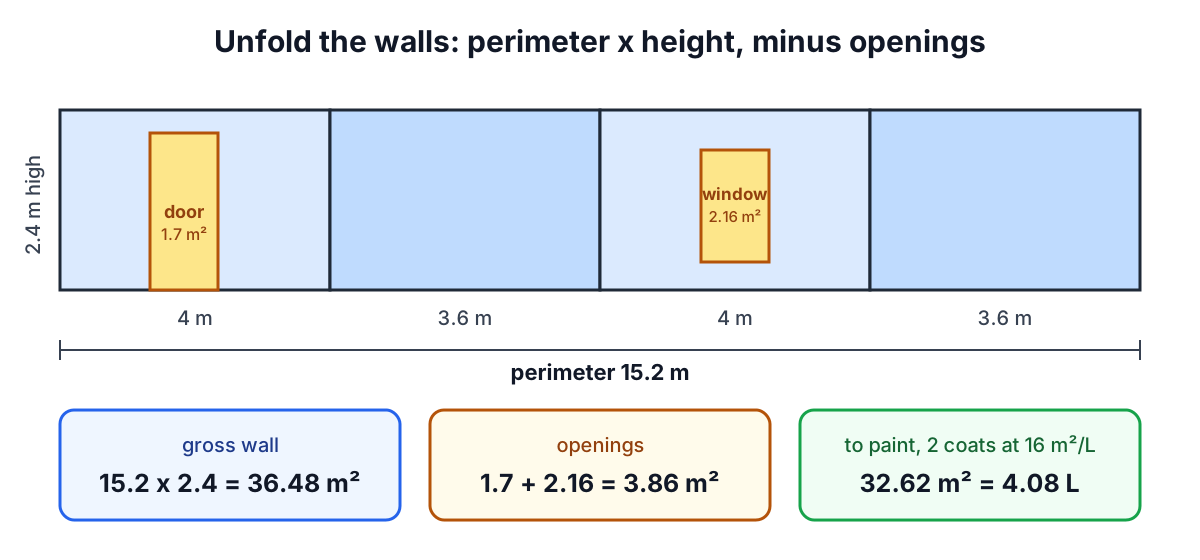
Take off what you are not painting: a tiled wall in the bathroom or laundry, a splashback, built-in robes, a feature wall getting wallpaper. Leave out the skirting, architraves and doors, which take an enamel or semi-gloss bought separately.
The spread rate on the tin
Australian tins and data sheets give coverage as a spread rate in square metres per litre for one coat. Premium interior acrylics are commonly around 16 m² per litre, the figure the Australian calculator starts from, taken from the theoretical spread rate on Dulux's Wash&Wear Low Sheen data sheet. It is a theoretical rate at the film thickness the maker tested on a smooth, sealed surface. Fresh plasterboard, bagged or rendered brick, a textured ceiling and a big colour change all spread less.
That gap changes what you buy for the same bedroom walls:
| Spread rate you assume | Litres for two coats | Tins the calculator suggests |
|---|---|---|
| 16 m²/L | 4.08 | 4 L + 1 L |
| 12 m²/L | 5.44 | 4 L + 2 x 1 L |
At 16 m²/L the room is only 0.08 litres over one 4 litre tin, so a careful painter might manage on one tin. The calculator never rounds down, because running out on the last wall means a second trip and possibly a slightly different batch.
Coats, sealer and undercoat
Two coats is the standard for walls, and Dulux's Wash&Wear Low Sheen page recommends two, with two hours before recoating. A white ceiling refreshed in the same white may need only one.
New plasterboard is the exception that catches people out on renovations and extensions. Bare plasterboard and set joints absorb paint unevenly, so the joints show through unless the board is sealed first. Dulux's instruction for unpainted plasterboard is one coat of a primer, sealer and undercoat before the top coats. In the calculator, enter that as a primer coat with the spread rate from its own tin.
For the bedroom in a new extension, walls and ceiling together are 47 m². One coat of sealer undercoat at 12 m²/L is 3.92 litres, a single 4 litre tin. The top coats are 4.08 litres for the walls and 1.80 for the ceiling, so a 4 litre tin and a 1 litre tin of wall colour, and two 1 litre tins of ceiling white.
From litres to tins
The calculator picks the combination of 15, 10, 4 and 1 litre tins that covers the job with the least left over, and never more than two 1 litre tins, because a third almost always costs more than a 4. Dulux also lists 500 mL and 2 litre tins for some products, which suit touch-ups and feature walls but rarely beat a 4 for a whole room.
| Job (16 m²/L, 2 coats) | Litres | Suggested tins |
|---|---|---|
| Bedroom walls | 4.08 | 4 L + 1 L |
| Bedroom walls and ceiling as one colour | 5.88 | 4 L + 2 x 1 L |
| Open living area, 6 x 4.5 m, 2.7 m walls, 2 doors of 1.7 m² and 2 windows of 3 m², walls and ceiling | 9.29 | one 10 L |
| Four bedrooms the same size, walls only | 16.31 | 15 L + 2 x 1 L |
The tin range changes the answer. With European 2.5 litre tins, the same bedroom would be a 2.5 and two 1 litre tins; here it is a 4 and a 1. For the living area, ceiling paint is usually a different product, so in practice you would buy 5.91 litres of wall colour (a 4 and two 1 litre tins) and 3.38 litres of ceiling white (a 4). For the four bedrooms, the 15 litre tin is usually the cheapest per litre and keeps the colour even across rooms. Enter your tin prices in A$ to compare the suggestion with the next size up, because specials change the answer often.
Older homes: lead and asbestos
The house's age matters more than the paint brand. Lead paint was used in most Australian homes built before 1970, according to the NSW Government's LeadSmart guidance. Paint in good condition can be left alone or painted over. If you prepare it yourself, wet sanding and wet scraping are the recommended methods, open-flame torches should not be used, and pregnant and breastfeeding women and young children should be kept away. The Australian Government's Lead Alert guide sets out six steps for painting an older home safely.
Homes built or renovated before 1990 might contain asbestos, including in some wall and eave sheeting, according to the Asbestos and Silica Safety and Eradication Agency. Do not sand or drill suspect sheeting before painting it.
Common mistakes
- Working from floor area. A 14.4 m² bedroom floor has 36.48 m² of wall around it.
- Planning on the theoretical spread rate. Use it for smooth, sealed, previously painted walls only.
- Skipping sealer on new plasterboard. The joints will show through the top coats.
- Buying walls and ceiling as one product. Work them out separately.
- Mixing batches. Buy the whole job at once, and pour tins of one colour together before you start.
For an odd-shaped room, the Floor Area Calculator (Australia) adds up the pieces, and the Wallpaper Calculator (Australia) uses the same wall measurements if you are papering a feature wall.
Frequently asked questions
How far does a 4 litre tin of paint go?
At 16 m² per litre, 64 m² for one coat or 32 m² for two, which is about the walls of a standard bedroom. On fresh plasterboard or with a strong colour change, plan on less: at 12 m² per litre, two coats cover 24 m².
How much paint do I need for a bedroom ceiling?
A 4 x 3.6 m ceiling is 14.4 m². Two coats at 16 m² per litre need 1.8 litres, so two 1 litre tins, or one coat of a ceiling white over the same white needs 0.9 litres.
Do I need sealer on new plasterboard?
Yes. Bare plasterboard and set joints absorb paint unevenly, so seal them first with a primer, sealer and undercoat, then apply the top coats. For a 4 x 3.6 m room with 2.4 m walls, walls and ceiling, that is about 3.9 litres at 12 m² per litre.
Is a 15 litre tin cheaper than smaller tins?
Usually per litre, and it keeps one batch across several rooms, but it only pays if you will use most of it. Enter the price of each size in the calculator and compare its suggestion with the next size up.
How do I know if my house has lead paint?
Lead paint was used in most homes built in Australia before 1970. If your home is that old, treat painted surfaces as possibly containing lead: leave sound paint alone or paint over it, and use wet methods if you must prepare it.
Sources and further reading
- Wash&Wear Low Sheen, Dulux Australia. Tin sizes, two coats, recoat time and sealer for unpainted plasterboard.
- Dulux Wash&Wear 101 Low Sheen data sheet (AUDU06253), Dulux Australia. Theoretical spread rate of 16 m² per litre and 2-hour recoat time.
- Renovating and maintenance, NSW Government (LeadSmart). Lead paint in homes built before 1970 and safe preparation.
- Lead Alert: the six step guide to painting your home (5th edition), Australian Government. Testing and safe surface preparation in older homes.
- Householders and home renovators, Asbestos and Silica Safety and Eradication Agency. Homes built or renovated before 1990 might contain asbestos.
- Australian trade measurement laws, business.gov.au. Legal units for goods sold by measurement, including litres.
More Construction & Home
Every tool in the Construction & Home section, free and in your browser.