
How Much Paint Do I Need for a Room? Litres and Tins
Wall area in square metres, what "up to 13 m² per litre" on a UK tin really means, mist coats on new plaster, and how to buy 10, 5, 2.5 and 1 litre tins.
By Redbison Dev · · 9 min read
United Kingdom edition. Square metres and litres, the 10, 5, 2.5 and 1 litre tins sold in the UK, coverage as printed on UK emulsion, mist coats on new plaster, and UK rules and guidance on VOC labels, lead paint and textured ceilings. US edition
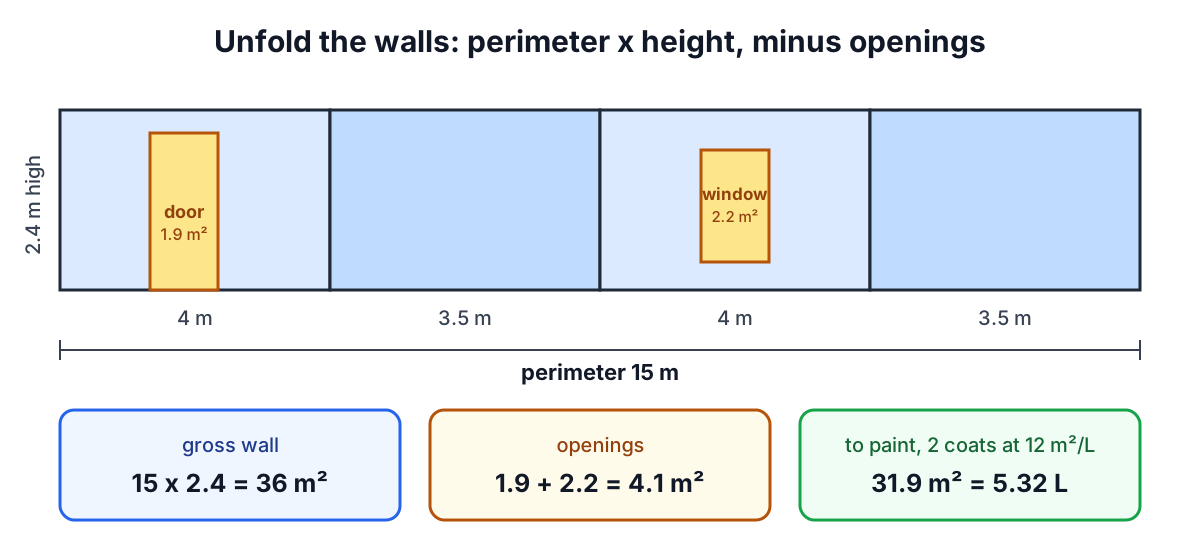
For a typical UK living room of 4 by 3.5 metres with 2.4 metre walls, one door and one window, two coats on the walls take about 5.3 litres of emulsion at 12 m² per litre, and the ceiling adds about 2.3 litres. That usually means a 5 litre tin plus a 1 litre tin for the walls and a separate 2.5 litre tin of ceiling white. The rest of this guide shows where those figures come from, why the coverage on the tin is a best case, and how to pick tins so you are not left with half a 10 litre tub in the shed. The numbers can all be reproduced in the Paint Calculator (UK).
Measure in metres, then unfold the walls
Paint quantities follow wall area, not floor area, so measure the room's length, width and floor-to-ceiling height in metres. The four walls laid side by side are one strip as long as the perimeter.
wall area    = 2 x (length + width) x height
ceiling area = length x width
The living room above has a perimeter of 15 m and 36 m² of wall. A standard UK internal door leaf of 762 x 1981 mm is 1.5 m²; with a wider leaf or the frame you are not painting, about 1.9 m² is a fair figure. Take that off, and a 2.2 m² window, and 31.9 m² is left.
British houses add their own shapes. A chimney breast adds the two returns on either side (often 0.3 to 0.4 m deep each, measure yours) to the perimeter. A bay window adds its splayed sides. A tiled splashback, a wall of fitted wardrobes or a feature wall you are papering comes off. If the room has a picture rail and you paint above and below it in different colours, measure the two bands separately.
What the coverage on a UK tin means
UK emulsion tins print coverage in square metres per litre for one coat, usually as "up to". Dulux, for example, gives up to 13 m² per litre for EasyCare Washable and Tough Matt and tells you to apply two coats. "Up to" is the figure for a smooth, sound, sealed wall at the film thickness the maker intends. Porous plaster, a rough lining paper, filler patches and a strong colour change all bring it down.
The figure you choose changes what you buy for the same living room:
| Coverage you assume | Litres for two coats | Tins the calculator suggests |
|---|---|---|
| 13 m²/L (the tin's best case) | 4.91 L | one 5 L |
| 12 m²/L | 5.32 L | 5 L + 1 L |
| 10 m²/L (porous or patched walls) | 6.38 L | 5 L + 2 x 1 L |
So the honest answer to "will one 5 litre tin do it?" is: only if your walls behave like the maker's test panel. On a previously painted, smooth wall in a similar colour, 12 m²/L is a sensible middle figure; on anything rougher, plan on 10.
Coats, mist coats and primers
Two coats is the normal plan for walls, and it is what most UK tins ask for. The first coat soaks into patches unevenly; the second evens out the colour and sheen. One coat can be enough for a white ceiling being refreshed in the same white. Going from a dark colour to a pale one, or using some strong reds and yellows, can need a third.
New plaster is different. It must be fully dry first, and its first coat is absorbed so heavily that a normal coat would flake or look patchy. The usual British answer is a mist coat: emulsion thinned with water to the dilution printed on the tin, or a contract matt sold for bare plaster. Paint makers do not agree on one ratio, so follow the tin rather than a forum. In the calculator, enter that first coat as a primer coat with its own coverage.
For a newly plastered 3.5 by 3 m bedroom with 2.4 m walls, one door and a 1.44 m² window, walls and ceiling together are 38.4 m². One sealing coat at 10 m²/L is 3.84 litres, and two finish coats at 12 m²/L are 6.39 litres. The calculator splits that into 4.64 litres for the walls and 1.75 litres for the ceiling, so you would buy a 5 L tin of wall colour and two 1 L tins (or one 2.5 L) of ceiling white.
From litres to tins
The UK range for emulsion is 10, 5 and 2.5 litres, with 1 litre tins for small jobs and some colours. The calculator picks the combination that covers the job with the least paint left over and never more than two 1 litre tins, because a third small tin almost always costs more than stepping up a size.
| Job | Litres needed | Suggested tins |
|---|---|---|
| Living room walls (above) | 5.32 | 5 L + 1 L |
| Living room walls and ceiling as one colour | 7.65 | 5 L + 2.5 L + 1 L |
| Same, ceiling bought separately | 5.32 + 2.33 | 5 L + 1 L, and 2.5 L of ceiling white |
| Three bedrooms, 3.5 x 3 m, walls only | 13.93 | 10 L + 2.5 L + 2 x 1 L |
Least paint is not always least money. For the three bedrooms, a 10 L and a 5 L tin give 15 litres in two tins instead of four, and big tins are often on offer. Enter the price of each size in the calculator to see the cost of its suggestion, then check the alternative yourself. If you buy several tins of a mixed colour, pour them together in a bucket before you start so the shade is the same on every wall.
Older houses: lead, textured ceilings and ladders
Preparation in an older British home can matter more than the paint. Lead was used in some paints for windows, doors and other woodwork until the mid-1960s, and Cambridge City Council's guidance on lead paint is not to dry-sand it, to wet-abrade instead, to keep children and pregnant women away from the work and to wear a mask with a P3 filter.
Textured ceiling coatings applied years ago can contain asbestos. HSE lists textured coatings among the places asbestos is found, and the lower-risk course is to paint over a sound ceiling rather than sand, scrape or drill it without knowing what it contains.
For ceilings and stairwells use a stable stepladder or platform rather than a chair; HSE's ladder guidance is written for work but applies at home too. Decorative paints sold in the UK carry a VOC content on the label under the VOC in Paints Regulations 2012, and water-based emulsions sit at the low end.
Common mistakes
- Measuring the floor. A 14 m² living room floor has 36 m² of wall around it.
- Planning on the "up to" figure. It is the best case. Use a lower number for porous, patched or textured walls.
- Skipping the mist coat. Bare plaster drinks the first coat, so count it as a separate coat.
- Buying one colour for walls and ceiling. Most ceilings are painted in a separate white, so work the quantities out separately.
- Including woodwork. Skirting, doors and frames take gloss or satinwood, bought separately and usually in smaller tins.
If you are papering one wall instead, the Wallpaper Calculator (UK) uses the same measurements, and the Square Footage Calculator (UK) helps with odd-shaped rooms.
Frequently asked questions
How far does a 2.5 litre tin of emulsion go?
At 12 m² per litre it covers 30 m² for one coat, or 15 m² for two. That is a small bathroom or a single feature wall, not usually a whole bedroom. At a tin's "up to 13 m²" it would be 32.5 m² for one coat, but only on a smooth, sealed wall.
Will one 5 litre tin paint a living room?
Only just, and only on good walls. A 4 by 3.5 m room with 2.4 m walls, a door and a window has 31.9 m² of wall. Two coats need 4.91 litres at 13 m²/L, 5.32 litres at 12 m²/L and 6.38 litres at 10 m²/L, so most rooms of that size need a 1 litre tin as well.
How much paint do I need for a mist coat?
Count it as a full coat over the new plaster, at the coverage the tin gives for that use. For a 3.5 by 3 m bedroom with walls and ceiling, 38.4 m² at 10 m²/L is about 3.8 litres for the sealing coat, before the two finish coats.
Should I paint the ceiling or the walls first?
Ceiling first, so drips and the edge where ceiling meets wall are covered when you paint the walls. Work the ceiling quantity out separately too, because it is usually a different white.
Is a 10 litre tin cheaper than two 5 litre tins?
Often per litre, but offers change that, and a 10 litre tin only helps if you will use most of it. Put the price of each size into the calculator and compare its suggestion with the next size up.
Sources and further reading
- Dulux EasyCare Washable and Tough Matt, Dulux UK. An example of UK coverage printed as "up to 13 m² per litre", with two coats.
- The Volatile Organic Compounds in Paints, Varnishes and Vehicle Refinishing Products Regulations 2012, legislation.gov.uk. VOC limits and labelling for decorative paints.
- Lead paint in your home, Cambridge City Council. Where lead paint is found in older homes and how to prepare it safely.
- Diagrams showing where asbestos can occur in buildings, Health and Safety Executive. Where asbestos is found in older buildings, including textured decorative coatings such as Artex.
- Ladders and stepladders, Health and Safety Executive. Safe use of stepladders.
More Construction & Home
Every tool in the Construction & Home section, free and in your browser.