
How to Write a Tax Invoice in Australia: ABN and GST
What an Australian tax invoice must show under and over A$1,000, GST-free lines worked through in A$, adjustment notes, and the 47% withheld when no ABN is quoted.
By Redbison Dev · · 10 min read
Australia edition. Written for Australian sole traders and small businesses: the ATO's tax invoice details, the A$82.50 and A$1,000 thresholds, GST-free lines, adjustment notes, no-ABN withholding, record keeping and Commonwealth payment terms. US edition
In Australia the word on top of the page matters. A tax invoice is the document your customer needs to claim a GST credit, and only a GST-registered business can issue one. An ordinary invoice is what you send if you are not registered: it still needs your ABN, or your customer may have to withhold 47% of the payment. So the first question is not the layout; it is whether you are registered for GST.
This edition covers both cases, works through a tax invoice with a GST-free line in Australian dollars using the Australian Tax Invoice Generator, and explains adjustment notes, the no-ABN rule and what to put in your payment terms. It is general information, not tax advice. A registered tax agent or BAS agent can check your set-up if you sell to overseas customers, use the margin scheme on property or receive recipient-created tax invoices.
Registered for GST or not?
You must register for GST once your GST turnover reaches A$75,000 a year (A$150,000 for non-profit bodies), and taxi and ride-sourcing drivers must register whatever their turnover. Below the threshold registration is optional.
| Registered for GST | Not registered | |
|---|---|---|
| Document title | Tax Invoice | Invoice |
| Your ABN | Required | Show it, so the customer does not withhold 47% |
| GST line | 10% on taxable lines | None; never add GST |
| Customer can claim a GST credit | Yes | No |
A common slip is a new sole trader using a template titled Tax Invoice with a GST line before the registration comes through. The customer cannot claim that GST, and you would be collecting tax you are not entitled to charge.
What a tax invoice must show
The ATO's tax invoice rules set out the content, based on section 29-70 of the GST Act.
For a sale under A$1,000 (GST-inclusive), seven things:
- That the document is intended to be a tax invoice. Titling it "Tax Invoice" does this.
- Your identity, as your business name.
- Your ABN.
- The date it was issued.
- A brief description of what you sold, with the quantity and price.
- The GST amount, or, where the GST is exactly one eleventh of the total, a statement such as "Total price includes GST".
- The extent to which each sale on the invoice is taxable.
For a sale of A$1,000 or more, add the buyer's identity or ABN. Both thresholds use the GST-inclusive price.
Two smaller rules round this out. You do not have to issue a tax invoice for a sale of A$82.50 or less including GST; the GST Regulations set that as A$75 excluding GST. And if a customer asks for a tax invoice for a taxable sale above that, you must give it to them within 28 days of the request.
The ABN is 11 digits, usually written 12 345 678 901. Check yours and your customer's on ABN Lookup, which also shows whether a business is registered for GST.
Worked example: consulting with a GST-free course
A Melbourne bookkeeper, registered for GST, invoices a Sydney client on 9 November 2026 for:
- 10 hours of consulting at A$150 (taxable)
- 1 accredited training course at A$250 (GST-free)
- a 10% discount on the whole invoice, agreed in the quote
- payment terms of 14 days
| Step | Working | Amount |
|---|---|---|
| Subtotal | A$1,500 taxable + A$250 GST-free | A$1,750.00 |
| Discount 10% | A$150 off the taxable line, A$25 off the GST-free line | -A$175.00 |
| Taxable amount | A$1,500 - A$150 | A$1,350.00 |
| GST-free amount | A$250 - A$25 | A$225.00 |
| GST 10% | 10% of A$1,350 | A$135.00 |
| Total | A$1,710.00 |
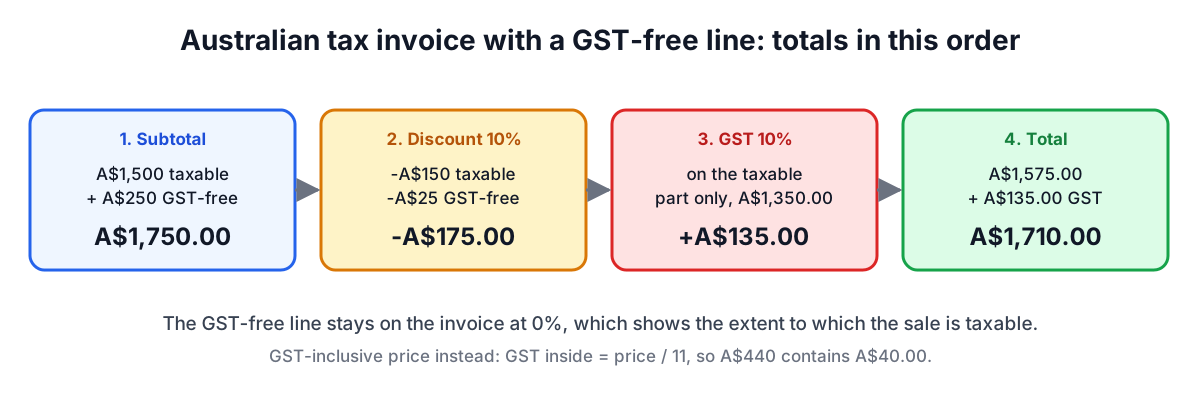
Three things make this a valid tax invoice. The total is over A$1,000, so the client's business name or ABN must be on it. The GST-free line stays on the invoice at 0%, which shows "the extent to which each sale is taxable". And the discount is shared across both lines in proportion, so GST is charged only on the discounted taxable amount.
Without the course and the discount, the job is A$1,500 plus A$150 GST, A$1,650 in all. If your prices are GST-inclusive, as they usually are for consumers, the GST inside is one eleventh: a A$440 sale contains A$40. Switch on "Prices already include tax" in the generator, or check any figure with the Australian GST calculator.
When the GST is reported
Most small businesses (aggregated turnover under A$10 million) can account for GST on a cash basis, so the A$135 goes on the BAS for the period in which the client pays. On a non-cash (accruals) basis it belongs to the period in which you issue the invoice, even if the client pays later.
Correcting an invoice: adjustment notes
Australia's version of a credit note is an adjustment note. If the price changes after you have issued a tax invoice (a refund, a later discount, a cancelled part of the job) and the change alters the GST, you issue one. The ATO's adjustment notes guidance says the customer generally needs a valid adjustment note before making a decreasing adjustment, unless the GST involved is A$75 or less, and you must issue it within 28 days of their request or of becoming aware of the adjustment, whichever is earlier. It shows the issue date, the original invoice, a brief reason and the change in GST. Keep invoice numbers in one sequence and never reuse one.
The no-ABN rule: why 47% can vanish
If you sell to a business without quoting your ABN on the invoice or another document, the payer must generally withhold 47% of the payment and send it to the ATO, the top marginal rate plus the Medicare levy. On the consulting invoice above, from a sole trader not registered for GST who forgot the ABN, a A$1,500 invoice would arrive as A$795, with A$705 withheld. You can claim it back in your tax return, but that may be many months away.
There are exceptions, such as hobby income or a supply that is wholly private, which you declare with the ATO's statement by a supplier not quoting an ABN. For normal business work, put your ABN on every invoice.
Payment terms in Australia
Australia has no general law that adds interest to a late business invoice. Outside construction, where each state's security of payment act sets its own deadlines, interest is owed only if your terms say so, so write it into the quote or contract before you start, not only on the invoice. Many sole traders use 14 days; agree the term in the quote.
Selling to the Australian Government is different. Under the Commonwealth's Supplier Pay On-Time or Pay Interest Policy (RMG 417), non-corporate Commonwealth entities must pay correct invoices within 20 calendar days, or 5 calendar days for e-invoices sent through the Peppol network where both sides use it, until 31 December 2026. From 1 January 2027 the updated RMG 417 sets a maximum of 10 business days for all invoices. Under the current policy, interest is payable when payment is late and the interest exceeds A$100. Peppol e-invoicing runs on an ABN-based network for which the ATO is the Australian Peppol Authority; a PDF tax invoice is still valid for every other customer.
Records
Keep a copy of every tax invoice and adjustment note you issue and receive for five years. A PDF saved from the generator, with its number in sequence, is a record; the browser draft is not.
Common mistakes on Australian invoices
- "Tax Invoice" with a GST line before you are registered.
- No buyer details at A$1,000 or more. Including the client's name and ABN on every invoice avoids this.
- GST worked out at 10% of an inclusive price. It is one eleventh: 10% of A$440 is A$44, but the GST inside is A$40.
- Leaving GST-free lines off the invoice. Show them at 0%.
- No ABN on an invoice from a non-registered sole trader. It invites 47% withholding.
Setting your rates? The freelance rate calculator works back from the income you want.
Frequently asked questions
What is the difference between an invoice and a tax invoice in Australia?
A tax invoice is issued by a GST-registered business for a taxable sale and lets the customer claim a GST credit. It must say it is intended to be a tax invoice and carry the ATO's required details. A business that is not registered issues an ordinary invoice with its ABN and no GST.
Does a tax invoice need the buyer's ABN?
Only when the sale is A$1,000 or more including GST, and then it needs the buyer's identity or ABN. Below A$1,000 the buyer's details are optional, although most businesses include them on every invoice.
Can I invoice without an ABN?
You can, but a business customer must then generally withhold 47% of the payment unless an exception applies, such as a hobby or a private sale declared on the ATO's supplier statement. For business work, quote your ABN.
How do I fix a tax invoice I have already sent?
Issue an adjustment note that refers to the original tax invoice and shows the change in GST, rather than editing the invoice. You must provide it within 28 days of the customer's request or of becoming aware of the adjustment.
How do I show GST-free items on a tax invoice?
Put them on their own lines at 0%. The GST total then covers only the taxable lines, and the invoice shows the extent to which each sale is taxable, as the ATO requires.
Sources and further reading
- Tax invoices, Australian Taxation Office. The seven details and the A$1,000 rule.
- A New Tax System (Goods and Services Tax) Act 1999, Federal Register of Legislation. Section 29-70, the definition of a tax invoice.
- A New Tax System (Goods and Services Tax) Regulations 2019, Federal Register of Legislation. The A$75 (GST-exclusive) tax invoice threshold.
- Adjustment notes, Australian Taxation Office. When a note is needed and the 28-day rule.
- Statement by a supplier not quoting an ABN, Australian Taxation Office. No-ABN withholding and its exceptions.
- ABN Lookup, Australian Business Register. Check an ABN and GST registration.
- Supplier Pay On-Time or Pay Interest Policy (RMG 417), Department of Finance. Commonwealth payment terms of 20 days and 5 days for e-invoices until 31 December 2026, and the A$100 interest threshold.
- Updated Commonwealth supplier payment terms, Department of Finance. A maximum of 10 business days for all invoices from 1 January 2027 (RMG 417 from 1 January 2027).
More Business Calculators
Every tool in the Business Calculators section, free and in your browser.