
How to Write an Invoice in Canada: GST/HST Rules
What a Canadian invoice needs at CA$100 and CA$500 so clients can claim input tax credits, which GST/HST rate to charge by province, and late interest that holds up.
By Redbison Dev · · 10 min read
Canada edition. Written for Canadian freelancers and small businesses: the CRA's input tax credit information tiers, GST/HST rates by place of supply including Nova Scotia's 14%, PST and QST, the small supplier threshold, and how the Interest Act and Criminal Code shape late payment charges. US edition
A Canadian invoice has a job beyond asking for money: if your client is a GST/HST registrant, it is the document they need to claim an input tax credit (ITC) for the tax you charged. The Input Tax Credit Information (GST/HST) Regulations set what it must contain in three tiers, at under CA$100, CA$100 to CA$499.99 and CA$500 or more, and the rate on it depends on the province where the supply is made, not where you live. Get either wrong and the client's accounts payable team sends the invoice back.
This edition covers the tiers, the rate by province, a full worked invoice in Canadian dollars, and how to word late payment interest so it can be collected. The figures come from the Canadian GST/HST Invoice Generator. It is general information, not tax or legal advice; if you sell into Quebec, sell digital products to consumers across provinces or have a construction holdback, an accountant can confirm your set-up.
If you are not registered for GST/HST
You do not have to register while you are a small supplier, which for most businesses means CA$30,000 or less of taxable sales over the last four consecutive calendar quarters (see the CRA's when to register page). Until you register, you cannot charge GST/HST, and your invoice should not show a tax line or a registration number. Once you pass CA$30,000 in a quarter or over four quarters, the CRA rules on when you must start charging apply, so watch the total as it approaches.
What the CRA expects on the invoice
Section 3 of the Input Tax Credit Information (GST/HST) Regulations (SOR/91-45) lists the information by the total amount of the sale:
| Total of the invoice | Information required |
|---|---|
| Under CA$100 | Your name or trade name; the invoice date; the total amount |
| CA$100 to CA$499.99 | All of the above, plus your GST/HST registration number; the tax charged, or a statement that the price includes tax; where the sale mixes supplies, which ones are taxable |
| CA$500 or more | All of the above, plus the buyer's name (or trade name, or authorized agent); the terms of payment; a description of each supply sufficient to identify it |
Most business invoices are over CA$500, so in practice every line in the bottom row belongs on yours. The registration number is your nine-digit business number plus RT and a four-digit account, for example 123456789 RT0001. The regulations do not require an invoice number, but use one anyway; you will need it for credit notes and collections.
Which rate goes on the invoice
The rate follows the place of supply. For most services that is the province of the client's business address you have on file; for goods it is generally where they are delivered. Rates from the CRA's GST/HST calculator and rates page:
| Place of supply | Rate | Notes |
|---|---|---|
| Ontario | 13% HST | |
| Nova Scotia | 14% HST | Down from 15% since April 1, 2025 |
| New Brunswick, Newfoundland and Labrador, Prince Edward Island | 15% HST | |
| Alberta, the territories | 5% GST | |
| British Columbia, Manitoba, Saskatchewan | 5% GST | Plus provincial sales tax where it applies |
| Quebec | 5% GST | Plus QST, administered by Revenu Québec |
PST and QST are separate taxes with their own registration and their own lists of what is taxable. Many professional services are not subject to BC PST or Manitoba RST, while Quebec's QST applies to most services. If you are registered for QST, show your QST number as well. The generator prints one tax per line, so add a provincial tax as a separate line only once you have checked that it applies.
Worked example: an Ontario designer's invoice
A Toronto studio, registered for GST/HST, bills a Toronto client on November 9, 2026:
- 1 x website design (home page and four templates) at CA$2,400.00
- 12.5 hours of development at CA$90.00
- 5% discount for a returning client
- CA$1,000.00 deposit already paid
- Terms: net 30 days
| Step | Working | Amount |
|---|---|---|
| Subtotal | CA$2,400 + 12.5 x CA$90 | CA$3,525.00 |
| Discount | 5% of CA$3,525.00 | -CA$176.25 |
| Amount before tax | CA$3,348.75 | |
| HST 13% | 13% of CA$3,348.75 = CA$435.3375 | CA$435.34 |
| Total | CA$3,784.09 | |
| Less deposit | -CA$1,000.00 | |
| Balance due | CA$2,784.09 |
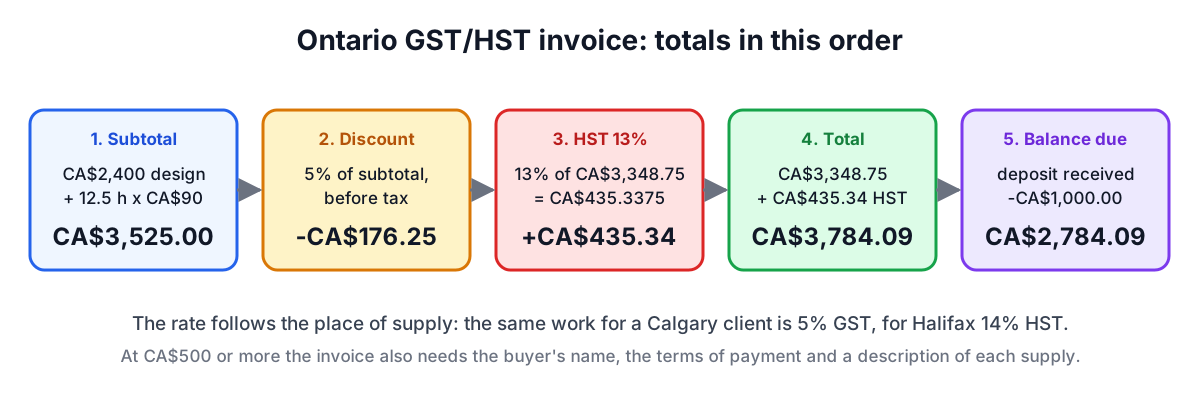
The discount comes off before tax because HST is charged on the price the client actually pays. The total is over CA$500, so the invoice carries the client's name, "Net 30 days" and a line-by-line description; the default draft in the generator has all three.
The same job in four provinces
Without the discount, the same CA$3,525.00 of work comes to:
| Client in | Tax | Total |
|---|---|---|
| Toronto, ON | HST 13%: CA$458.25 | CA$3,983.25 |
| Calgary, AB | GST 5%: CA$176.25 | CA$3,701.25 |
| Halifax, NS | HST 14%: CA$493.50 | CA$4,018.50 |
| Moncton, NB | HST 15%: CA$528.75 | CA$4,053.75 |
A template still set to 15% for Nova Scotia overcharges this client by CA$35.25, and the client can only claim the tax that was properly payable. A Vancouver client would pay the 5% GST from you; BC PST depends on the service.
A small sale with tax included
A CA$90.40 sale including 13% HST contains CA$10.40 of HST (90.40 x 13 / 113). Under CA$100 the regulations need only your name, the date and the total, but an invoice from CA$100 up with tax-included prices must say that tax is included and give the rate, which is what "Includes HST 13%" does when you switch on "Prices already include tax".
Late payment: write the interest rate the way the law reads it
No federal statute adds interest to an overdue business invoice for you. Interest is owed because your terms say so, and two federal laws decide whether those terms hold.
The first is section 4 of the Interest Act. If a written contract sets interest at a rate per day, week or month (any period shorter than a year), no more than 5% a year can be recovered unless the contract also states the equivalent yearly rate. "2% per month on overdue balances" on its own risks being read down to 5% a year. "2% per month (24% per year) on overdue balances" states both.
The second is the criminal interest rate in section 347 of the Criminal Code: 35% APR on the credit advanced. Ordinary invoice terms of 1.5% or 2% a month sit well below it, but stacked "late fees" plus interest can creep up, so keep the charges simple.
Worked example: the Toronto invoice paid late
The client pays the CA$2,784.09 balance two months after the due date. With simple interest at 2% a month (24% a year), as the terms state:
- one month: CA$2,784.09 x 2% = CA$55.68
- two months: CA$111.36
Had the invoice said only "2% per month", the client could argue that 5% a year applies: about CA$23.20 for the two months. The words "(24% per year)" are worth CA$88 on this one invoice. The terms must also be agreed before the work, for example in the quote or contract, not just printed on the invoice for the first time.
In construction, Ontario's Construction Act has its own prompt payment rules, under which an owner must pay a contractor's proper invoice within 28 days; trades should follow that regime instead.
Credit notes, records and paper size
If you need to reduce the price after invoicing, issue a credit note that refers to the original invoice and the GST/HST being credited, rather than editing the invoice. The CRA expects records, including copies of sales invoices, to be kept for six years from the end of the year they relate to (keeping records). Canadian clients print on letter paper (8.5 x 11 in.), which is the generator's default here, and an ISO date such as 2026-11-09 avoids the day-month confusion that 09/11/2026 creates.
Common mistakes on Canadian invoices
- The rate of the province you live in. Charge the rate of the place of supply.
- The business number without RT0001. The full GST/HST account number is what clients and the CRA's registry check.
- No terms on a CA$500-plus invoice. "Due on receipt" or "Net 30 days" satisfies the rule.
- A monthly interest rate with no yearly equivalent.
- GST/HST charged before registration. You cannot collect tax you are not registered to charge.
If you are still working out your prices, the freelance rate calculator starts from the income you want to keep.
Frequently asked questions
What needs to be on an invoice in Canada for the client to claim the GST/HST?
For a total of CA$500 or more: your name, the invoice date, the total, your GST/HST registration number, the tax charged (or a statement that it is included, with the rate), the buyer's name, the terms of payment and a description of each supply. Smaller invoices need less; see the three tiers above.
Which HST rate do I charge a client in another province?
The rate of the province where the supply is made, which for most services is the province of the client's business address. An Ontario freelancer bills a Halifax client 14% HST and a Calgary client 5% GST.
Can I charge interest on a late invoice in Canada?
Yes, if the client agreed to the terms beforehand. State the yearly rate as well as any monthly rate, because section 4 of the Interest Act limits recovery to 5% a year when only a monthly rate is given. Keep the total cost below the 35% APR criminal rate.
Do I need an invoice number in Canada?
The GST/HST regulations do not require one, but a unique number in sequence makes credit notes, collections and CRA questions much easier to handle, and most clients' payables systems expect it.
Do I charge GST/HST if I earn less than CA$30,000?
No, not while you are a small supplier and not registered. You can register voluntarily, which lets you claim input tax credits on your own costs, but then you must charge GST/HST on taxable sales.
Sources and further reading
- Input Tax Credit Information (GST/HST) Regulations, SOR/91-45, Justice Laws Website. Section 3 tiers at CA$100 and CA$500.
- GST/HST calculator (and rates), Canada Revenue Agency. Rates by province, including Nova Scotia's 14%.
- When to register for and start charging the GST/HST, Canada Revenue Agency. The CA$30,000 small supplier test.
- Interest Act, section 4, Justice Laws Website. Monthly rates need a yearly equivalent.
- Criminal Code, section 347, Justice Laws Website. The criminal interest rate.
- Keeping records, Canada Revenue Agency. How long to keep invoices.
More Business Calculators
Every tool in the Business Calculators section, free and in your browser.