
How to Write an Invoice in the UK: VAT and Late Payment
What a UK invoice must show with or without VAT registration, a full VAT invoice worked through in pounds, the tax point, credit notes and late payment interest.
By Redbison Dev · · 10 min read
United Kingdom edition. Written for UK sole traders and limited companies: GOV.UK's invoice contents, HMRC's full and simplified VAT invoice rules from VAT Notice 700, the tax point, statutory late payment interest and compensation, and e-invoicing from April 2029. US edition
A UK invoice has two sets of rules, and which one applies depends on a single fact: whether you are registered for VAT. If you are not, GOV.UK lists nine things the invoice must show, and you must not charge VAT. If you are, the invoice also becomes the document your customer uses to reclaim VAT, so HMRC's VAT Notice 700 sets out its contents line by line, and you normally have 30 days from the tax point to issue it.
This edition walks through both, then builds a VAT invoice in pounds with the UK VAT Invoice Generator and works out what you can add when the customer pays late. It is general information for UK businesses, not tax advice. If you trade across the Irish border, sell under the margin scheme or work in construction under CIS, ask an accountant before you change your invoices.
If you are not registered for VAT
Most new sole traders start below the VAT threshold, which is £90,000 of taxable turnover in the last 12 months. Below it, your invoice is a request for payment and a record for your own accounts. GOV.UK says it must include:
| What to show | Notes for UK businesses |
|---|---|
| A unique identification number | Keep one sequence; see numbering below |
| Your business name, address and contact details | Sole trader: your own name and any trading name. Limited company: the full name exactly as on the certificate of incorporation |
| The customer's company name and address | Use the legal entity, not a brand, so the invoice reaches the right ledger |
| A clear description of what you are charging for | "Logo design, three concepts and final files" beats "design work" |
| The date the goods or service were supplied | The supply date, which can differ from the invoice date |
| The invoice date | Starts the payment clock |
| The amounts being charged | Per line, so the customer can check them |
| The VAT amount, if applicable | Leave this out completely if you are not registered |
| The total owed |
Two traps catch new businesses. A sole trader who uses a trading name must also give an address where legal documents can be delivered. And a company that lists its directors on the invoice must list all of them, not just one. Never add a VAT line "to look established": charging VAT without a VAT number is not allowed, and the customer cannot reclaim it.
What a full VAT invoice must show
Once HMRC registers you, paragraph 16.3.1 of VAT Notice 700 lists the contents of a full VAT invoice. In plain terms:
- a unique invoice number that follows on from the last one;
- the time of supply (the tax point) and the date of issue, if they differ;
- your name, address and VAT registration number;
- the customer's name and address;
- a description that identifies each item, with the quantity, the rate of VAT and the unit price or amount excluding VAT;
- the total excluding VAT, any cash discount offered, and the total VAT charged, which must be in sterling.
Simplified invoices up to £250
If a supply is £250 or less including VAT and the customer agrees, you can issue a simplified VAT invoice: your name, address and VAT number, the time of supply, a description, and for each VAT rate the total including VAT and the rate. A plumber's £180 call-out shows "Total £180.00 including VAT at 20%". The VAT inside a 20% inclusive price is one sixth of it, £30.00, which the generator prints when you switch on "Prices already include tax".
The tax point and the 30-day limit
The tax point is when VAT becomes due, and it decides which VAT return the sale belongs on. For services it is usually the day the work is finished. Paragraph 14.2.2 of Notice 700 adds a rule that most small businesses rely on without knowing it: if you issue the VAT invoice within 14 days after the supply, the invoice date becomes the tax point. Issue it later and the earlier supply date stands, so print both dates. HMRC expects a VAT invoice within 30 days of the tax point.
Mixed rates, foreign currency and reverse charge
Give each line its own rate. A self-publisher billed £400 for cover design at 20% and 50 printed books at £8 at 0% sees VAT of £80.00 on a total of £880.00; the zero-rated books stay on the invoice with their 0% rate. If you invoice in euros or dollars, the lines can stay in that currency but the total VAT must also appear in pounds. For building work under the domestic reverse charge, add no VAT and state that the customer must account for it to HMRC.
Worked example: a full VAT invoice in pounds
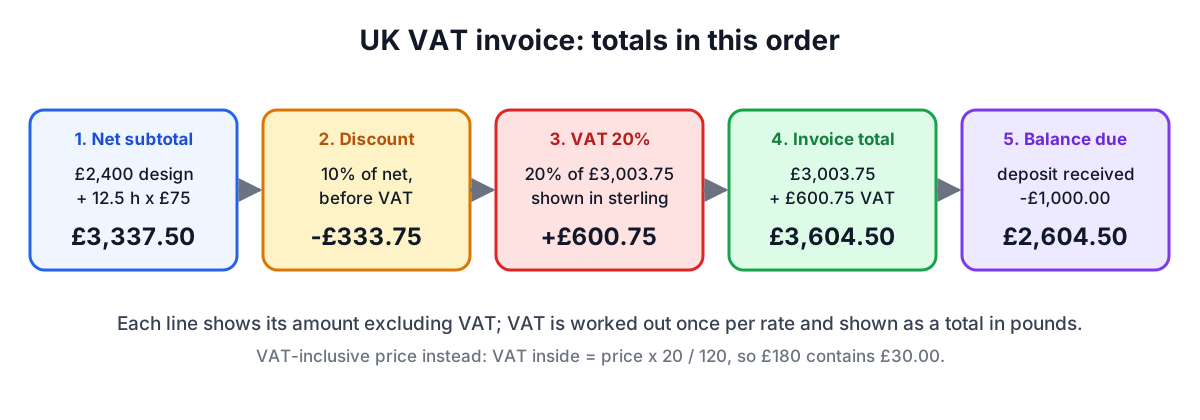
A Leeds web studio, registered for VAT, invoices a Manchester client on 9 November 2026 for work finished on 6 November:
- 1 x website design (home page and four templates) at £2,400.00
- 12.5 hours of development at £75.00
- 10% discount agreed in the contract
- £1,000.00 deposit already received
- Terms: 30 days
The UK VAT Invoice Generator works it through like this:
| Step | Working | Amount |
|---|---|---|
| Net subtotal | £2,400.00 + 12.5 x £75.00 | £3,337.50 |
| Discount | 10% of £3,337.50 | -£333.75 |
| Net after discount | £3,003.75 | |
| VAT at 20% | 20% of £3,003.75 | £600.75 |
| Invoice total | £3,604.50 | |
| Less deposit received | -£1,000.00 | |
| Balance due by 9 December 2026 | £2,604.50 |
The discount comes off before VAT, because VAT is charged on what the customer actually pays for the supply. Because the invoice went out three days after the work finished, 9 November is also the tax point. Without the discount the same job is £3,337.50 net, £667.50 VAT and £4,005.00 in total. You can check any VAT figure in either direction with the UK VAT calculator.
Two notes on the deposit. If you took the £1,000 before the work and it was a real payment for the supply, it created its own tax point when you received it, so the VAT on it belongs to that earlier return. And a "pro forma" request for the deposit is not a VAT invoice; Notice 700 suggests writing "This is not a VAT invoice" on it.
Rounding
Paragraph 17.5 of Notice 700 lets you round the total VAT on an invoice down to the whole penny, and allows VAT to be worked out per line or on the total for each rate as long as you are consistent. The generator works in whole pence and calculates VAT once per rate, so the printed lines always add up.
Numbering, credit notes and keeping records
HMRC asks for a unique number in a sequence. INV-0001 upwards, 2026-001, or a client prefix such as ACME-014 all work, provided no number repeats. If an invoice is wrong after you have sent it, do not edit and resend it: issue a credit note that refers to the original number and shows the VAT being reversed, then send a fresh invoice with a new number. VAT records, including copies of your sales invoices, must normally be kept for six years under VAT Notice 700/21.
Payment terms and late payment in the UK
UK law gives small suppliers more help with late payers than many people realise. Under the Late Payment of Commercial Debts (Interest) Act 1998, a business customer who pays late owes statutory interest unless your contract sets a different, substantial rate. GOV.UK's late payment guidance adds the timing rules:
- With no agreed date, payment is late 30 days after the customer receives the invoice, or after you deliver, if that is later.
- An agreed date should usually be within 60 days for business customers and 30 days for public authorities. Longer business terms must be fair to both sides.
The rate is 8% a year over the Bank of England's Bank Rate, but not today's Bank Rate. Article 4 of the 2002 rate order fixes it at the rate in force on 30 June for interest that starts running between 1 July and 31 December, and on 31 December for interest that starts between 1 January and 30 June. Bank Rate stood at 3.75% on 30 June 2026 (see the Bank of England's Bank Rate page), so interest that started running in the second half of 2026 is charged at 11.75% a year.
On top of the interest you can claim fixed compensation once per invoice: £40 for a debt under £1,000, £70 from £1,000 to £9,999.99, and £100 at £10,000 or more.
Worked example: the studio's invoice paid late
The client pays the £2,604.50 balance 30 days after the 9 December due date. Interest started running on 10 December 2026, so the 30 June rate applies:
- yearly interest: £2,604.50 x 11.75% = £306.03
- daily interest: £306.03 / 365 = about £0.84
- 30 days late: £25.15
- fixed compensation for a debt between £1,000 and £9,999.99: £70.00
The studio can claim £95.15 on top of the balance. Many small firms never claim it, but stating "Statutory interest and compensation will be charged on late payment under the Late Payment of Commercial Debts (Interest) Act 1998" in the invoice notes tells the customer you know the rule. The Act does not apply to sales to consumers.
Mandatory e-invoicing for VAT invoices
HMRC's policy paper VAT: electronic invoicing, published on 28 October 2026, introduces e-invoicing requirements for VAT invoices, including those issued by public bodies, from April 2029. The scope, technical format and exemptions will be set in regulations or an HMRC notice. A PDF emailed to a client is not an e-invoice in that sense, so a PDF from a browser tool will remain fine for customers outside the mandate until the regulations say otherwise.
Mistakes UK businesses make on invoices
- A VAT line before the VAT number arrives. You may not show VAT until HMRC has issued your number. Notice 700 then gives you 30 days from being told the number to send VAT invoices for supplies made since your registration date.
- Trading name only. The legal name must appear too.
- No supply date. It matters for the tax point and, for late payment, for when the 30 days start.
- VAT on the pre-discount price. VAT goes on the discounted amount.
- VAT in euros only. The total VAT must be shown in sterling.
If you are still setting your prices, the UK freelance rate calculator works back from the income you want after tax and National Insurance.
Frequently asked questions
What does an invoice need if I am not VAT registered?
A unique number, your name or company name with address and contact details, the customer's name and address, a description of the work, the supply date, the invoice date, the amounts charged and the total owed. Leave out any VAT line. A sole trader using a trading name also gives an address where legal documents can be delivered.
How much interest can I charge a UK business that pays late?
Statutory interest of 8% a year over the Bank of England Bank Rate on 30 June or 31 December, whichever date came last before the interest began. For interest starting in the second half of 2026 that is 11.75% a year. You can also claim £40, £70 or £100 of fixed compensation, depending on the size of the debt.
When can I use a simplified VAT invoice?
When the supply is £250 or less including VAT and the customer agrees. It needs your name, address and VAT number, the time of supply, a description, and for each rate the total including VAT and the rate. Above £250, issue a full VAT invoice.
Is the invoice date the tax point?
Only if you issue the VAT invoice within 14 days after the goods or services are supplied. Issue it later and the tax point is the supply date. A payment received before either date creates its own tax point for the amount paid.
Can I invoice a UK customer in euros?
Yes. The prices and total can be in euros, but the total VAT must also be shown in pounds, using an exchange rate HMRC accepts, so the customer can reclaim it.
Sources and further reading
- VAT guide (VAT Notice 700), HM Revenue and Customs. Full invoice contents (16.3.1), simplified invoices, the 14-day tax point rule (14.2.2) and VAT rounding (17.5).
- Invoices: what they must include, GOV.UK. The nine items, sole traders and limited companies.
- Register for VAT: when to register, GOV.UK. The £90,000 threshold.
- Late commercial payments: charging interest and debt recovery, GOV.UK. Payment periods, statutory interest and fixed compensation.
- Late Payment of Commercial Debts (Rate of Interest) (No. 3) Order 2002, article 4, legislation.gov.uk. Which Bank Rate date sets the statutory rate.
- Bank Rate, Bank of England. Current and past Bank Rate.
- Record keeping for VAT (VAT Notice 700/21), HM Revenue and Customs. How long to keep invoices.
- VAT: electronic invoicing, HM Revenue and Customs. E-invoicing for VAT invoices from April 2029.
More Business Calculators
Every tool in the Business Calculators section, free and in your browser.