
GST Invoice Format: How to Make a Tax Invoice in India
What a GST tax invoice must show under rule 46, CGST plus SGST or IGST worked in rupees, time limits, e-invoicing, credit notes and MSME late payment interest.
By Redbison Dev · · 10 min read
India edition. Written for GST-registered businesses and freelancers in India: rule 46 particulars, HSN/SAC digits, CGST and SGST against IGST, rule 47 time limits, e-invoicing thresholds, credit notes under section 34 and interest on late payment to micro and small enterprises. US edition
A GST tax invoice in India is not just a bill. Your buyer can claim input tax credit only on an invoice that carries the particulars in rule 46 of the CGST Rules and appears in their GSTR-2B, so a missing GSTIN, a wrong place of supply or a tax shown as one lump instead of CGST plus SGST costs the buyer money and costs you a follow-up. This edition goes through the particulars, the choice between CGST plus SGST and IGST, the time limits, e-invoicing, credit notes and the interest a micro or small supplier can claim on late payment.
The worked examples use the GST Invoice Generator, which prints CGST, SGST or IGST lines, HSN/SAC codes and the place of supply in your browser. It is general information, not tax advice; a chartered accountant or GST practitioner should check your set-up if you deal in exports with refunds, job work or SEZ supplies.
Which document do you need?
GST law uses four everyday documents, and the right one depends on who you are and what is happening.
| Situation | Document | Key rule |
|---|---|---|
| Registered supplier making a taxable supply | Tax invoice | Rule 46 particulars, tax shown separately |
| Composition taxpayer, or exempt supply | Bill of supply | No GST charged; rule 49 |
| Advance received for services before the invoice | Receipt voucher | Rule 50; GST is due on the advance |
| Price reduced or goods returned after invoicing | Credit note | Section 34; declare it by 30 November after the year ends |
If you are not registered, you issue an ordinary invoice with no GST at all. Most service providers must register once aggregate turnover crosses ₹20 lakh in a financial year (lower in a few special category States), and anyone making inter-State supplies of goods generally has to register whatever the turnover.
What a tax invoice must show under rule 46
Rule 46 of the CGST Rules lists the particulars. The ones that trip people up most are in the right-hand column.
| Particular | What to watch |
|---|---|
| Supplier's name, address and GSTIN | Use the legal name on the registration certificate |
| Serial number | At most 16 characters, letters, digits, hyphen or slash, unique for the financial year, e.g. BLR/26-27/0001 |
| Date of issue | Starts the buyer's credit and your return period |
| Recipient's name, address and GSTIN | For an unregistered buyer, add the State and its code when the taxable value is ₹50,000 or more |
| HSN code for goods or SAC for services | 4 digits if last year's aggregate turnover was up to ₹5 crore, 6 digits above that (Notification 78/2020-Central Tax) |
| Description, quantity and unit | |
| Total value and taxable value | Taxable value is after any discount |
| Rate and amount of each tax | CGST, SGST or UTGST, and IGST each on their own line |
| Place of supply with State name | Required on inter-State supplies |
| Whether tax is payable on reverse charge | Say "No" explicitly |
| Signature or digital signature | Of the supplier or an authorised representative |
The rates themselves changed with the GST Council's 56th meeting: from 22 September 2025 most goods and services sit at 5% or 18%, with a 40% rate for a short list of luxury and sin goods. Most professional services, including design, software and consultancy, are at 18%.
CGST plus SGST, or IGST?
The split depends on where you are and where the supply goes, not on the buyer's head office.
- Same State: CGST plus SGST, each at half the rate. 18% prints as CGST 9% and SGST 9%.
- Same Union territory without a legislature (Chandigarh, for example): CGST plus UTGST.
- Different State, export or SEZ unit: IGST at the full rate, with the place of supply.
The first two digits of a GSTIN are the State code: 29 is Karnataka, 27 is Maharashtra, 07 is Delhi. If yours and the buyer's differ and the place of supply is in the buyer's State, the supply is usually inter-State.
Worked example: a Bengaluru studio's tax invoice
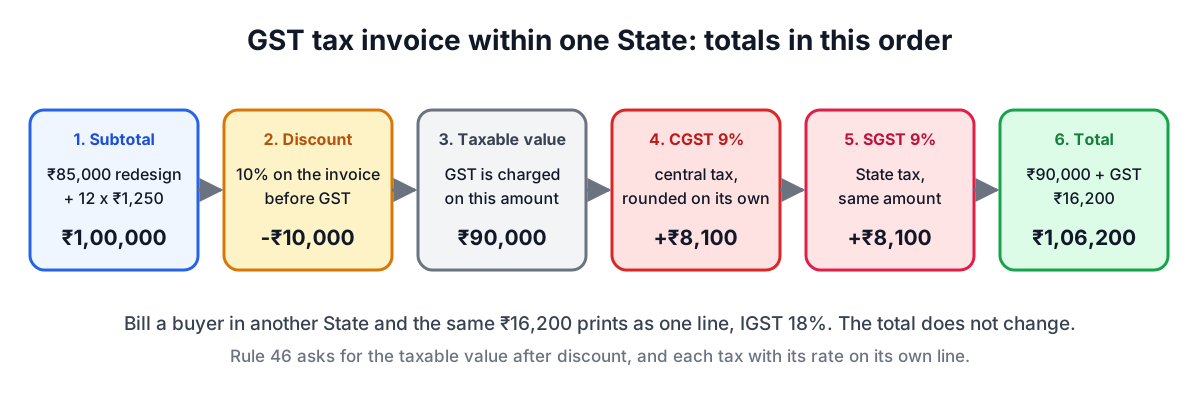
A design studio in Indiranagar, registered in Karnataka (State code 29), bills a Whitefield client for a website redesign. The contract gives a 10% discount, which is printed on the invoice.
- Website redesign, SAC 998314: 1 x ₹85,000
- Hosting and maintenance, SAC 998315: 12 months x ₹1,250
- Discount 10%, GST 18%, serial BLR/26-27/0042, dated 9 November 2026
| Step | Working | Amount |
|---|---|---|
| Subtotal | ₹85,000 + 12 x ₹1,250 | ₹1,00,000 |
| Discount | 10% of ₹1,00,000 | -₹10,000 |
| Taxable value | ₹90,000 | |
| CGST 9% | 9% of ₹90,000 | ₹8,100 |
| SGST 9% | 9% of ₹90,000 | ₹8,100 |
| Invoice total | ₹1,06,200 |
The discount is allowed out of the taxable value because it was agreed before the supply and recorded on the invoice. A discount given months later works differently: it needs a credit note, and the buyer must reverse the matching input tax credit.
Now bill the same work to a client in Pune. The place of supply is Maharashtra (27), so choose IGST in the generator: one line, IGST 18% ₹16,200, and the same total of ₹1,06,200. Only the ledger changes, and that matters, because the buyer claims IGST credit, not CGST and SGST. Without the discount the job is ₹1,00,000 plus ₹18,000 GST, ₹1,18,000 in all, the default in the generator.
The generator's preview shows ₹ with Indian grouping. The PDF prints INR 1,06,200.00 instead, because the standard PDF fonts have no rupee sign.
Time limits and copies
Section 31 of the CGST Act and rule 47 set when the invoice must be issued:
- Goods: before or at the time of removal or delivery.
- Services: within 30 days of the date of supply. Banks, insurers and NBFCs get 45 days.
Rule 48 asks for goods invoices in triplicate (original for the recipient, duplicate for the transporter, triplicate for you) and services invoices in duplicate. A PDF you keep and a PDF you send meet that in practice for services.
Advances
If a client pays an advance for services before you invoice, GST is due on the advance when you receive it, and you issue a receipt voucher under rule 50. The tax invoice later shows the full value and adjusts the tax already paid. For goods, GST on advances was removed for most suppliers in 2017, so tax is due when the invoice is issued.
E-invoicing: when a PDF is not enough
E-invoicing means reporting each B2B invoice to the Invoice Registration Portal, which returns an IRN and a signed QR code. Under Notification 10/2023-Central Tax it applies to businesses whose aggregate turnover has exceeded ₹5 crore in any financial year since 2017-18, from 1 August 2023. A GSTN advisory adds that businesses with aggregate turnover of ₹10 crore or more cannot report an invoice to the IRP more than 30 days after its date, from 1 April 2025. Below ₹5 crore, a correct tax invoice from a PDF tool is fine; above it, B2B invoices must go through the IRP, usually from your accounting software. From 1 January 2027, businesses already under e-invoicing must also get an IRN for the self-invoices they raise on reverse-charge purchases from unregistered suppliers and on imported services (Notification 04/2026-Central Tax). The ₹5 crore threshold is unchanged. Check the current limit on the GST portal before relying on a threshold.
Credit notes and corrections
Do not edit and reissue an invoice with the same number. If the value falls after supply (a post-supply discount, a deficiency in service, a return), issue a credit note under section 34 that refers to the original invoice. It must be declared by 30 November following the end of the financial year, or the date you file the annual return if that is earlier. If you undercharged, issue a debit note.
Getting paid: the 45-day rule for micro and small suppliers
If you are a micro or small enterprise with Udyam registration, the MSMED Act, 2006 protects you on payment. Section 15 says a buyer must pay by the agreed date, and the agreed date cannot be more than 45 days after acceptance of the goods or services; with no agreement, the limit is 15 days. Section 16 then charges the buyer compound interest with monthly rests at three times the bank rate notified by the RBI, as the Development Commissioner (MSME)'s note on delayed payments summarises. Disputes go to your State's Micro and Small Enterprise Facilitation Council, which must decide a reference within 90 days.
The RBI's Bank Rate is 5.75% after its 7 October 2026 policy (shown on the RBI home page), so the MSMED rate is 17.25% a year, or 1.4375% a month compounded.
Worked example: the studio is paid late
The client accepted the work on 9 November 2026 and agreed to pay in 45 days, by 24 December. It pays the ₹1,06,200 two months after that date.
- Monthly rate: 3 x 5.75% / 12 = 1.4375%
- After one month: ₹1,06,200 x 1.4375% = ₹1,526.63
- After two months: ₹1,06,200 x (1.014375² - 1) = ₹3,075.20
The studio can claim ₹3,075.20 of interest, assuming the Bank Rate stays at 5.75%. A contract clause that offers a lower rate does not override section 16. Put "Payment within 45 days of acceptance; interest under section 16 of the MSMED Act, 2006 applies to late payment" in the Notes field with your Udyam number. If you are pricing a new client, the India freelance rate calculator shows what you need to charge after tax.
Common mistakes on Indian invoices
- IGST charged within the State, or CGST and SGST on an inter-State sale. Tax paid under the wrong head is not moved across: the supplier pays under the right head and claims a refund of the wrong one, and the buyer's credit waits until then.
- Serial numbers over 16 characters or repeated across branches. Use a prefix per branch, such as BLR and PUN.
- No place of supply on an inter-State invoice.
- Discount given later but deducted on the original invoice. Use a credit note.
- Export invoice without the endorsement. Under an LUT, write "Supply meant for export under bond or letter of undertaking without payment of integrated tax".
Frequently asked questions
What is the difference between a tax invoice and a bill of supply?
A tax invoice is issued by a registered supplier for a taxable supply and shows the GST charged, so the buyer can claim credit. A bill of supply is issued for an exempt supply or by a composition taxpayer, shows no GST, and gives the buyer no input tax credit.
Within how many days must I issue a GST invoice for services?
Within 30 days of the date of supply under rule 47 of the CGST Rules. Banks, insurance companies and NBFCs have 45 days. For goods, the invoice is issued before or at the time of removal or delivery.
Do I need to show CGST and SGST separately?
Yes. Rule 46 asks for the rate and amount of each tax on its own line, so an intra-State 18% supply prints CGST 9% and SGST 9%. An inter-State supply prints IGST 18% as one line, with the place of supply.
How much interest can a small supplier claim if the buyer pays late?
Under section 16 of the MSMED Act, a micro or small supplier can claim compound interest with monthly rests at three times the RBI bank rate from the day after the agreed date, which cannot be more than 45 days after acceptance. At the 5.75% bank rate that is 17.25% a year.
When is an e-invoice with IRN compulsory?
For B2B invoices of businesses whose aggregate turnover has exceeded ₹5 crore in any financial year since 2017-18, from 1 August 2023. Businesses at ₹10 crore or more must also report each e-invoice within 30 days of its date. From 1 January 2027 the same businesses must also e-invoice their self-invoices for reverse-charge purchases from unregistered suppliers and for imported services.
Sources and further reading
- Rule 46: Tax invoice, CGST Rules, 2017, Central Board of Indirect Taxes and Customs. The particulars of a tax invoice.
- Section 34: Credit and debit notes, CGST Act, 2017, Central Board of Indirect Taxes and Customs. The 30 November time limit.
- GST Acts, Central Board of Indirect Taxes and Customs. Section 31 on when an invoice is issued.
- Notification No. 78/2020-Central Tax, GST Council. HSN digits by turnover.
- Goods and Services Tax portal, GSTN. GSTIN search, e-invoice advisories and returns.
- Delayed payments to micro and small enterprises under the MSMED Act, 2006, Office of the Development Commissioner (MSME). Sections 15 to 24 and the Facilitation Councils.
- Reserve Bank of India, RBI. Current Bank Rate and policy repo rate.
More Business Calculators
Every tool in the Business Calculators section, free and in your browser.