
How to Write a GST Invoice in New Zealand
What a New Zealand tax invoice must show at NZ$200 and NZ$1,000, 15% GST worked out in NZ dollars, the 3/23 rule, supply correction information and payment terms.
By Redbison Dev · · 10 min read
New Zealand edition. Written for New Zealand sole traders and small businesses: Inland Revenue's taxable supply information tiers at NZ$200 and NZ$1,000, 15% GST and the 3/23 fraction, zero-rated lines, supply correction information, GST registration and the accounting basis that decides when GST is due. US edition
In New Zealand what an invoice must show depends on whether you are registered for GST and on the size of the sale. Since 1 April 2023 the law talks about taxable supply information rather than tax invoices, but Inland Revenue says invoices that met the old rules still comply and you can keep calling the document a tax invoice. Over NZ$200 it needs your GST number and the GST; over NZ$1,000 it also needs the buyer's name and one identifier if the buyer is registered. The NZ Tax Invoice Generator is set up for that: NZ dollars, 15% GST, your GST number in the From block and room for the buyer's NZBN.
This is general information, not tax advice. A chartered accountant or tax agent can help if you sell to overseas customers, deal in second-hand goods or land, or use buyer-created invoices.
Registered for GST or not?
You must register for GST if your taxable activity turnover was at least NZ$60,000 in the last 12 months or is expected to be in the next 12, according to Inland Revenue's registration guidance. You also have to register if you add GST to your prices, whatever your turnover. Below the threshold registration is voluntary.
| GST registered | Not registered | |
|---|---|---|
| Title | Tax Invoice (or Invoice) | Invoice |
| GST number | Required over NZ$200 | None to show |
| GST line | 15% on standard-rated lines | Never charge GST |
| Buyer can claim the GST | Yes | No |
A common slip is a new contractor copying a template with "GST 15%" before the registration has come through. If you are not registered, set the rate to 0 and title the document Invoice.
What the invoice must show at each tier
Inland Revenue's page on how taxable supply information works sets three tiers for ordinary sales:
| Detail | NZ$200 or less | Over NZ$200 to NZ$1,000 | Over NZ$1,000 |
|---|---|---|---|
| Your name or trade name | Yes | Yes | Yes |
| Your GST number | No | Yes | Yes |
| Date of the invoice (or time of supply) | Yes | Yes | Yes |
| Description of the goods or services | Yes | Yes | Yes |
| The amount | The price | GST-exclusive amount, GST and total; or the total and a statement that GST is included, if every line is at 15% | Same as the middle tier |
| Buyer's details | No | No | If the buyer is registered: their name plus one identifier |
The identifier can be an address, phone number, email address, trading name, New Zealand Business Number or website. Having one layout that meets the top tier is the simplest approach, because it also satisfies the smaller sales.
A GST-registered buyer can ask for taxable supply information on a sale over NZ$200, and you must give it within 28 days of the request or by another date you agree. Inland Revenue also accepts the information sent directly between buyer and seller software, such as Peppol eInvoicing, instead of a PDF.
Worked example: an electrician's invoice
A Christchurch electrician, registered for GST, invoices a property company for a fit-out on 9 November 2026:
- 14 hours of labour at NZ$95 an hour
- materials NZ$860
- a 5% discount agreed in the quote
- a deposit of NZ$500 already paid
| Step | Working | Amount |
|---|---|---|
| Labour | 14 x NZ$95 | NZ$1,330.00 |
| Materials | NZ$860.00 | |
| Subtotal | NZ$2,190.00 | |
| Discount 5% | NZ$66.50 off labour, NZ$43.00 off materials | -NZ$109.50 |
| GST-exclusive amount | NZ$2,080.50 | |
| GST 15% | NZ$189.53 on labour + NZ$122.55 on materials | NZ$312.08 |
| Total | NZ$2,392.58 | |
| Less deposit | -NZ$500.00 | |
| Balance due | NZ$1,892.58 |
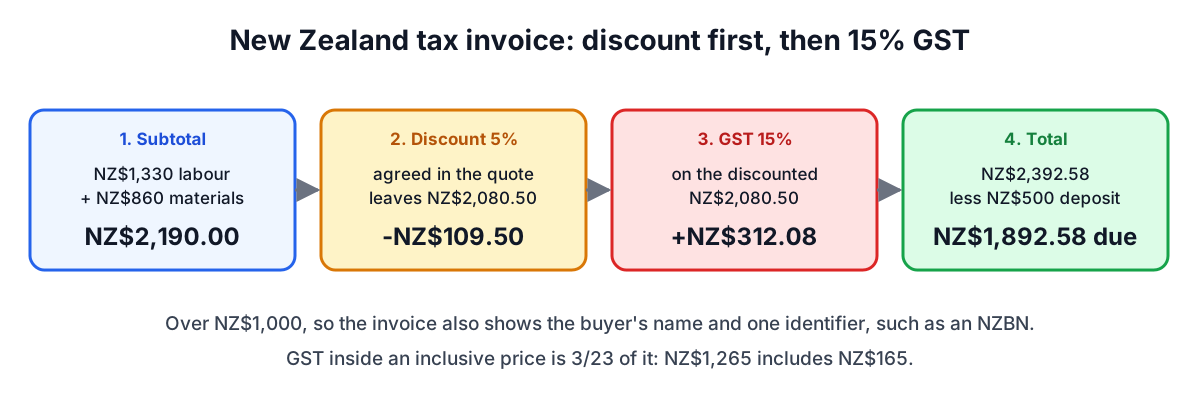
The sale is over NZ$1,000, so the property company's name and one identifier, such as its NZBN, must be on the invoice. GST is charged on the price after the discount, which is why the discount line comes before the GST line. Without the discount the job would be NZ$2,190 plus NZ$328.50 GST, NZ$2,518.50 in all.
The invoice shows the GST on the whole job, NZ$312.08, and the deposit simply reduces the balance due. If the NZ$500 arrived in an earlier GST period, or you invoiced it separately, part of that GST may already belong in an earlier return; ask your accountant how to show it so the GST is not counted twice.
GST-inclusive prices: the 3/23 rule
If you price for consumers, your prices usually include GST. The GST inside a GST-inclusive price is 3/23 of it, the fraction Inland Revenue gives in its charging GST guidance. A NZ$1,265 sale contains NZ$165 of GST (1,265 x 3 / 23), on NZ$1,100 before GST. It is over NZ$1,000 whether you count the GST or not, so a registered buyer's details are needed. Switch on "Prices already include tax" in the generator and it extracts the GST line by line.
A quick check: 15% of the exclusive price is the same as 3/23 of the inclusive price. 15% of NZ$1,100 is NZ$165.
Zero-rated and standard-rated lines together
Some supplies are zero-rated: GST is charged at 0% where certain requirements are met, and Inland Revenue's zero-rated supplies page lists goods you export among them. Put them on their own line at 0% so the invoice shows the split. NZ$2,000 of local work and NZ$3,000 of exported goods come to NZ$5,300: NZ$300 GST on the local line and none on the export.
When the GST is due
How you account for GST decides which return the NZ$312.08 goes in. Inland Revenue's page on accounting bases and filing frequencies sets out the options:
| Basis | Who can use it | GST on a sale is returned when |
|---|---|---|
| Payments | Sales of NZ$2 million or less in 12 months | The customer pays |
| Invoice | Anyone | You issue the invoice, paid or not |
| Hybrid | Anyone | Sales on invoice basis, expenses on payments basis |
You can file six-monthly if sales are under NZ$500,000 in any 12-month period and two-monthly if they are under NZ$24 million; anyone can file monthly, and businesses with sales over NZ$24 million must. On the invoice basis, a client who pays late leaves you paying their GST to Inland Revenue first, so firm payment terms matter more.
Correcting an invoice: supply correction information
New Zealand's replacement for credit notes and debit notes is supply correction information. Inland Revenue's supply correction guidance says you provide it when an order is changed or cancelled, goods are returned, a price or GST amount was wrong, or a party's details were incorrect. It needs your name and GST number, the date, details that identify the original invoice (such as its number) and the correction, including any change in GST. You do not need it for a discount whose terms were agreed in writing or set out on the original invoice. Include it in the GST return for the period in which you provide it.
Payment terms
If you intend to charge interest or a fee on late payment, agree it in the quote or contract and repeat it on the invoice. State the due date as a date, not only as "14 days", and if your client pays on a set day each month, such as the 20th of the month following, write that day on the invoice. Put your bank account number in the payment details and ask the customer to quote the invoice number as the reference.
Common mistakes on New Zealand invoices
- Charging GST before registration. Set the rate to 0 until your GST number is issued.
- No buyer identifier over NZ$1,000. Add the client's NZBN or email address to every invoice.
- Working out GST as 15% of an inclusive price. It is 3/23: 15% of NZ$1,265 is NZ$189.75, but the GST inside is NZ$165.
- Editing a sent invoice. Issue supply correction information instead.
- Taking the discount after GST. Discount first, then 15% on what is left.
To work out your hourly rate before quoting, try the freelance rate calculator. The unit price guide for NZ supermarkets shows the same GST-inclusive pricing from the shopper's side, and the guide to sales tax, VAT and discounts compares GST with other systems.
Frequently asked questions
Do I still need a tax invoice in New Zealand?
The law now asks for taxable supply information rather than a tax invoice, but Inland Revenue says documents that met the old rules still comply, and you can keep titling yours Tax Invoice. What matters is that it shows the details for the sale's tier: NZ$200 or less, over NZ$200 to NZ$1,000, or over NZ$1,000.
What must a GST invoice show for a sale over NZ$1,000?
Your name or trade name and GST number, the date, a description, and either the GST-exclusive amount, the GST and the total, or the total with a statement that GST is included when every line is at the standard rate. If the buyer is GST registered, add their name and one identifier: an address, phone number, email address, trading name, NZBN or website.
How do I work out the GST in a GST-inclusive price?
Multiply the inclusive price by 3 and divide by 23. NZ$1,265 contains NZ$165 of GST, leaving NZ$1,100. The generator's "Prices already include tax" switch does this for every line.
What replaced credit notes in New Zealand?
Supply correction information, which you provide when an order changes, goods come back or an invoice had the wrong price, GST or details. It identifies the original invoice and shows the correction and any change in GST, and it goes in the GST return for the period in which you provide it.
Sources and further reading
- How taxable supply information for GST works, Inland Revenue. The NZ$200 and NZ$1,000 tiers, buyer identifiers, the 28-day rule and electronic exchange.
- Taxable supply information for GST, Inland Revenue. The 1 April 2023 change and why old-style tax invoices still comply.
- Supply correction information, Inland Revenue. When corrections are needed and what they contain.
- Charging GST, Inland Revenue. The 15% rate, the 3/23 fraction and zero-rated supplies.
- Zero-rated supplies, Inland Revenue. Exported goods and services that qualify for 0% GST.
- Registering for GST, Inland Revenue. The NZ$60,000 threshold and voluntary registration.
- Which GST accounting basis and filing frequency should I use, Inland Revenue. Payments, invoice and hybrid bases and the filing frequency thresholds.
More Business Calculators
Every tool in the Business Calculators section, free and in your browser.