
Australian Cups, 20 ml Tablespoons and Recipe Conversions
Why an Australian tablespoon holds a third more than a US one, cups to grams in a 250 ml cup, fan-forced oven settings, US recipes and shoe sizes from overseas.
By Redbison Dev · · 9 min read
Australia edition. Written for Australian kitchens: the 250 ml metric cup and 20 ml tablespoon against US and UK measures, grams per cup by ingredient, fan-forced and conventional ovens, nutrition panels per 100 g, and converting overseas shoe sizes from foot length. US edition
Three tablespoons of salt in an American recipe is 54 g. Measure it with an Australian tablespoon and you add 73 g, a third more, because the Australian spoon holds 20 ml where the American one holds 14.8 ml. Cups differ far less, by about 6%, and ovens differ by whether the recipe was written for fan-forced heat. This edition works through the conversions an Australian kitchen meets with the Australian cups to grams converter, then covers labels, tins and buying shoes from overseas sites with the shoe size converter.
The tablespoon is the trap
Penguin Random House Australia's conversion page for one of its cookbooks sets out the convention Australian recipe publishers use: one Australian metric cup holds 250 ml, one Australian tablespoon 20 ml and one teaspoon 5 ml, while North America, New Zealand and the United Kingdom use a 15 ml tablespoon.
| Spoon | Volume | Table salt | Baking powder | Honey |
|---|---|---|---|---|
| Australian tablespoon | 20 ml | 24.3 g | 16.2 g | 28.4 g |
| Metric tablespoon (UK, NZ) | 15 ml | 18.3 g | 12.2 g | 21.3 g |
| US tablespoon | 14.8 ml | 18 g | 12 g | 21 g |
One Australian tablespoon is 1.35 US tablespoons. For flavourings the difference is a matter of taste. For salt, baking powder, bicarbonate of soda and gelatine it matters more: a cake made with an Australian tablespoon of baking powder from an American recipe gets about 4 g more raising agent than it was tested with.
The fix is simple. When a recipe comes from overseas, measure tablespoons as three 5 ml teaspoons, since the teaspoon is the same 5 ml nearly everywhere, or weigh the ingredient.
Cups: 250 ml here, 236.6 ml in the US
The cup gap is smaller but adds up across a recipe. The converter uses King Arthur Baking's grams per US cup and scales them to the 250 ml Australian cup:
| Ingredient | 1 Australian cup (250 ml) | 1 US cup (236.6 ml) |
|---|---|---|
| Plain flour, spooned and levelled | 126.8 g | 120 g |
| White sugar | 209.2 g | 198 g |
| Butter | 239.9 g | 227 g |
| Honey | 355 g | 336 g |
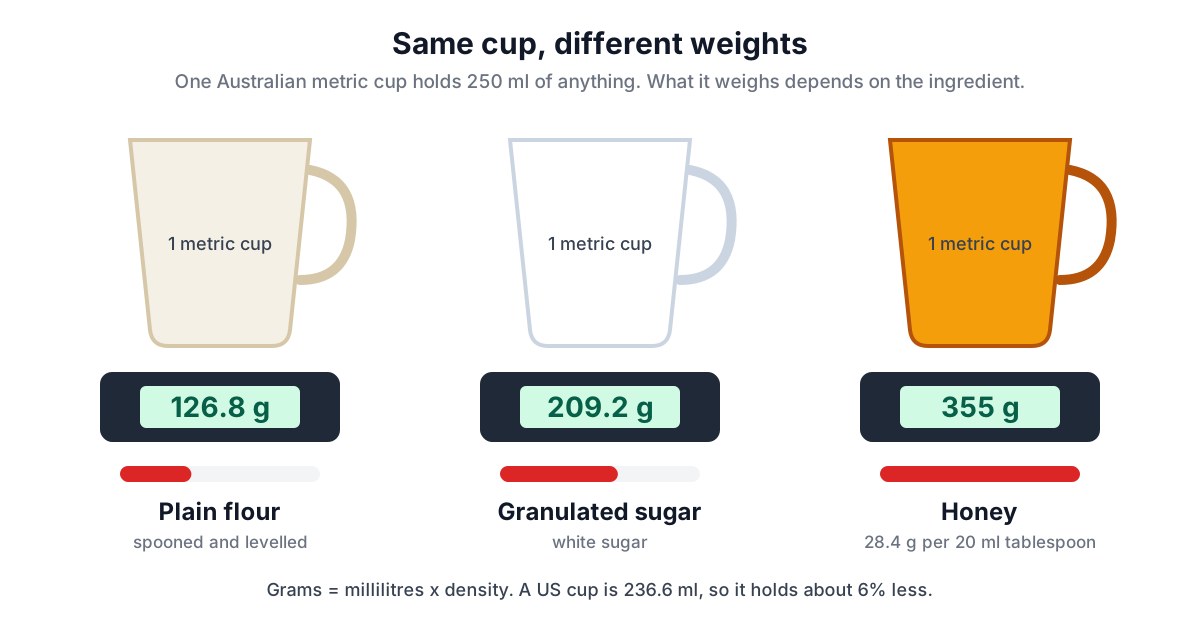
For most American recipes you can use Australian cups as they are and accept a slightly richer, slightly drier result. Penguin's page rounds the North American cup to 240 ml; the converter keeps the exact 236.6 ml. Where precision matters, as in bread or a sponge, convert to grams and weigh. A US stick of butter is half a US cup, 113 g.
Flour is the ingredient most sensitive to technique. The 126.8 g figure assumes flour spooned into the cup and levelled; scooping it straight from the bag packs in more. Self-raising flour already contains raising agent, so use plain flour wherever an American recipe says all-purpose.
Fan-forced and conventional ovens
Australian recipes give °C, and some, like the Penguin book, are written for fan-forced ovens; American recipes give °F. Convert with °C = (°F − 32) × 5 ÷ 9, then adjust for the fan:
| US recipe | Exact °C | Conventional setting | Fan-forced, 20°C lower |
|---|---|---|---|
| 325°F | 162.8 | 160°C | 140°C |
| 350°F | 176.7 | 180°C | 160°C |
| 375°F | 190.6 | 190°C | 170°C |
| 425°F | 218.3 | 220°C | 200°C |
The size of the fan adjustment is a rule of thumb, and sources do not agree. The converter uses 20°C. Penguin's page tells readers of its fan-forced recipes to add about 25°C for a conventional oven. Treat both as starting points, check a cake 5 to 10 minutes early, and use an oven thermometer if your results run dark or pale.
British recipes sometimes give a gas mark: gas mark 4 is 350°F, 180°C conventional or about 160°C fan-forced.
From cups to the nutrition panel
Food Standards Australia New Zealand says the nutrition information panel shows average amounts per serving and per 100 g, or per 100 mL for a liquid, and that the per 100 g column is the one to compare products with. A serving size is set by the food business, so it may not match what you measure out.
To use the panel for a recipe, convert the cup to grams first. One Australian cup of white sugar is 209.2 g, so multiply the per 100 g figures by 2.09. One cup of plain flour is 126.8 g, a multiplier of 1.27. FSANZ also notes that each per 100 g figure reads as a percentage: 20 g of fat per 100 g means the food is 20% fat. If you sell what you bake, FSANZ's Nutrition Panel Calculator is built to help food businesses work out average nutrient content and prepare the panel itself.
Scaling recipes and swapping tins
Scaling is one factor applied to every line: from 4 serves to 6 is 1.5, so 2¼ cups of flour becomes 3⅜ cups and 2 eggs becomes 3. Tins scale by area, not diameter. A 22 cm round tin has 1.21 times the area of a 20 cm one, and a 23 cm tin 1.32 times, so the same mixture bakes thinner and faster in the bigger tin. American recipes give tins in inches: an 8 inch round tin is 20.3 cm and a 9 inch tin 22.9 cm.
Shoe sizes from overseas websites
Ordering shoes from a US or European site means converting between scales that count in different steps. UK and US sizes step by a third of an inch; EU sizes step by two thirds of a centimetre; US women's sizes sit two above UK and US men's one above. The cleanest route is your foot length in centimetres:
| Foot length | UK | US | EU (formula) |
|---|---|---|---|
| Women's 24.5 cm | 6 | 8 | 39 |
| Men's 26.5 cm | 8.5 | 9.5 | 42 |
| Men's 27.1 cm | 9 | 10 | 42.5 |
Measure standing, late in the day, heel to longest toe, and use the longer foot. Check the brand's own chart too, since brands round EU sizes differently and build shoes on their own lasts. For children, a fitting matters more than any chart: the Evelina London children's footwear leaflet advises measuring both feet for length, width and circumference and leaving at least 6 mm, ideally 10 mm, in front of the longest toe.
Frequently asked questions
How many ml is an Australian tablespoon?
20 ml, or four 5 ml teaspoons, by the Australian convention that Penguin's conversion page describes. The UK, New Zealand and North America use a 15 ml tablespoon, and the exact US tablespoon is 14.8 ml.
How many grams is a cup of flour in Australia?
About 127 g of plain flour in a 250 ml cup, spooned in and levelled. A US cup holds about 120 g.
Do I need to change the temperature for a fan-forced oven?
Yes, if the recipe was written for a conventional oven. Lower it by about 20°C, so 180°C becomes 160°C fan-forced. Some publishers use 25°C, so check early the first time.
Can I use Australian cups for an American recipe?
Usually, yes: the 250 ml cup is about 6% larger, which most recipes tolerate. Tablespoons are the exception, so measure those as three teaspoons each.
Sources and further reading
- Conversion chart, Bake with Brooki, Penguin Random House Australia. 250 ml Australian cup, 20 ml tablespoon and 5 ml teaspoon as an Australian publishing convention, 15 ml tablespoon elsewhere, 240 ml North American cup, 25°C fan adjustment.
- Nutrition information panels, Food Standards Australia New Zealand. Amounts per serving and per 100 g or 100 mL.
- Nutrition Panel Calculator, Food Standards Australia New Zealand. A tool to help food manufacturers calculate average nutrient content and prepare a nutrition information panel.
- Ingredient weight chart, King Arthur Baking. Grams per US cup and tablespoon for flour, sugar, butter, salt and honey.
- Your child's footwear, Evelina London, Guy's and St Thomas' NHS Foundation Trust. Measuring children's feet and toe space.
Open the Cooking Measurement Converter
More Everyday Calculators
Every tool in the Everyday Calculators section, free and in your browser.
- Age Calculator
- Time Card Calculator
- Time Calculator
- GPA Calculator
- Final Grade Calculator
- Fuel Cost Calculator
- Tire Size Calculator
- Ring Size Converter
- Shoe Size Converter
- Cooking Measurement Converter
- Heat Index Calculator
- Wind Chill Calculator
- Week Number Calculator
- Day of the Week Calculator
- Recipe Scaler
- Unit Price Calculator