
Cups to Grams, OTG Temperatures and Shoe Sizes in India
Baking US and UK recipes in an Indian kitchen: cups of maida and atta in grams, °F to °C for an OTG, UK and US shoe sizes, and the Bha sizing project.
By Redbison Dev · · 9 min read
India edition. Written for Indian kitchens and shoppers: American cups converted for maida, atta, sugar and dahi, oven settings for OTGs and convection microwaves in °C, shoe sizes on the UK, US and EU scales, and the CSIR-CLRI foot survey behind the proposed Bha system. US edition
A cake recipe from an American website says 2 cups of all-purpose flour, which is 240 g of maida, and 350°F, which is 180°C on an OTG dial. A cup of whole wheat flour is about 113 g, a cup of sugar 198 g, and none of these numbers is the same if your measuring cup holds 250 ml instead of 236.6 ml. Shoes have the same problem in another form: the size on an Indian box, a US website and a European brand's chart can describe one foot with three different numbers. This edition works through both with the cooking measurement converter, the shoe size converter for India and the unit converter.
Why a cup of maida is not a cup of sugar
A cup measures volume; a recipe that works needs weight. Flour is light and full of air, sugar packs tightly, and dahi is close to water. King Arthur Baking's weight chart, which the converter uses for the American cup of 236.6 ml, gives 120 g for all-purpose flour, 113 g for whole wheat flour and 198 g for granulated sugar.
| Ingredient | American cup (236.6 ml) | 250 ml cup |
|---|---|---|
| Maida (all-purpose flour) | 120 g | 126.8 g |
| Atta or whole wheat flour | 113 g | 119.4 g |
| Sugar | 198 g | 209.2 g |
| Dahi (plain yogurt) | 227 g | 239.9 g |
| Oil | 218 g | 230.4 g |
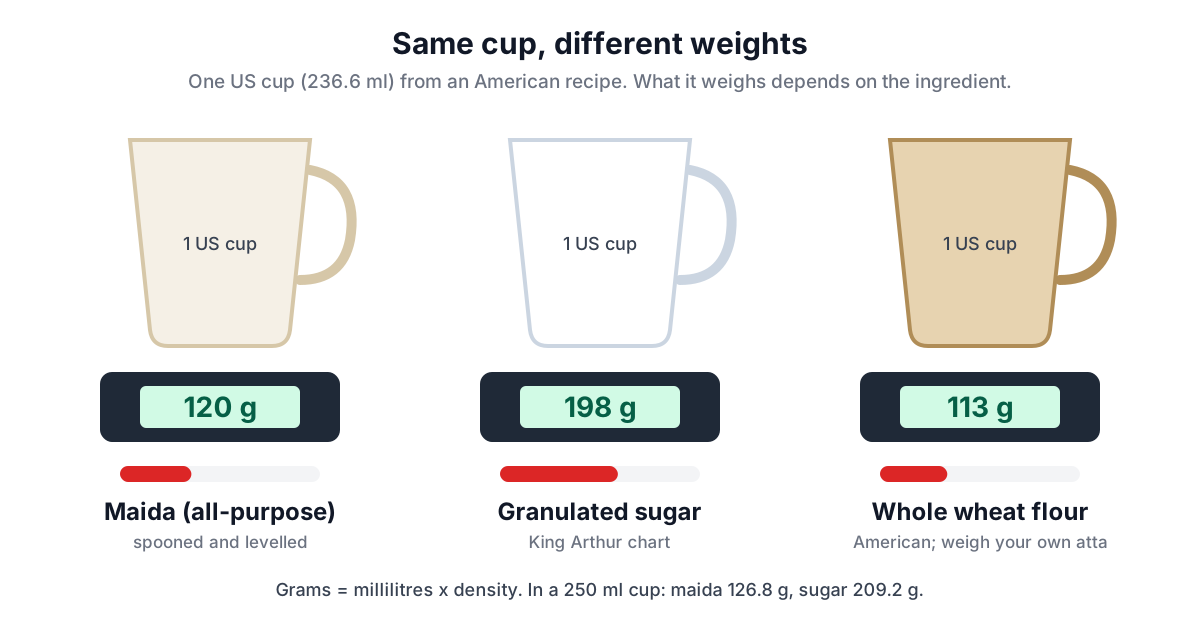
Two warnings make the table more useful. First, check the millilitre marking on your own measuring cup, because cup sizes differ by country and the recipe's origin decides which one it meant: Penguin's Australian conversion page, for instance, gives 250 ml for an Australian cup and 240 ml for a North American one. Second, the whole wheat figure is for American whole wheat flour. Chakki atta is milled differently and can sit at a different weight per cup, so weigh one cup of your usual atta on a kitchen scale once and use that from then on.
The flour figures assume flour spooned into the cup and levelled. Dipping the cup into the dabba and pressing packs in noticeably more, which can turn a soft cake dry. A digital kitchen scale removes the guesswork. NIST, the US measurement institute, gives the same advice for American recipes: cups and spoons mean different things in different countries, so the safest conversion is to measure the ingredient with an American measuring cup and then weigh the result in grams.
Spoons and katoris
Tablespoons differ less: the US one is 14.8 ml, the metric one 15 ml, and both hold about 18 g of table salt. Australian recipes are the exception, with a 20 ml tablespoon, so a tablespoon of baking powder in an Australian recipe is 16.2 g rather than 12 g. A katori is not a standard measure at all; family recipes written in katoris need one weighing in your own katori to convert.
Oven settings: OTGs and convection microwaves
If your OTG or convection microwave is marked in °C, you need to convert: American recipes give °F and British ones often give gas marks, so convert with °C = (°F − 32) × 5 ÷ 9 and round to the dial:
| Recipe says | Exact °C | Set the OTG to | Gas mark |
|---|---|---|---|
| 325°F | 162.8 | 160°C | 3 |
| 350°F | 176.7 | 180°C | 4 |
| 375°F | 190.6 | 190°C | 5 |
| 425°F | 218.3 | 220°C | 7 |
When a recipe was written for a fan or "fan-forced" oven, the temperature is already lower than in a conventional recipe. The converter's oven table allows 20°C between the two, and the Penguin conversion page tells readers of its fan-oven recipes to add about 25°C for a conventional oven. If your OTG has a fan setting, start with the conventional figure minus 20°C and check early. An oven thermometer tells you what the dial does not.
Shoe sizes: UK, US, EU and the Bha project
The sizes on shoes sold in India come from systems designed abroad, which is why the Bha project exists. They count in different steps:
- UK sizes count in barleycorns, a third of an inch per size, on one scale for men and women.
- US sizes use the same step but sit one above UK for men and two above for women.
- EU sizes count in Paris points of two thirds of a centimetre, so they never line up with UK half sizes.
The shoe size converter turns any of them into a foot length and back:
| Size | Foot length | Other scales |
|---|---|---|
| Men's UK 8 | 26.2 cm | US 9, EU 41.5 by formula (42 or 41 by brand) |
| Women's UK 5 | 23.7 cm | US 7, EU 37.5 |
| Women's foot of 24.5 cm | 24.5 cm | UK 6, US 8, EU 39 |
| Men's US 10 on an American site | 27.1 cm | UK 9, EU 42.5 |
The women's US scale is the one that catches online shoppers: a US women's 7 is a UK 5, not a UK 7.
Wider feet and the Bha survey
A shoe that fits on length can still pinch. CSIR-CLRI's summary of the foot survey run under DPIIT for the revision of Indian footwear sizing standards lists 1,02,084 people measured between 2 December 2021 and 31 March 2022: about 20,000 each of children aged 4 to 11, girls and boys aged 12 to 18, and men and women aged 19 to 55. Business Today's report on the proposed "Bha" system, which gives the survey as 1,01,880 people in 79 locations, says the study found Indian feet tend to be wider than Western feet and proposed eight sizes. It was still a proposal at the time of that report, so the converter does not use it; until a standard is notified and brands adopt it, convert between UK, US and EU and try shoes on for width.
Measure at home the simple way: stand on paper in the evening, mark the heel and the longest toe, and measure both feet. Use the longer foot, and leave room in front of the toes.
Body measurements: feet, inches and centimetres
Heights are often given in feet and inches, while forms and BMI calculators usually want centimetres. An inch is exactly 2.54 cm, so 5 feet 6 inches (66 inches) is 167.64 cm and 5 feet 10 inches is 177.8 cm; 170 cm is 66.93 inches, just under 5 feet 7. Convert the whole height to inches first rather than typing 5.6 feet, which is 5 feet 7.2 inches, not 5 feet 6. Body weight from a US fitness app or an imported scale may be in pounds: 158 lb is 71.67 kg.
Scaling a recipe and choosing a tin
Doubling or halving is one factor applied to every line: going from 4 to 6 servings multiplies by 1.5, so 2¼ cups of maida becomes 3⅜ cups, or 405 g. Eggs come in whole numbers, so 2 eggs becomes 3. Cake tins scale by area: a 9 inch (22.9 cm) round tin holds about 1.27 times the batter of an 8 inch (20.3 cm) tin, so a recipe for one will bake thinner and faster in the other.
Frequently asked questions
How many grams is 1 cup of maida?
About 120 g in an American 236.6 ml cup, spooned in and levelled, and about 127 g in a 250 ml cup. Scooping straight from the container packs in more.
What is 180°C in Fahrenheit for an OTG?
180°C is 356°F, the rounded equivalent of a 350°F recipe setting. Gas mark 4 in British recipes is the same setting.
Is an Indian shoe size the same as UK?
Check which scale the label uses. If it gives a UK size, that scale is the same for men and women. US sizes run one higher for men and two higher for women.
What is the Bha shoe size system?
A sizing system proposed after CSIR-CLRI's 3D foot survey, reported as eight sizes designed for wider Indian feet. It has not replaced UK, US and EU sizes in shops.
Sources and further reading
- Commencement of foot survey: revision of standards on Indian footwear sizing, CSIR-Central Leather Research Institute. Survey summary under DPIIT, 2 December 2021 to 31 March 2022, 1,02,084 people by age group.
- Indians to have new shoe sizing system as Bha set to replace EU, UK, US sizes, Business Today. The Bha proposal, eight sizes and the finding on foot width.
- Metric Kitchen: Culinary Measurement Tips, National Institute of Standards and Technology. Cups and spoons mean different things in different countries; measure an American recipe's ingredient with an American cup, then weigh it.
- Ingredient weight chart, King Arthur Baking. Grams per US cup for all-purpose and whole wheat flour, sugar and other ingredients.
- Conversion chart, Bake with Brooki, Penguin Random House Australia. 240 ml North American and 250 ml Australian cups, 20 ml Australian tablespoon, fan-oven adjustment.
Open the Cooking Measurement Converter
More Everyday Calculators
Every tool in the Everyday Calculators section, free and in your browser.
- Age Calculator
- Time Card Calculator
- Time Calculator
- GPA Calculator
- Final Grade Calculator
- Fuel Cost Calculator
- Tire Size Calculator
- Ring Size Converter
- Shoe Size Converter
- Cooking Measurement Converter
- Heat Index Calculator
- Wind Chill Calculator
- Week Number Calculator
- Day of the Week Calculator
- Recipe Scaler
- Unit Price Calculator