
Margin vs Markup and Break-Even With GST in Australia
Work margin on the GST-exclusive price, read the GST in a shelf price, find break-even and an after-tax target at the 25% company rate, and test a sale price.
By Redbison Dev · · 8 min read
Australia edition. Written for Australian small businesses: margins on GST-exclusive prices, the ACCC rule that consumer prices include GST, the A$75,000 registration threshold, and the 25% base rate entity company tax for profit targets. US edition
For an Australian business registered for GST, margin and markup are worked on the GST-exclusive price. The shelf price a consumer sees must include GST, but one-eleventh of it goes to the ATO, so a A$39.95 ticket is A$36.32 of revenue. This edition works through one online homewares store with the margin and markup calculator with GST and the break-even calculator, in Australian dollars. It explains the maths, not your tax position; your accountant or BAS agent can confirm how the rules apply to you.
The GST and pricing rules
- 10% GST, one-eleventh of the price. business.gov.au describes GST as a tax of 10% on most goods and services, and a registered business collects one-eleventh of the sale price from the customer.
- Registration. You must register once your GST turnover is A$75,000 or more (A$150,000 for non-profits), and taxi and ride-sourcing drivers must register regardless. Below the threshold registration is optional, and an unregistered business does not include GST in its prices.
- Total price. The ACCC requires the total price as a single figure that includes taxes, duties and unavoidable fees.
To find the GST-exclusive price, divide by 1.1. To find the GST in a price, divide by 11.
Reading the margin in a A$39.95 ticket
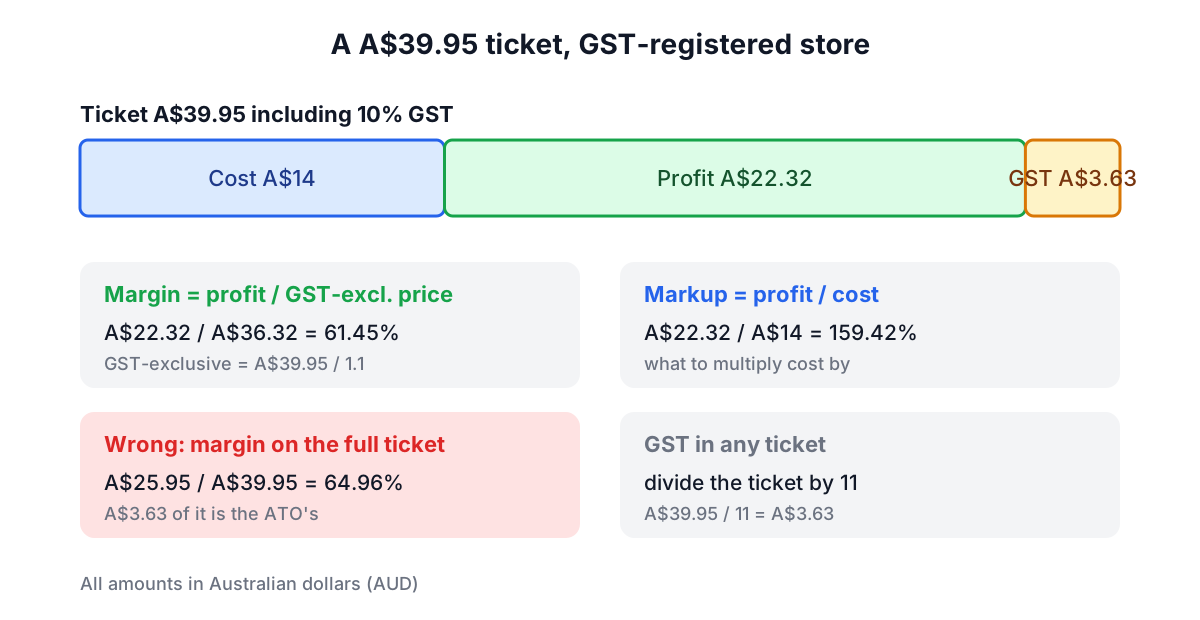
The store sells a linen tea towel set at A$39.95 including GST. The landed cost from the supplier, freight included, is A$14 excluding GST.
GST-exclusive price  A$39.95 / 1.1   = A$36.32
GST in the price     A$39.95 / 11    = A$3.63
profit               A$36.32 - A$14  = A$22.32
margin 61.45%   markup 159.42%
Work the margin on the A$39.95 by mistake and you get 64.96%, three and a half points too high, because A$3.63 of that "profit" is the ATO's.
Going the other way, a new product costing A$14 priced for a 50% margin needs A$28 excluding GST, a 100% markup (keystone pricing), and a A$30.80 ticket. Adding 50% to cost would give A$21 and only a 33.33% margin.
Break-even and a profit target after company tax
The store's fixed costs are A$9,000 a month: warehouse share, online store subscription, insurance, accounting and one casual packer. Pick-and-pack, payment fees and a shipping subsidy add about A$2.60 an order, so the variable cost is A$16.60.
It is a company, and business.gov.au gives a 25% lower company tax rate for a base rate entity: aggregated turnover under A$50 million and no more than 80% of assessable income from passive sources such as interest, dividends and rent. Otherwise the full rate is 30%. To keep A$6,000 a month after 25% tax it needs A$8,000 before tax.
| Monthly plan | Figure |
|---|---|
| Contribution per set | A$19.72 (54.29%) |
| Break-even | 457 sets (A$16,577 excluding GST) |
| For A$6,000 after tax | 863 sets |
| Expected sales | 650 sets |
| Profit before tax at 650 | A$3,816.82 |
| Margin of safety | 29.8% |
At 650 sets the store makes a profit, but not the target. It needs either 213 more sets a month, a higher price, or lower variable costs. Entering the GST-inclusive A$39.95 as the price would make break-even look lower than it is, a costly mistake when deciding how much stock to commit to.
What a 25% off sale costs
End-of-financial-year and Boxing Day sales are the usual test of a pricing plan. At 25% off, the ticket drops to A$29.96, or A$27.24 excluding GST. Contribution per set falls from A$19.72 to A$10.64, and break-even rises from 457 to 846 sets a month. The sale needs to nearly double volume just to earn the same contribution as a normal month. If it is a clearance of stock you would otherwise write off, that may be fine; if it is a routine promotion, set the everyday price so the discounted price still clears your margin floor.
Below the A$75,000 threshold
A business that is not registered does not charge GST and cannot claim GST credits, so its cost is what it paid including GST, and its price is all revenue. If the store were unregistered, the A$14 landed cost would be A$15.40 if the supplier charged GST, and the A$39.95 ticket would be all its own. Once GST turnover approaches A$75,000, model both cases: at the same ticket price, registration lowers revenue per sale by one-eleventh.
Frequently asked questions
Do I calculate margin including or excluding GST?
Excluding GST, if you are registered. Divide the GST-inclusive price by 1.1 to get the GST-exclusive price and work the margin on that. A A$39.95 ticket on a A$14 cost is a 61.45% margin, not the 64.96% you get from the full ticket.
How do I work out the GST in a price?
Divide the GST-inclusive price by 11. A A$39.95 price includes A$3.63 of GST, and A$30.80 includes A$2.80. That is the same as the difference between the ticket and the ticket divided by 1.1.
What company tax rate should I use for an after-tax target?
The 25% lower rate if your company is a base rate entity, meaning aggregated turnover under A$50 million and no more than 80% of assessable income from passive sources. Otherwise use 30%. A sole trader uses personal tax rates instead.
Do Australian prices have to include GST?
For consumers, yes: the ACCC requires a single total price including taxes and unavoidable fees. An unregistered business does not charge GST at all.
Sources and further reading
- Register for goods and services tax (GST), business.gov.au. 10% GST, one-eleventh of the price and the A$75,000 threshold.
- Price displays, Australian Competition and Consumer Commission. Total prices including taxes and unavoidable fees.
- Income tax for business, business.gov.au. 25% and 30% company tax rates and the base rate entity test.
- 3.1 Explain Contribution Margin, OpenStax, Rice University. Contribution margin per unit and ratio.
- 3.2 Calculate a Break-Even Point in Units and Dollars, OpenStax, Rice University. Break-even in units and revenue.
- 3.3 Perform Break-Even Sensitivity Analysis, OpenStax, Rice University. How break-even moves with price and costs.
Open the Margin and Markup Calculator
More Business Calculators
Every tool in the Business Calculators section, free and in your browser.