
Margin, Markup and Break-Even With GST/HST in Canada
Price on the pre-tax amount, see what GST or HST adds by province, find break-even and an after-tax target for a small CCPC, and when the $30,000 threshold bites.
By Redbison Dev · · 8 min read
Canada edition. Written for Canadian small businesses: margins on pre-tax prices, GST/HST rates by province, the $30,000 small supplier threshold, and the Ontario CCPC small business rate for profit targets, in Canadian dollars. US edition
In Canada, margin and markup are worked on the pre-tax price. GST or HST is collected for the Canada Revenue Agency (CRA) and passed on after input tax credits, so it is never revenue for a registered business. What changes from province to province is the amount your customer pays on top, from 5% GST in Alberta to 15% HST in the Atlantic provinces. This edition follows one Ontario business through pricing, break-even and an after-tax profit target, using the margin calculator with GST/HST and the break-even calculator, with all amounts in Canadian dollars (CAD). It explains the math, not your tax situation; an accountant can confirm how the rules apply to you.
The tax rules that touch a price
- Rates. The CRA's GST/HST rate table lists 5% GST in Alberta, British Columbia, Manitoba, Saskatchewan, Quebec and the territories; 13% HST in Ontario; 14% HST in Nova Scotia (cut from 15% on April 1, 2025); and 15% HST in New Brunswick, Newfoundland and Labrador and Prince Edward Island. British Columbia, Manitoba, Saskatchewan and Quebec also have their own provincial sales tax.
- Showing tax. The CRA's guide for registrants (RC4022) lets you either say the price includes GST/HST or show the tax separately, on receipts, invoices, contracts or signs.
- Small suppliers. You do not have to register while your worldwide taxable revenue is $30,000 or less in a single calendar quarter and over the last four consecutive quarters ($50,000 for public service bodies).
- Is the product taxable at all? Most goods are, and RC4022 lists clothing and footwear among its examples of taxable supplies. Some are zero-rated, with no GST/HST charged: the CRA's basic groceries memorandum names coffee beans, for example. Ontario, Nova Scotia and Prince Edward Island also give a point-of-sale rebate of the provincial part of the HST on children's clothing and footwear. Check your product before adding tax to a price.
Pricing one T-shirt
A Toronto screen-printing shop's direct cost for an adult T-shirt is $9.50: the blank shirt, ink, press time and the mailer bag. It wants a 40% gross margin.
pre-tax price = $9.50 / (1 - 0.40) = $15.83
markup        = $6.33 / $9.50     = 66.67%
Adding 40% to cost instead gives $13.30 and only a 28.57% margin. The calculator shows that comparison under every result so it is hard to miss.
The pre-tax price is the same wherever the shirt goes. What the customer pays is not:
| Delivered to | Rate | Customer pays |
|---|---|---|
| Alberta | 5% GST | $16.63 |
| Ontario | 13% HST | $17.89 |
| Nova Scotia | 14% HST | $18.05 |
| New Brunswick | 15% HST | $18.21 |
Which rate applies is set by the CRA's place-of-supply rules; this example assumes each shirt is taxed at the rate of the province it is delivered to. If you print one tax-included price for the whole country, your margin will differ by province, so price before tax and let the checkout add the right rate.
Break-even and an after-tax target
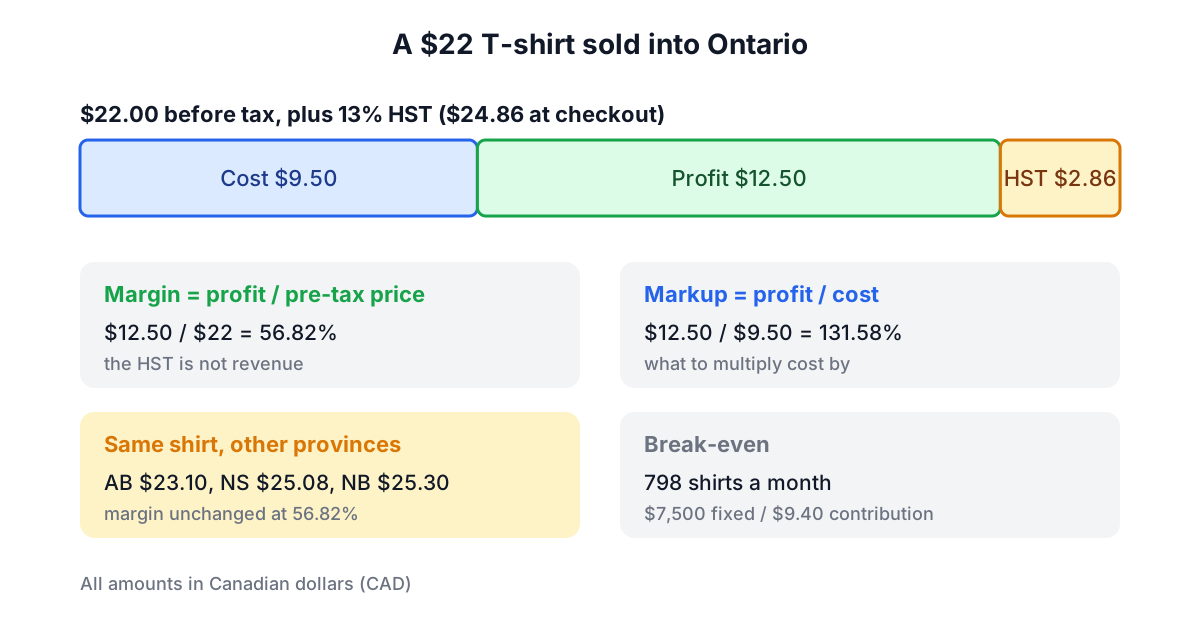
The shop actually sells at $22 pre-tax, a 56.82% margin. Its fixed costs are $7,500 a month: rent on the workshop, the press lease, insurance and a part-time employee. Shipping subsidy and payment fees add about $3.10 a shirt, so the variable cost is $12.60.
It is a Canadian-controlled private corporation (CCPC) earning less than Ontario's $500,000 business limit, so its income qualifies for the small business rate: 9% federal plus Ontario's lower rate, which the CRA lists as 2.2% from July 1, 2026 (down from 3.2%). That is 11.2% combined. To keep $4,000 a month after tax it needs $4,000 / (1 - 0.112) = $4,504.50 before tax.
| Monthly plan | Figure |
|---|---|
| Contribution per shirt | $9.40 (42.73%) |
| Break-even | 798 shirts ($17,553 of sales) |
| For $4,000 after tax | 1,278 shirts |
| Expected sales | 1,300 shirts |
| Profit before tax at 1,300 shirts | $4,720 |
| Margin of safety | 38.6% |
| Operating leverage | 2.59 |
At 1,300 shirts the business clears its target. An operating leverage of 2.59 means a 10% drop in volume cuts profit by about 26%, which is worth knowing before committing to a bigger lease.
When a side business crosses $30,000
A side business printing shirts at home and selling at $22 each stays a small supplier only while revenue is $30,000 or less over four consecutive quarters, about 113 shirts a month. Past that it must register and charge GST/HST. For a registered business the tax is not a cost, but customers in Ontario will see $24.86 instead of $22 if the pre-tax price does not change. Selling mainly to other registered businesses, which can claim the tax back, softens the effect. Zero-rated sales count towards the $30,000 too: a coffee roaster selling only beans still has to register past the threshold, even though it charges no tax on them.
Discounts and price changes
A 15% off promotion takes the pre-tax price from $22 to $18.70. Contribution falls from $9.40 to $6.10 a shirt, and break-even jumps from 798 to 1,230 shirts a month, 54% more volume to cover the same fixed costs. Run the promotion through the break-even calculator before announcing it.
Frequently asked questions
Do I calculate margin before or after HST?
Before. GST/HST collected from customers goes to the CRA after your input tax credits, so it is not revenue. If your shelf price includes HST, divide by 1.13 in Ontario, or by 1.05 where only GST applies, to get the pre-tax price, then work out the margin on that.
What tax rate should a small Canadian corporation use for a profit target?
For income eligible for the small business deduction, the 9% federal rate plus your province's lower rate. The CRA lists Ontario's lower rate at 2.2% from July 1, 2026 and British Columbia's at 2%. A sole proprietor uses personal marginal rates instead, so the corporate figure does not apply.
When do I have to start charging GST/HST?
When you stop being a small supplier: once taxable revenue goes over $30,000 in a single calendar quarter or over the last four consecutive quarters. At $22 a shirt that is roughly 113 shirts a month over a year.
Should my price include tax in Canada?
You can choose. The CRA allows you to state that a price includes GST/HST or to add the tax separately, as long as customers are told. Showing pre-tax prices and adding the tax at checkout keeps one price list for every province.
Sources and further reading
- GST/HST calculator (and rates), Canada Revenue Agency. Rates by province, including Nova Scotia at 14% from April 1, 2025.
- General Information for GST/HST Registrants (RC4022), Canada Revenue Agency. Small supplier threshold, examples of taxable and zero-rated supplies, point-of-sale rebates and showing tax to customers.
- GST/HST Memorandum 4.3, Basic Groceries, Canada Revenue Agency. Coffee beans among the zero-rated basic groceries.
- Corporation tax rates, Canada Revenue Agency. 9% federal small business rate and provincial lower rates.
- 3.1 Explain Contribution Margin, OpenStax, Rice University. Contribution margin per unit and ratio.
- 3.2 Calculate a Break-Even Point in Units and Dollars, OpenStax, Rice University. Break-even in units and revenue.
- 3.3 Perform Break-Even Sensitivity Analysis, OpenStax, Rice University. How break-even moves with price.
Open the Margin and Markup Calculator
More Business Calculators
Every tool in the Business Calculators section, free and in your browser.