
Profit Margin, Markup and Break-Even for UK Sellers
Margin and markup on the price before VAT, how VAT registration at £90,000 moves your break-even, Corporation Tax on profit targets, and commission pay rules.
By Redbison Dev · · 8 min read
United Kingdom edition. Written for UK small businesses: margins worked on prices net of 20% VAT, the £90,000 registration threshold, consumer prices that must include VAT, the 19% small profits rate for targets, and the National Living Wage floor under commission pay. US edition
For a UK seller, margin and markup are always worked on the price before VAT. VAT is collected for HMRC, so the £21 on a shelf label is not £21 of revenue once you are registered: at the standard 20% rate, £3.50 of it goes to HMRC and £17.50 is yours to cover costs and profit. That one fact changes your margin calculation, your break-even volume and what happens when your turnover approaches the £90,000 registration threshold. This edition works through one small business with the margin calculator with VAT, the break-even calculator and the commission calculator. It explains the arithmetic, not your tax position; an accountant can confirm how the rules apply to you.
The VAT rules that shape a price
Three GOV.UK and Trading Standards rules sit underneath everything below:
- Rates. The standard rate is 20%, with a reduced 5% rate for items such as children's car seats and home energy, and a zero rate for most food and children's clothes.
- Registration. You must register for VAT if your taxable turnover for the last 12 months goes over £90,000, or you expect it to go over £90,000 in the next 30 days alone.
- Consumer prices include VAT. Under the Price Marking Order, all price indications consumers can see must include VAT and other compulsory charges. Prices for business buyers can be shown without it.
To take VAT out of a shelf price, divide by 1.2 at the standard rate. The VAT in a price is one sixth of it, not 20% of it.
Margin and markup on one candle
A candle maker's direct cost is £6.40 a candle before VAT: wax, jar, wick, label and box. She wants a 45% gross margin.
net price  = £6.40 / (1 - 0.45) = £11.64
markup     = £5.24 / £6.40      = 81.82%
shelf price incl. 20% VAT       = £13.96
The slip people make is to add 45% to cost: £6.40 x 1.45 = £9.28, which is only a 31.03% margin and £2.36 short on every candle. The calculator prints that comparison under every result for exactly this reason.
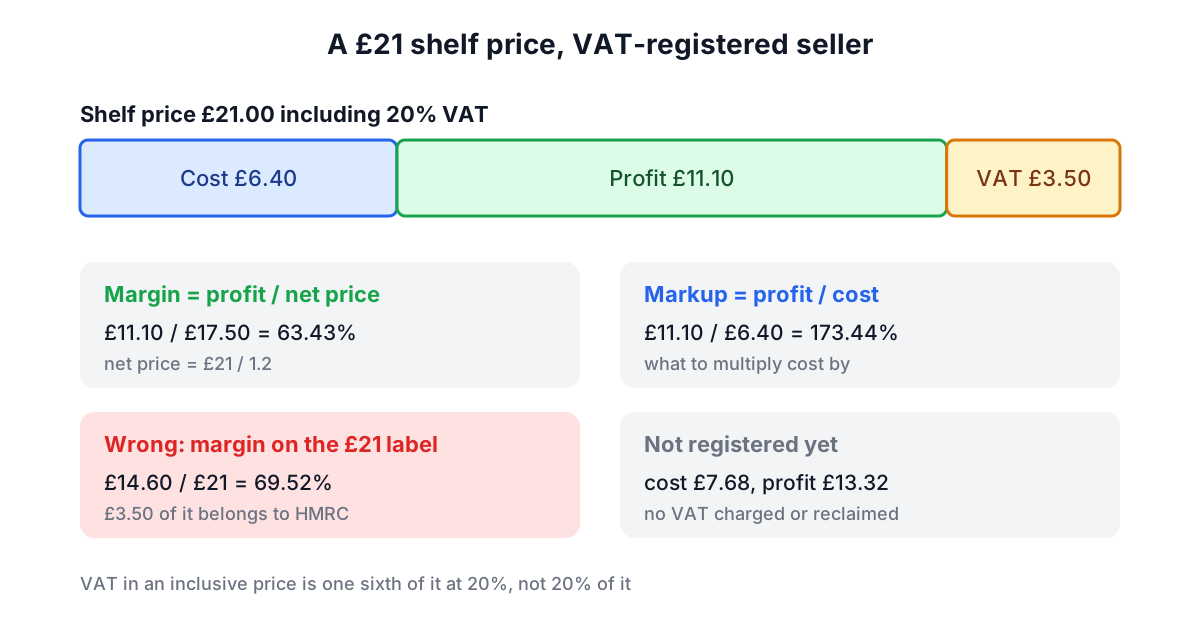
In practice she sells at a rounder £21 on the label. Registered for VAT, that is £17.50 net and £11.10 of profit, a 63.43% margin and a 173.44% markup. Work the margin on the £21 by mistake and you would report 69.52%, six points too high, because £3.50 of the "profit" belongs to HMRC.
Before and after VAT registration
Here is the twist. Before she registers, she cannot reclaim the VAT on her supplies, so her cost per candle is £7.68 (£6.40 plus 20%), and she keeps the whole £21. Her profit per candle is £13.32. After registering, with the same shelf price, it falls to £11.10, because the £3.50 output VAT is bigger than the £1.28 input VAT she can now reclaim.
Now put that into break-even. Her fixed costs are £2,400 a month (workshop rent, insurance, website and a part-time packer), card fees and postage add about £1.20 a candle, and she wants £1,500 a month after Corporation Tax at the 19% small profits rate, which applies to profits of £50,000 or less. That is £1,851.85 before tax.
| Same £21 shelf price | Not VAT-registered | VAT-registered |
|---|---|---|
| Revenue per candle | £21.00 | £17.50 |
| Variable cost per candle | £8.88 | £7.60 |
| Contribution per candle | £12.12 | £9.90 |
| Break-even a month | 199 candles | 243 candles |
| For £1,500 after tax | 351 candles | 430 candles |
| Profit at 300 candles | £1,236 | £570 |
| Margin of safety at 300 | 34.0% | 19.2% |
At 300 candles a month she turns over £75,600 a year, under the threshold. Somewhere above 357 candles a month (£90,000 / £21 / 12) she has to register, and the same volume then earns less unless the shelf price rises. The table is the case for reviewing prices before the month you register, not after. If you sell mainly to VAT-registered businesses, the effect is smaller, because they reclaim the VAT you charge.
Discounts take margin, not just revenue
A 20% off sale takes the label from £21 to £16.80, or £14.00 net of VAT. Profit per candle drops from £11.10 to £7.60, the margin from 63.43% to 54.29%, and the registered break-even rises from 243 to 375 candles a month. Before a promotion, ask whether it will add at least that much volume.
Commission for a sales agent
If she pays a trade sales agent to place candles in gift shops, commission becomes another variable cost. On a plan of 3% up to £20,000, 5% from £20,000 to £40,000 and 8% above, a month of £48,000 of orders pays:
- Marginal (graduated) tiers: £600 + £1,000 + £640 = £2,240, an effective 4.67%.
- Whole-amount tiers: 8% of £48,000 = £3,840.
If the agent is her employee rather than self-employed, UK pay rules apply on top of the plan. The National Living Wage is £12.71 an hour from April 2026 for workers aged 21 and over (and £13.21 from April 2027), so an employee working 160 hours in a month must receive at least £2,033.60 for that month, however little commission they earned.
Frequently asked questions
Should I calculate profit margin with or without VAT?
Without, if you are VAT-registered. Divide the VAT-inclusive price by 1.2 at the standard rate and work the margin on that. If you are not registered, use the full price you charge and include the VAT you paid on supplies in your costs, because you cannot reclaim it.
How does VAT registration change my break-even point?
At the same shelf price you keep less of each sale once registered: a £21 price becomes £17.50 of revenue. You can reclaim VAT on supplies, which helps, but for most retail goods the output VAT is larger. In the candle example break-even rises from 199 to 243 a month.
What is the difference between margin and markup in the UK?
The arithmetic is the same everywhere: margin divides profit by the selling price and markup divides it by cost. The UK twist is that both are worked on the price net of VAT. A 45% margin on a £6.40 cost needs an £11.64 net price, which is an 81.82% markup and £13.96 on the shelf.
Which tax rate should I use for an after-tax profit target?
For a limited company with profits of £50,000 or less, the 19% small profits rate. Above £250,000 the main rate is 25%, with marginal relief between the two. A sole trader pays Income Tax and National Insurance instead, so use your own marginal rate.
Sources and further reading
- VAT rates, GOV.UK. Standard 20%, reduced 5% and zero rate, with examples.
- Register for VAT, GOV.UK. The £90,000 threshold over 12 months or the next 30 days.
- Price marking of goods for retail sale, Business Companion (Chartered Trading Standards Institute). Consumer prices must include VAT.
- Corporation Tax rates and reliefs, GOV.UK. 19% small profits rate, 25% main rate and marginal relief.
- National Minimum Wage and National Living Wage rates, GOV.UK. £12.71 from April 2026 and £13.21 from April 2027.
- 3.2 Calculate a Break-Even Point in Units and Dollars, OpenStax, Rice University. Break-even in units and revenue.
Open the Margin and Markup Calculator
More Business Calculators
Every tool in the Business Calculators section, free and in your browser.