
Margin on MRP, Markup and Break-Even With GST in India
Work margin on the price before GST, read a retailer margin quoted on MRP, find break-even after marketplace fees, and compare regular GST with composition.
By Redbison Dev · · 8 min read
India edition. Written for Indian sellers and brands: MRP inclusive of all taxes under the Legal Metrology rules, the 5% and 18% GST slabs from 22 September 2025, retailer margins quoted on MRP, and the composition scheme. US edition
In India the price a customer sees is the MRP, and by law it includes every tax. A GST-registered seller who claims input tax credit does not keep the GST inside that MRP, so margin and markup are worked on the price before GST: an MRP of ₹118 on an 18% item is ₹100 of revenue and ₹18 of GST. This edition shows how that plays out for a distributor's margin quoted on MRP, a D2C brand fixing its MRP, and a small shop choosing between regular registration and the composition scheme, using the margin calculator with GST and the break-even calculator. It explains the arithmetic; a chartered accountant can confirm the GST treatment for your business.
The rules behind an Indian price tag
- MRP is tax-inclusive. The Legal Metrology (Packaged Commodities) Rules, 2011 define the retail sale price as the maximum price at which a packaged commodity may be sold to the consumer, inclusive of all taxes, printed as "MRP Rs. xx.xx incl. of all taxes" and rounded to the nearest rupee or 50 paise.
- GST slabs. The 56th GST Council moved to a standard rate of 18% and a merit rate of 5%, with a special 40% rate for a few goods, in force from 22 September 2025 for services and most goods. Hair oil, toilet soap, shampoo and toothpaste were among the items cut to 5%.
- Composition taxpayers cannot charge GST. The GSTN welcome kit says a composition dealer cannot issue a tax invoice, collect GST from customers or claim input tax credit, and pays a fixed percentage of turnover instead.
To strip GST out of a price, divide by 1.18 at 18% or 1.05 at 5%.
A retailer margin "on MRP"
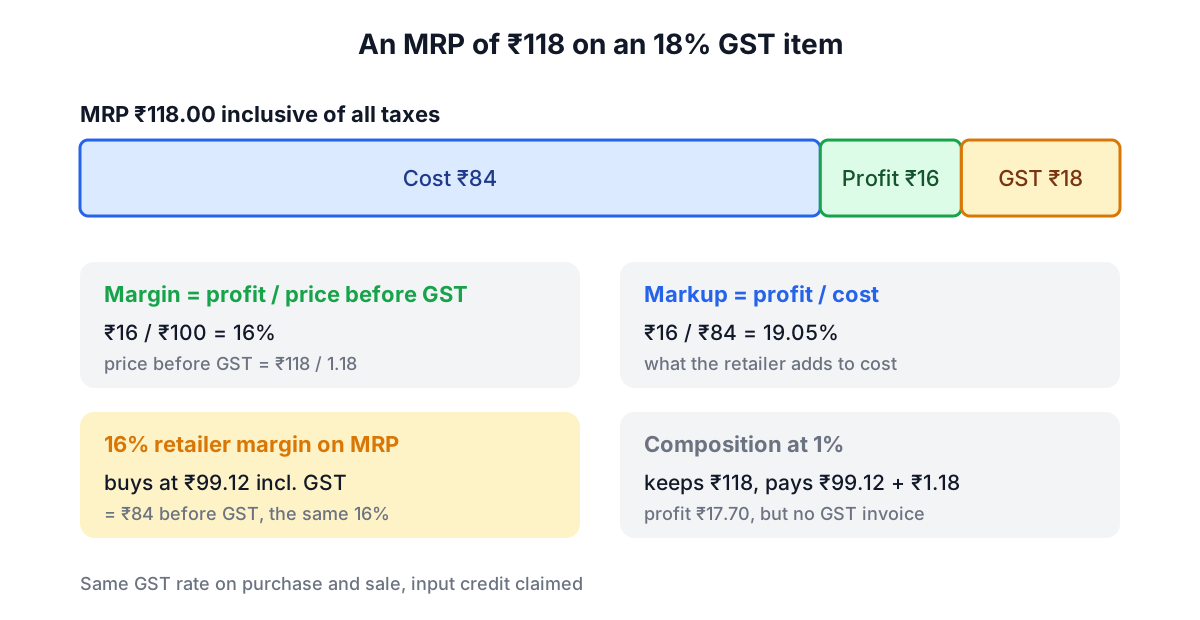
Distributors and brands often quote a retailer margin as a percentage of MRP. Take a product with an MRP of ₹118 at 18% GST and a 16% retailer margin on MRP.
retailer buys at  ₹118 x (1 - 0.16)  = ₹99.12 including GST
cost before GST   ₹99.12 / 1.18      = ₹84.00
sells at MRP      ₹118 / 1.18        = ₹100.00 before GST
profit ₹16.00, margin 16.00%, markup 19.05%
The 16% on MRP and the 16% margin on the price before GST are the same number. That only holds when the purchase and the sale carry the same GST rate and the retailer claims the input credit, which is the normal case for a registered shop. The markup, 19.05%, is what the retailer actually adds to his ex-GST cost.
Fixing an MRP for a target margin
A D2C brand's product costs ₹310 to make and ship to its warehouse. It wants a 40% margin on the price before GST, with 18% GST:
price before GST  ₹310 / (1 - 0.40) = ₹516.67
markup            66.67%
with 18% GST      ₹609.67  -> print an MRP of ₹610 (or ₹609.50)
Adding 40% to cost instead gives ₹434 before GST and only a 28.57% margin: the usual margin-versus-markup slip.
Break-even after marketplace fees
Now say the brand settles on an MRP of ₹599 for the psychological price point. Before GST that is ₹507.63, and the gross margin on a ₹310 cost is 38.93%. But it sells through a marketplace, and in this example the commission and fees come to 20% of the price before GST, about ₹101.53 a unit.
| Monthly plan | Figure |
|---|---|
| Price before GST | ₹507.63 |
| Variable cost (₹310 + 20% fees) | ₹411.53 |
| Contribution per unit | ₹96.10 (18.93%) |
| Fixed costs (salaries, rent, ads retainer) | ₹2,40,000 |
| Break-even | 2,498 units (₹12,67,725 of sales before GST) |
| For ₹1,00,000 profit | 3,538 units |
| At 2,000 units | loss of ₹47,797 |
A 38.93% gross margin turns into an 18.93% contribution once the platform's cut is counted, and the brand needs 2,498 orders a month just to cover its costs. Every rupee of fees saved goes straight to contribution, which is why the fee schedule deserves as much attention as the MRP.
Regular GST or composition for a small shop
The CBIC's GST update lists composition rates of 1% for traders and manufacturers and 5% for restaurants, for businesses with turnover in the previous year up to ₹1.5 crore (₹75 lakh in some special category states). Services or mixed suppliers have a separate ₹50 lakh limit in the welcome kit.
Take the same ₹118 MRP product, bought at ₹99.12 including GST:
| Regular GST | Composition at 1% | |
|---|---|---|
| Revenue kept from ₹118 | ₹100.00 | ₹118.00 |
| Cost | ₹84.00 (credit claimed) | ₹99.12 (no credit) |
| Tax on turnover | none | ₹1.18 |
| Profit per piece | ₹16.00 | ₹17.70 |
| Margin | 16.00% | 15.00% on ₹118 |
Selling to consumers at MRP, the composition shop keeps ₹1.70 more per piece in this case, but it cannot charge GST, cannot claim credit, and cannot make inter-State supplies. Shops that sell to registered businesses, who want a tax invoice to claim credit, may lose that trade under composition.
Frequently asked questions
Is margin calculated on MRP or on the price without GST?
For a regular GST-registered seller, on the price without GST, because the GST is passed on to the government after input credit. When a margin is quoted on MRP and the same GST rate applies to the purchase and the sale, the percentage comes out the same either way: 16% on an ₹118 MRP is also 16% of the ₹100 price before GST.
How do I calculate MRP from cost price?
Divide the cost by one minus your target margin to get the price before GST, then add GST. For a ₹310 cost and a 40% margin at 18% GST, that is ₹516.67 before GST and ₹609.67 with it, so an MRP of ₹610. The Legal Metrology rules require MRP to include all taxes.
Why is my break-even so high when my margin looks healthy?
Because break-even uses contribution, not gross margin. Marketplace commission, payment gateway charges, shipping and returns all come out of every order. A product with a 38.93% gross margin can have only 18.93% contribution after 20% fees, which roughly doubles the volume needed to cover fixed costs.
Does a composition dealer earn more than a regular dealer?
Sometimes, on sales to consumers at MRP: in the ₹118 example the composition shop keeps ₹17.70 against ₹16 for a regular dealer. But composition dealers cannot collect GST, claim input credit or sell inter-State, and business customers who need a tax invoice may buy elsewhere.
Sources and further reading
- The Legal Metrology (Packaged Commodities) Rules, 2011, with amendments, Department of Consumer Affairs. MRP inclusive of all taxes and rounding.
- Recommendations of the 56th Meeting of the GST Council, GST Council. 5%, 18% and 40% rates from 22 September 2025.
- Welcome Kit for New Businesses, Goods and Services Tax Network. Composition limits and restrictions.
- GST: An Update, Central Board of Indirect Taxes and Customs. Composition rates for traders, manufacturers and restaurants.
- 3.1 Explain Contribution Margin, OpenStax, Rice University. Contribution margin per unit and ratio.
- 3.2 Calculate a Break-Even Point in Units and Dollars, OpenStax, Rice University. Break-even in units and revenue.
Open the Margin and Markup Calculator
More Business Calculators
Every tool in the Business Calculators section, free and in your browser.