
Markup vs Margin and Break-Even With VAT in South Africa
Work margin on the price excluding 15% VAT, see how the R2,3 million registration threshold changes break-even, and gross up profit targets for company tax.
By Redbison Dev · · 8 min read
South Africa edition. Written for South African small businesses: margins on prices excluding 15% VAT, the R2,3 million compulsory and R120 000 voluntary VAT thresholds from 1 April 2026, and the 27% company rate and SBC table for profit targets, in rand. US edition
A South African business that is a registered VAT vendor works margin and markup on the price excluding VAT. The 15% inside a VAT-inclusive price belongs to SARS, so a R199,99 price tag brings in R173,90 for the business. Since 1 April 2026 the compulsory registration threshold is R2,3 million of taxable supplies a year, and the sums differ for a business below it. This edition works through one online store with the markup and margin calculator with VAT and the break-even calculator, in rand. It explains the arithmetic, not your tax position; a registered tax practitioner can confirm how the rules apply to you.
The VAT rules behind a price
The SARS VAT page sets out the parts that matter for pricing:
- Taxable supplies are charged at the standard rate of 15% or at the zero rate, and some supplies are exempt.
- From 1 April 2026 the compulsory registration threshold rose from R1 million to R2,3 million of taxable supplies in a 12-month period, and the voluntary threshold from R50 000 to R120 000.
To take VAT out of a price, divide by 1,15. The VAT in a price is 15/115 of it, a little over 13%, not 15%.
Margin and markup on one product
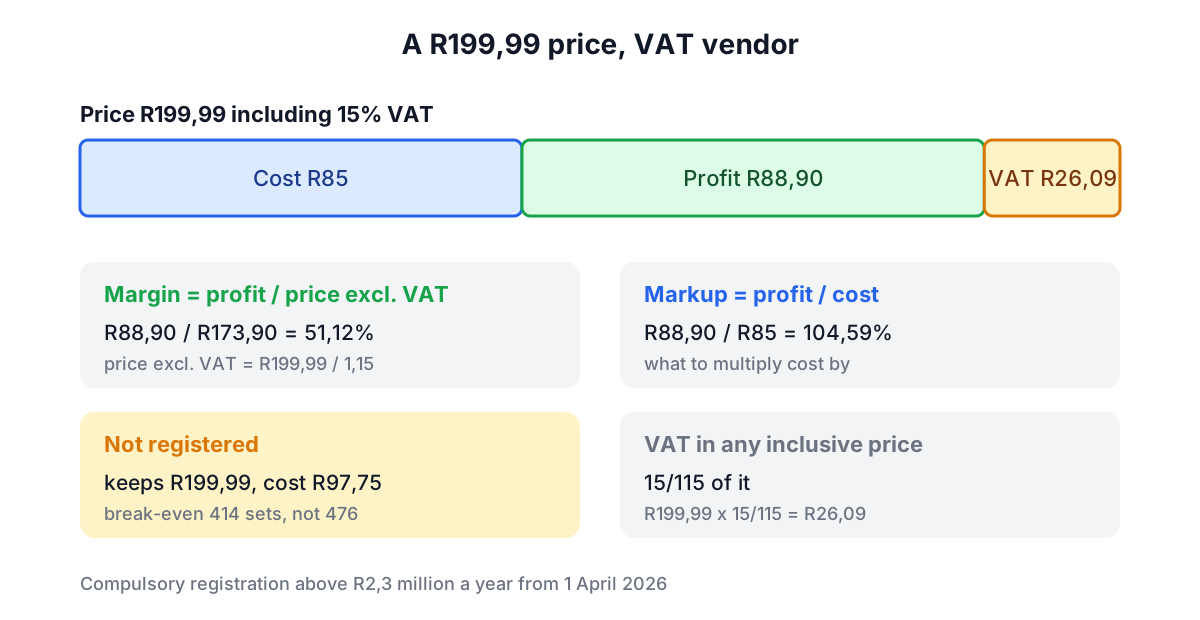
An online kitchenware store sells a stainless steel braai tool set at R199,99 including VAT. Its landed cost is R85 excluding VAT.
price excluding VAT  R199,99 / 1,15   = R173,90
VAT                                     R26,09
profit               R173,90 - R85    = R88,90
margin 51,12%   markup 104,59%
For a new product on the same R85 cost, a 45% margin needs R154,55 excluding VAT (an 81,82% markup) and R177,73 including VAT. Adding 45% to cost instead gives R123,25 and only a 31,03% margin, which is the classic mix-up between the two percentages.
Break-even for a VAT vendor
The store's fixed costs are R38 000 a month: a small unit in an industrial park, website and hosting, insurance and a packer's wages. Courier contribution and payment fees add about R9 an order, so variable cost is R94.
It is a company, and the SARS rates for companies list 27% for years of assessment ending between 1 April 2026 and 31 March 2027. To keep R20 000 a month after tax at 27%, it needs R27 397,26 before tax.
| Monthly plan | Figure |
|---|---|
| Contribution per set | R79,90 (45,95%) |
| Break-even | 476 sets (R82 703,45 excluding VAT) |
| For R20 000 after 27% tax | 819 sets |
| Expected sales | 700 sets |
| Profit before tax at 700 | R17 933,04 |
| Margin of safety | 32,06% |
At 700 sets a month it makes a profit but falls short of the target by about 119 sets.
A small business corporation pays much less
If the business qualifies as a small business corporation (SBC), the same profit is taxed on the SBC table rather than at 27%. For years of assessment ending between 1 April 2026 and 31 March 2027, SARS lists 0% up to R99 000 of taxable income, 7% of the amount above R99 000 up to R365 000, R18 620 plus 21% of the amount above R365 000 up to R550 000, and R57 470 plus 27% above R550 000.
At 700 sets a month the store's profit is about R215 197 a year. On the SBC table, tax is 7% of the R116 197 above R99 000, about R8 134, an effective rate of 3,78% against 27% for an ordinary company. The after-tax target then needs far fewer sets. SBC status has its own qualifying conditions, so check them with SARS or a tax practitioner before you plan on the lower rate.
Below the R2,3 million threshold
An unregistered business charges no VAT, so the whole R199,99 is revenue, but it cannot claim back VAT on its purchases, so its R85 cost becomes R97,75 including the supplier's VAT, and the R9 of courier and payment fees per order becomes R10,35. The R38 000 of fixed costs is kept the same here; any VAT on rent and hosting would push the unregistered break-even higher.
| Same R199,99 price | VAT vendor | Not registered |
|---|---|---|
| Revenue per set | R173,90 | R199,99 |
| Variable cost per set | R94,00 | R108,10 |
| Contribution per set | R79,90 | R91,89 |
| Break-even a month | 476 sets | 414 sets |
At 700 sets a month the store turns over about R1,46 million a year excluding VAT, under the R2,3 million threshold, so registration may be voluntary rather than compulsory. At the same shelf price, registering raises break-even from 414 to 476 sets. It works out better when most customers are VAT vendors who can claim the VAT back, because the price excluding VAT can then stay at R199,99 with VAT added on top. Run both cases before deciding.
Frequently asked questions
Do I calculate margin on the price with or without VAT?
Without VAT if you are a registered vendor, because the 15% is paid over to SARS. Divide the VAT-inclusive price by 1,15 and work the margin on that. An unregistered business uses the full price and counts the VAT it pays on purchases as part of its cost.
What is the VAT registration threshold in South Africa?
From 1 April 2026, registration is compulsory once taxable supplies exceed R2,3 million in a 12-month period, up from R1 million. A business with more than R120 000 of taxable supplies may register voluntarily, up from R50 000.
What tax rate should I use for an after-tax profit target?
27% for a company with a year of assessment ending between 1 April 2026 and 31 March 2027. A qualifying small business corporation pays on the SBC table: 0% up to R99 000 and 7% from there to R365 000, so its effective rate on a modest profit is far lower.
How do I remove VAT from a price?
Divide by 1,15. R199,99 / 1,15 = R173,90, so the VAT is R26,09. The VAT in any inclusive price is 15/115 of it, which is why taking 15% off the inclusive price gives the wrong answer.
Sources and further reading
- Value-Added Tax, South African Revenue Service. 15% standard rate and the R2,3 million and R120 000 thresholds from 1 April 2026.
- Companies, trusts and small business corporations: rates of tax, South African Revenue Service. 27% company rate and the SBC table.
- 3.1 Explain Contribution Margin, OpenStax, Rice University. Contribution margin per unit and ratio.
- 3.2 Calculate a Break-Even Point in Units and Dollars, OpenStax, Rice University. Break-even in units and revenue.
- 3.3 Perform Break-Even Sensitivity Analysis, OpenStax, Rice University. How break-even moves with price and costs.
Open the Margin and Markup Calculator
More Business Calculators
Every tool in the Business Calculators section, free and in your browser.