
Healthy Waist Measurement in Australia: Waist-to-Hip Ratio
The healthdirect waist figures (80 and 88 cm for women, 94 and 102 cm for men), what the ABS found when it measured Australians, and what the hip ratio adds.
By Redbison Dev · · 8 min read
Australia edition. Built on the waist figures healthdirect publishes and the ABS National Health Survey measurements, in centimetres, with the WHO hip ratio, waist-to-height and the lower IDF waist line for Asian Australians. US edition
For most Australian adults, the healthdirect figures are the ones to know. For women, a waist of 80 cm or more means increased risk and 88 cm or more greatly increased risk; for men, the lines are 94 cm and 102 cm. When the Australian Bureau of Statistics measured waists in its 2022 National Health Survey, more than two in three adults (67.9%) were at or over the first line. This guide covers how to measure, what those figures mean, who they do not fit, and how the waist-to-hip and waist-to-height ratios sit beside them. The Waist-to-Hip Ratio Calculator (Australia) works in centimetres and shows all three.
The numbers screen for risk; they do not diagnose. If yours are high, your GP can check blood pressure, blood glucose and cholesterol and talk through what helps.
The healthdirect waist figures
| Waist | Women | Men |
|---|---|---|
| Increased risk | 80 cm or more | 94 cm or more |
| Greatly increased risk | 88 cm or more | 102 cm or more |
These match the World Health Organization's two waist steps for adults of European descent, where the 0.90 and 0.85 waist-to-hip ratio limits also come from. healthdirect is clear about who the figures are for. Waist measurements only apply to adults, and do not apply to:
- children;
- pregnant people;
- people with a health issue that makes the abdomen very enlarged;
- people from certain non-European backgrounds.
What the ABS found
The ABS 2022 National Health Survey, released in December 2023, used the same cut-offs and combined both bands into one "increased risk" group:
| Adults, 2022 | Waist at increased risk or above |
|---|---|
| Men (94 cm or more) | 63.5% |
| Women (80 cm or more) | 72.1% |
| All adults | 67.9% |
Women were more likely than men to be over their line. One caution on the numbers: 39.4% of adult respondents did not have their waist measured, and the ABS imputed their values.
Asian Australians and the lower waist line
healthdirect's note about non-European backgrounds has a practical answer for some groups. The International Diabetes Federation's worldwide definition of the metabolic syndrome sets 90 cm, rather than 94 cm, for South Asian, Chinese and Japanese men, with 80 cm for women in all these groups. It also states the cut-offs go by ethnic group, not country of residence, so they apply to an Australian of Chinese or Indian heritage as much as to someone living in Shanghai or Chennai. For Sub-Saharan African and Middle Eastern populations the IDF says to use the European figures until better data are available. Tick the Asian threshold box in the calculator to apply the 90 cm line.
How to measure
healthdirect gives four steps:
- Place the tape directly on your skin, or over no more than one layer of light clothing.
- Measure halfway between your lowest rib and the top of your hip bone.
- Breathe out normally, then measure.
- Keep the tape snug without squeezing the skin.
For the waist-to-hip ratio, also measure around the widest part of your bottom with the tape level. The WHO protocol adds a stretch-resistant tape and standing with feet close together, arms by your sides.
The two ratios
Waist-to-hip ratio is waist divided by hips. The WHO treats 0.85 or more in women and 0.90 or more in men as substantially increased risk. It describes shape, so broad hips can hide a large waist.
Waist-to-height ratio is waist divided by height in the same units. Keeping your waist under half your height (a ratio under 0.5) is a widely used rule, and the UK's NICE guideline bands it as 0.4 to 0.49 (no increased risk), 0.5 to 0.59 (increased) and 0.6 or more (high), for men and women and all ethnic groups. It needs no hip measurement and adjusts for height, which helps shorter and taller people alike.
Worked examples
Each uses the Australian calculator in centimetres.
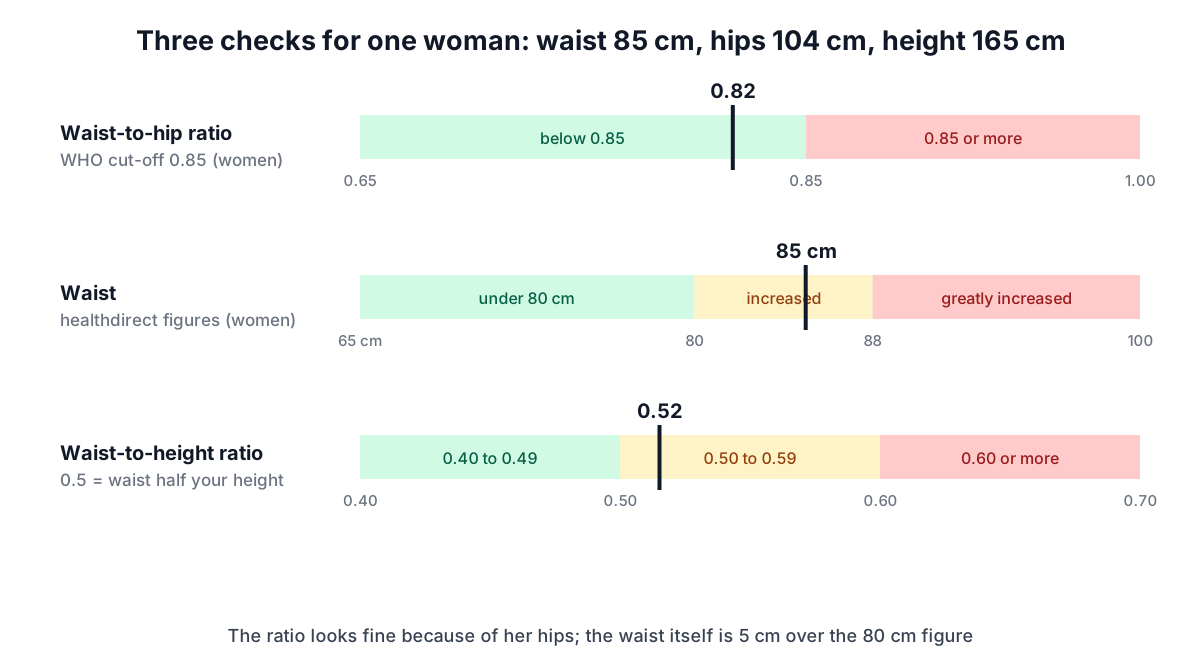
Woman, waist 85 cm, hips 104 cm, 165 cm tall. The ratio is 85 ÷ 104 = 0.82, under 0.85, so on shape alone she looks fine. Her waist, though, is 5 cm over healthdirect's 80 cm figure, and 85 ÷ 165 = 0.52, above half her height. Half her height is 82.5 cm, so she needs to trim more than 2.5 cm, to below 82.5 cm, to clear the height rule; the 80 cm figure needs a further 2.5 cm.
Man, waist 100 cm, hips 103 cm, 178 cm tall. The ratio is 0.97, over 0.90. His waist is in the increased band, 2 cm short of greatly increased, and 100 ÷ 178 = 0.56. At the same hips, a ratio of 0.90 needs a waist of 92.7 cm, close to the 94 cm figure; below 89 cm to get under half his height.
Man of Chinese background, waist 91 cm, hips 95 cm, 170 cm tall. On healthdirect's 94 cm figure he is under the line. With the IDF 90 cm threshold ticked, the calculator shows increased risk. His ratio is 0.96 and 91 ÷ 170 = 0.54, so both ratios agree with the lower waist line rather than the standard one.
What to do with the result
A waist over the line is a reason to see your GP, especially with a family history of type 2 diabetes or heart disease. The useful follow-up is a blood pressure check and blood tests, which show what the tape cannot.
Waist fat comes off the same way as fat elsewhere: eating a little less energy than you use, regular movement and less alcohol. Australians count food energy in kilojoules, and the kilojoule deficit planner works in kJ, with our guide to kilojoule deficits for weight loss on how large a deficit makes sense. The BMI calculator for Australia shows the healthdirect BMI bands and the same waist figures. Re-measure every few weeks, at the same time of day, rather than daily.
Frequently asked questions
What is a healthy waist measurement for a woman in Australia?
Under 80 cm, by the figures healthdirect publishes. Risk is increased at 80 cm and greatly increased at 88 cm. These figures do not apply in pregnancy or for some non-European backgrounds.
Is a 94 cm waist bad for a man?
It is the point where healthdirect says risk is increased, and 102 cm is greatly increased. For men of South Asian, Chinese or Japanese background, the International Diabetes Federation puts the first line at 90 cm instead.
How many Australians have a waist over the healthy range?
In the ABS 2022 National Health Survey, 67.9% of adults had a measured waist that put them at increased risk: 63.5% of men and 72.1% of women. About two in five respondents were not measured, so their values were imputed.
Should I use waist-to-hip or waist-to-height ratio?
Use the waist on its own first, since that is what Australian guidance publishes. Waist-to-height is a good second check because it adjusts for height and works across groups. Waist-to-hip adds shape information but can be thrown off by broad or narrow hips.
Can I measure over my clothes?
healthdirect says to put the tape on your skin, or over no more than one layer of light clothing. Jeans, belts and jumpers all add to the reading.
Sources and further reading
- Body mass index (BMI) and waist circumference, healthdirect Australia. The waist figures, how to measure and who they do not apply to.
- Waist circumference and BMI, Australian Bureau of Statistics. Measured waists in the 2022 National Health Survey.
- Waist circumference and waist-hip ratio: report of a WHO expert consultation, World Health Organization. The two waist steps and the 0.85 and 0.90 ratio limits.
- The IDF consensus worldwide definition of the metabolic syndrome, International Diabetes Federation. Table 2, ethnic-specific waist values.
- Overweight and obesity management (NG246), National Institute for Health and Care Excellence (UK). The waist-to-height bands.
Open the Waist-to-Hip Ratio Calculator
More Fitness Calculators
Every tool in the Fitness Calculators section, free and in your browser.
- BMI Calculator
- Calorie Calculator
- Protein Calculator
- Hydration Calculator
- Calorie Deficit Planner
- Body Fat Calculator
- Ideal Weight Calculator
- Running Pace Calculator
- Target Heart Rate Calculator
- One Rep Max Calculator
- Barbell Plate Calculator
- RPE Calculator
- Interval Timer
- Calories Burned Calculator
- Body Surface Area Calculator
- Waist-to-Hip Ratio Calculator
- VO2 Max Calculator
- Steps to Distance & Calories Calculator