
Waist Circumference and Waist-to-Hip Ratio in Canada
Health Canada's 102 cm and 88 cm waist lines, how they combine with BMI into a risk grid, and what the WHO hip ratio and waist-to-height add, in inches.
By Redbison Dev · · 8 min read
Canada edition. Built on Health Canada's body weight classification (waist 102 cm or 40 in. for men, 88 cm or 35 in. for women, read with BMI) and the Obesity Canada guideline, worked in inches with the WHO and IDF figures alongside. US edition
In Canada the official waist line is simple: 102 cm (40 in.) or more for men and 88 cm (35 in.) or more for women means increased health risk. That comes from Health Canada's Canadian Guidelines for Body Weight Classification in Adults, which reads the waist together with BMI rather than on its own. Many calculators, ours included, also show the World Health Organization's earlier step at 94 cm (37 in.) for men and 80 cm (31.5 in.) for women, plus the waist-to-hip ratio and the waist-to-height ratio. This guide explains how the Canadian chart works, why other numbers flag you sooner, and how to read the three together. The Waist-to-Hip Ratio Calculator (Canada) starts in inches.
A tape measure is a screening tool. If your results are high, your family doctor or nurse practitioner can check blood pressure, blood sugar and cholesterol.
Health Canada's waist and BMI grid
Health Canada's quick reference tool for professionals uses waist circumference only for adults with a BMI of 18.5 to 34.9. At a BMI of 35 or more, it says, the waist adds no information about risk. Within that range the waist moves you up one level of risk:
| Waist | Normal BMI (18.5 to 24.9) | Overweight (25 to 29.9) | Obese class I (30 to 34.9) |
|---|---|---|---|
| Men under 102 cm, women under 88 cm | Least risk | Increased risk | High risk |
| Men 102 cm or more, women 88 cm or more | Increased risk | High risk | Very high risk |
So a man with a BMI of 27 and a 39 in. (99.1 cm) waist is at increased risk because of his weight; with a 41 in. (104.1 cm) waist the same BMI becomes high risk.
The tool also lists who the classification does not suit: people under 18, pregnant and breastfeeding people, and some groups where it may underestimate or overestimate risk, including certain ethnic and racial groups, very lean or muscular people, young adults still growing and adults over 65. Health Canada notes that for people 65 and older, the "normal" BMI range may start a little above 18.5 and run into the overweight range.
Why other charts flag you sooner
The WHO's 2008 expert consultation keeps two waist steps for adults of European descent:
| Waist | Men | Women | Risk of metabolic complications |
|---|---|---|---|
| First step | over 94 cm (37 in.) | over 80 cm (31.5 in.) | Increased |
| Second step | over 102 cm (40 in.) | over 88 cm (34.6 in.) | Substantially increased |
The second step is the Health Canada line. The first is extra, which is why the calculator can say "increased" for a 38 in. waist while the Canadian grid says nothing until 40 in.
The International Diabetes Federation goes further for some groups. Its worldwide definition of the metabolic syndrome sets 90 cm for South Asian, Chinese and Japanese men and 80 cm for women, and it states the values follow ethnic group, not country of residence. For the many Canadians of South Asian or Chinese heritage, that means a man is flagged at 35.4 in., not 40 in. Tick the Asian threshold box in the calculator to use it.
Obesity Canada's adult clinical practice guideline points the same way. Its assessment chapter recommends measuring waist circumference in people with a BMI of 25 to 35, and its 2025 pharmacotherapy update recommends measures of central adiposity, such as waist circumference, waist-to-hip ratio or waist-to-height ratio, "using sex- and ethnicity-specific cut offs if applicable".
How to measure
Health Canada's tool describes the professional method: the person measuring stands beside you and places the tape midway between your lowest rib and the iliac crest (the top of the hip bone), snug but without compressing the soft tissue. At home:
- Stand straight with your feet together and breathe out normally.
- Find the lowest rib and the top of the hip bone on one side and measure around the midpoint, keeping the tape level.
- For hips, measure around the widest part of your buttocks.
- Measure on bare skin. A waist taken over jeans reads high, and pant sizes are not waist measurements.
Canadians often think of height in feet and inches and of the waist in inches, so the calculator starts in inches. To convert, multiply inches by 2.54: 35 in. is 88.9 cm and 40 in. is 101.6 cm.
The two ratios
Waist-to-hip ratio divides the waist by the hips. The WHO treats 0.90 or more in men and 0.85 or more in women as substantially increased risk. Health Canada does not use the ratio, so read it as extra information about shape.
Waist-to-height ratio divides the waist by your height in the same unit. A ratio of 0.5 or more, a waist more than half your height, is the usual mark of increased risk; the bands used in the U.K.'s NICE guideline are 0.4 to 0.49, 0.5 to 0.59 and 0.6 or more, for men and women and all ethnic groups. At 5 ft 11 in. (71 in.), half your height is 35.5 in.
Worked examples
Each uses the Canadian calculator in inches.
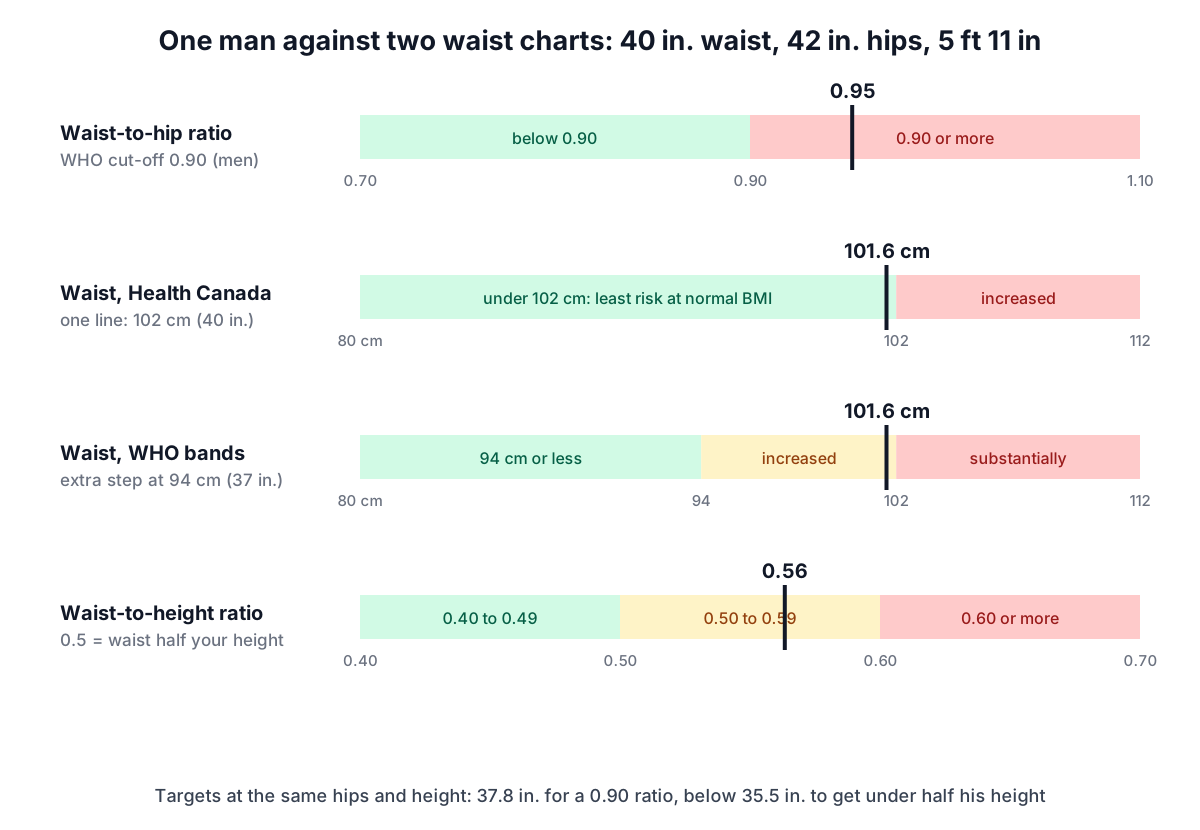
Man, 40 in. waist, 42 in. hips, 5 ft 11 in. The ratio is 40 ÷ 42 = 0.95, over 0.90. His waist is 101.6 cm: over the WHO 94 cm step, but 0.4 cm under Health Canada's 102 cm line, so on the Canadian grid it is the BMI that sets his risk. Waist-to-height is 40 ÷ 71 = 0.56. To bring the ratio to 0.90 at the same hips, the waist would need to be 37.8 in.; to get under half his height, below 35.5 in.
Woman, 35 in. waist, 41 in. hips, 5 ft 5 in. The ratio is 35 ÷ 41 = 0.854, which rounds to 0.85, the WHO limit for women. Her waist is 88.9 cm, over Health Canada's 88 cm, so her risk level steps up one row on the grid whatever her BMI between 18.5 and 34.9. Waist-to-height is 35 ÷ 65 = 0.54. Every measure agrees.
South Asian Canadian man, 36 in. waist, 39 in. hips, 5 ft 8 in. His ratio is 0.92. His waist is 91.4 cm: well under Health Canada's line and under the WHO 94 cm step, so a standard chart calls it low risk. With the IDF South Asian threshold ticked, 91.4 cm is over 90 cm and the calculator shows increased risk, and 36 ÷ 68 = 0.53 puts his waist above half his height. For him, the ethnic-specific line and the height ratio are the readings to act on.
What to do next
A high waist is a reason to look closer, not a diagnosis. Health Canada's grid is meant for professionals, so take your numbers to your family doctor, who can check blood pressure and order blood tests for glucose and lipids. People with a family history of type 2 diabetes, or of South Asian, Chinese or other backgrounds the IDF flags at smaller waists, have more reason to ask.
Fat around the middle responds to the same changes as fat elsewhere: a modest calorie deficit, regular activity and less alcohol. The Canadian calorie deficit planner works in pounds, and our guide to calorie deficits in pounds for Canadians covers how fast is realistic. Re-measure every few weeks with the same method rather than every day.
Frequently asked questions
What waist size is a health risk in Canada?
Health Canada uses 102 cm (40 in.) or more for men and 88 cm (35 in.) or more for women, read with BMI for adults with a BMI of 18.5 to 34.9. Above those lines, each BMI category moves up one level of risk.
Why does my calculator say increased risk at 38 inches?
Because it also shows the WHO bands, which add a first step at 94 cm (37 in.) for men and 80 cm (31.5 in.) for women. Health Canada has only the second step. A 38 in. waist is 96.5 cm: over the WHO first step, under the Canadian line.
Does Health Canada use the waist-to-hip ratio?
No. Its guidelines use BMI and waist circumference. The ratio comes from the WHO, which sets 0.90 for men and 0.85 for women, and Obesity Canada's 2025 pharmacotherapy update lists it among acceptable measures of central fat.
Are there different waist cut-offs for Asian Canadians?
Health Canada publishes one set, and says the classification may misjudge risk in some ethnic groups. The International Diabetes Federation uses 90 cm for South Asian, Chinese and Japanese men and 80 cm for women, applied by ethnic group wherever people live.
Does the waist count if my BMI is over 35?
Not on Health Canada's grid. Its tool says that at a BMI of 35 or more, waist circumference does not provide additional information about the level of risk.
Sources and further reading
- Canadian Guidelines for Body Weight Classification in Adults: quick reference tool for professionals, Health Canada. The 102 and 88 cm lines, the BMI and waist grid, measuring and who it does not suit.
- Canadian Adult Obesity Clinical Practice Guidelines: assessment, Obesity Canada. Waist measurement at a BMI of 25 to 35, and the 2025 pharmacotherapy update on central adiposity measures.
- Waist circumference and waist-hip ratio: report of a WHO expert consultation, World Health Organization. The 94/102 cm and 80/88 cm steps and the 0.90 and 0.85 ratio limits.
- The IDF consensus worldwide definition of the metabolic syndrome, International Diabetes Federation. Ethnic-specific waist values, applied by ethnic group rather than country of residence.
- Overweight and obesity management (NG246), National Institute for Health and Care Excellence (U.K.). The waist-to-height bands used for all ethnic groups.
Open the Waist-to-Hip Ratio Calculator
More Fitness Calculators
Every tool in the Fitness Calculators section, free and in your browser.
- BMI Calculator
- Calorie Calculator
- Protein Calculator
- Hydration Calculator
- Calorie Deficit Planner
- Body Fat Calculator
- Ideal Weight Calculator
- Running Pace Calculator
- Target Heart Rate Calculator
- One Rep Max Calculator
- Barbell Plate Calculator
- RPE Calculator
- Interval Timer
- Calories Burned Calculator
- Body Surface Area Calculator
- Waist-to-Hip Ratio Calculator
- VO2 Max Calculator
- Steps to Distance & Calories Calculator