
Waist Size and Waist-to-Hip Ratio for Indians: The Cut-offs
Why Indian men are flagged at a 90 cm waist, not 94 cm, what the ICMR-INDIAB survey found, and how waist-to-hip and waist-to-height ratios fit in.
By Redbison Dev · · 8 min read
India edition. Built on the Indian abdominal obesity cut-offs (90 cm men, 80 cm women) used by ICMR-INDIAB, the ICMR-NIN dietary guidelines and the IDF South Asian values, with heights in feet and centimetres. US edition
For an Indian adult, the waist line that matters is 90 cm for men and 80 cm for women. Those are the cut-offs the ICMR-INDIAB study used to define abdominal obesity, and they match the International Diabetes Federation's values for South Asians. A man with a 92 cm waist is therefore over the line in India, even though an international chart built for people of European origin, with its 94 cm step, would call the same waist low risk. This guide explains where the Indian numbers come from, how they sit beside the waist-to-hip and waist-to-height ratios, and what to do with your result. The Waist-to-Hip Ratio Calculator (India) has the Indian waist threshold switched on.
A tape measure screens for risk; it does not diagnose anything. If your numbers are high, a doctor can check your blood sugar, blood pressure and lipids.
The Indian and international waist lines
Three sets of numbers are in common use, and a calculator or report may quote any of them:
| Source | Men | Women | Meaning |
|---|---|---|---|
| ICMR-INDIAB (Indian Journal of Medical Research) | 90 cm or more | 80 cm or more | Abdominal obesity |
| IDF, South Asians | 90 cm or more | 80 cm or more | Central obesity (metabolic syndrome) |
| WHO, adults of European descent | over 94 cm / over 102 cm | over 80 cm / over 88 cm | Increased / substantially increased risk |
For women the first step is the same 80 cm everywhere. For men the Indian line sits 4 cm lower than the WHO's first step. The IDF table describes its South Asian values as "based on a Chinese, Malay and Asian-Indian population", and it asks that these ethnic-group cut-points be used wherever the person lives, so they apply equally to Indians in India, Dubai or Toronto.
In inches, which is how many Indians think of their waist from trouser sizes, 90 cm is 35.4 in and 80 cm is 31.5 in. A trouser label is not a waist measurement, though; the tape goes higher, as described below.
What ICMR-INDIAB found
The ICMR-INDIAB study, published in the Indian Journal of Medical Research, measured 13,800 adults aged 20 and over in Tamil Nadu, Maharashtra, Jharkhand and Chandigarh, both urban and rural. With the 90 and 80 cm cut-offs, abdominal obesity was found in:
| Region | Adults with abdominal obesity |
|---|---|
| Chandigarh | 36.1% |
| Tamil Nadu | 26.6% |
| Maharashtra | 18.7% |
| Jharkhand | 16.9% |
Urban residents had significantly more abdominal obesity than rural residents in all four regions. Extrapolating from the three states, the authors put the number of Indians with abdominal obesity at about 153 million, a figure they describe as interim because it rests on only part of the country.
The ICMR-National Institute of Nutrition's Dietary Guidelines for Indians make the same point in plain language. Guideline 9 says abdominal obesity, an increased waist that indicates fat in and around the internal organs, "is associated with risk of lifestyle diseases", and asks people to adopt a healthy lifestyle to prevent it as well as overweight and overall obesity.
Measuring the waist and hips
There are two slightly different landmarks in use, and it helps to know which one a cut-off was built on:
- WHO and IDF: midway between the lowest rib and the top of the hip bone (iliac crest), with the tape horizontal, at the end of a normal breath out.
- ICMR-INDIAB: the smallest horizontal girth between the ribs and the iliac crest, with a non-stretch tape, at the end of a breath out.
For most people the two points are close, but the smallest girth can read a little lower than the midpoint. Pick one and stick with it so that your trend is meaningful. The calculator's instructions follow the WHO midpoint.
Hips are measured around the widest part of the buttocks with the tape level. Measure on bare skin, not over a kurta, saree pleats or jeans, standing with feet together.
Waist-to-hip and waist-to-height ratios
The waist-to-hip ratio divides one by the other. The WHO treats 0.90 or more in men and 0.85 or more in women as substantially increased risk. It captures shape, which is useful, but it can mislead: narrow hips push it up, broad hips pull it down.
The waist-to-height ratio divides the waist by your height in the same units. A value of 0.5 or more, a waist more than half your height, is the widely used mark of increased risk, and the bands of 0.4 to 0.49, 0.5 to 0.59 and 0.6 or more apply to men and women alike. Many Indians give their height in feet and inches, so convert first: 5 ft 7 in is 67 in or 170.2 cm. Half of 170 cm is 85 cm, so a man of that height should aim for a waist under 85 cm, which is stricter than the 90 cm abdominal obesity line.
Worked examples
All three use the India calculator in centimetres with the Asian waist box ticked.
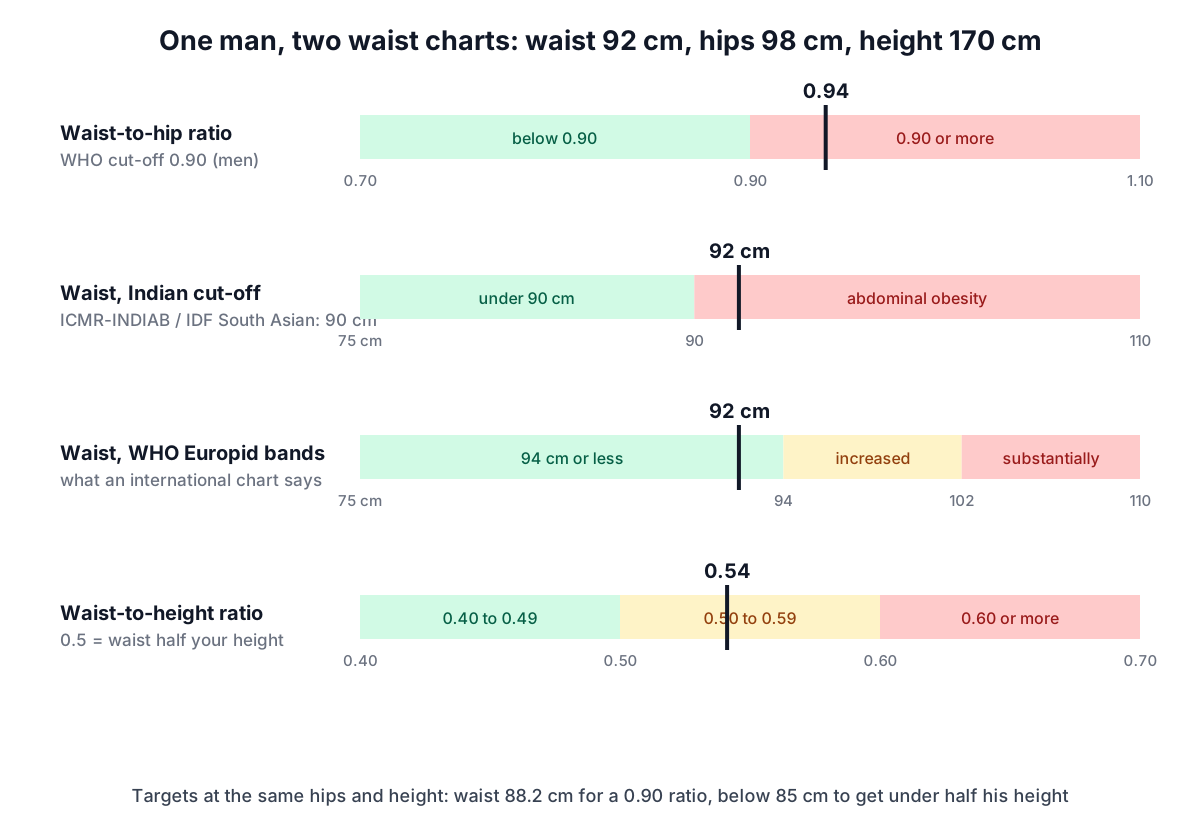
Man, waist 92 cm, hips 98 cm, height 170 cm. The ratio is 92 ÷ 98 = 0.94, over 0.90. The waist is over the Indian 90 cm line, so the calculator shows increased risk. Waist-to-height is 92 ÷ 170 = 0.54, increased. Untick the Asian box and the waist alone reads low against the WHO 94 cm band, which is exactly the gap the Indian cut-off is meant to close. To reach a ratio of 0.90 at the same hips he would need a waist of 88.2 cm; to get under half his height, below 85 cm.
Woman, waist 82 cm, hips 100 cm, height 155 cm (about 5 ft 1 in). The ratio is 0.82, under 0.85, so on shape alone she looks fine. But 82 cm is over the 80 cm cut-off, and 82 ÷ 155 = 0.53 puts her waist above half her height. A woman who goes by the ratio alone would miss both signals.
Man, waist 88 cm, hips 97 cm, height 172 cm. The ratio is 0.91, just over 0.90, because his hips are narrow. His waist is under 90 cm, so the abdominal obesity line is not crossed, while 88 ÷ 172 = 0.51 is just into the increased band. When the measures disagree like this, track the waist every few weeks and treat a family history of diabetes as a reason to get tested anyway.
Who should read these numbers carefully
- Pregnancy and children. Adult waist cut-offs do not apply in pregnancy or to children and adolescents.
- Conditions that swell the abdomen, such as a hernia, fluid or a large fibroid, make the waist reading meaningless.
- Normal weight is not a free pass. The whole reason for a lower waist line in South Asians is that risk appears at smaller sizes, so a high waist with a normal BMI is still worth acting on.
Bringing the waist down
The ICMR-NIN guidelines pair the abdominal obesity advice with practical steps: cut down on sugar, salt, excess refined oil, deep-fried and refined foods, avoid soft drinks and alcohol, eat more fruit, vegetables and pulses, prefer whole grains and millets, and sleep 6 to 8 hours. Guideline 10 asks adults for at least 30 to 45 minutes of brisk walking or other moderate activity. Slow and steady loss is advised over extreme diets.
To set a calorie target, the calorie deficit planner for India works in kilograms and kcal and checks the goal against the Indian BMI cut-offs, and our calorie deficit guide for Indian readers covers how large a deficit is sensible. The BMI calculator (India) opens with the Asian Indian BMI cut-offs of 23 and 25.
Frequently asked questions
What is the normal waist size for an Indian man?
Under 90 cm (about 35.4 in), measured at the waist rather than where trousers sit. ICMR-INDIAB defines abdominal obesity as a waist of 90 cm or more in men, which is also the International Diabetes Federation's value for South Asian men.
What is a good waist-to-hip ratio for Indian women?
Below 0.85, the WHO limit for women. Indian guidance leans on the waist itself, though, so also check that the waist is under 80 cm. A pear shape can give a ratio below 0.85 with a waist above 80 cm.
Why do Indians have a lower waist cut-off than Europeans?
The International Diabetes Federation's consensus gives separate, lower values for South Asian, Chinese and Japanese men, and states that the cut-points follow ethnic group rather than country. The ICMR-NIN guidelines explain why the waist matters at all: an increased waist indicates fat in and around the internal organs, which is linked with lifestyle diseases.
Should I use my height in feet or centimetres?
Either, as long as the waist is in the same unit. Convert feet and inches to inches (5 ft 4 in is 64 in) or to centimetres (162.6 cm) before dividing. A ratio has no units, so both give the same answer.
My waist is 86 cm and I am 5 ft 5 in. Am I at risk?
As a man, 86 cm is under the 90 cm line, but 5 ft 5 in is 165.1 cm and 86 ÷ 165.1 is 0.52, above half your height. As a woman, 86 cm is over the 80 cm line. Either way it is a reasonable prompt for a blood sugar check, especially with diabetes in the family.
Sources and further reading
- Prevalence of generalized and abdominal obesity in urban and rural India: the ICMR-INDIAB Study (Phase-I), Indian Journal of Medical Research. Pradeepa, Anjana, Joshi and colleagues; the 90 and 80 cm definitions, measuring method and state results.
- Dietary Guidelines for Indians, ICMR-National Institute of Nutrition. Guideline 9 on abdominal obesity and Guideline 10 on physical activity.
- The IDF consensus worldwide definition of the metabolic syndrome, International Diabetes Federation. Table 2, ethnic-specific waist values for South Asians.
- Waist circumference and waist-hip ratio: report of a WHO expert consultation, World Health Organization. The measuring protocol and the 0.90 and 0.85 ratio limits.
- Overweight and obesity management (NG246), National Institute for Health and Care Excellence. The waist-to-height bands of 0.4 to 0.49, 0.5 to 0.59 and 0.6 or more, set for all ethnicities.
Open the Waist-to-Hip Ratio Calculator
More Fitness Calculators
Every tool in the Fitness Calculators section, free and in your browser.
- BMI Calculator
- Calorie Calculator
- Protein Calculator
- Hydration Calculator
- Calorie Deficit Planner
- Body Fat Calculator
- Ideal Weight Calculator
- Running Pace Calculator
- Target Heart Rate Calculator
- One Rep Max Calculator
- Barbell Plate Calculator
- RPE Calculator
- Interval Timer
- Calories Burned Calculator
- Body Surface Area Calculator
- Waist-to-Hip Ratio Calculator
- VO2 Max Calculator
- Steps to Distance & Calories Calculator