
Waist to Height vs Waist to Hip Ratio: NHS and NICE Rules
Why the NHS now asks for your waist to be under half your height, how NICE bands the ratio, where the WHO waist-to-hip limits still fit, worked in inches.
By Redbison Dev · · 8 min read
United Kingdom edition. Worked in inches and feet, built around the NHS half-your-height rule and the NICE NG246 waist-to-height bands, with the WHO hip ratio and the IDF waist lines for South Asian, Chinese and Japanese adults in the UK. US edition
If you have been told to check your waist recently, it was almost certainly against your height rather than your hips. The NHS line is short: "You should try to keep your waist size to less than half your height." At 5 ft 10 in that means a waist under 35 inches; at 5 ft 4 in, under 32 inches. The older waist-to-hip ratio, with its World Health Organization limits of 0.90 for men and 0.85 for women, still turns up in research, gyms and some clinics, so this guide covers both and shows where they disagree. The UK Waist-to-Hip Ratio Calculator works in inches by default and gives all three readings at once.
These are screening numbers, not a diagnosis. If your result worries you, the NHS suggests talking to your local pharmacist or GP surgery.
What NICE changed
The National Institute for Health and Care Excellence guideline on overweight and obesity (NG246) asks clinicians to use waist-to-height ratio alongside BMI for adults with a BMI below 35. Recommendation 1.9.14 sets three bands, the same for men and women and for every ethnic group, including people with a lot of muscle:
| Waist-to-height ratio | NICE classification | What it indicates |
|---|---|---|
| 0.4 to 0.49 | Healthy central adiposity | No increased health risks |
| 0.5 to 0.59 | Increased central adiposity | Increased health risks |
| 0.6 or more | High central adiposity | Further increased health risks |
The risks NICE names are type 2 diabetes, high blood pressure and cardiovascular disease. Recommendation 1.9.15 turns the table into the advice the NHS repeats: keep your waist to less than half your height, a ratio under 0.5. NICE uses the same bands for children and young people aged 5 and over.
Why the shift away from hips? A waist-to-height ratio needs one tape measurement and a height most people already know, and the same cut-off works whether you are 5 ft 2 in or 6 ft 3 in. It also avoids a trap of the hip ratio: broad hips can make a large waist look reassuring.
Measuring your waist the NICE way
Box 1 of NG246 gives the home method. Find the bottom of your ribs and the top of your hips, wrap the tape around your waist midway between them, which is just above the belly button, and breathe out naturally before reading it. Then:
- use the same units for waist and height: both inches or both centimetres;
- convert feet and inches to inches first (5 ft 7 in is 67 inches);
- divide waist by height.
NICE's own example is a 38 in waist at 5 ft 7 in: 38 ÷ 67 = 0.57, in the increased band. The same person measured in centimetres, 96.5 cm and 170 cm, also comes out at 0.57.
That point, just above the belly button, is usually higher than where trousers sit, and trouser labels describe the garment rather than your body, so do not use your trouser size.
For the waist-to-hip ratio you also need the hips: the widest part of your bottom, tape level all the way round. The WHO consultation behind the hip ratio limits recommends measuring both sites standing, feet close together, arms at the sides, with a stretch-resistant tape.
Half your height, in inches
Because most adults in the UK know their height in feet and inches, here is the half-height line worked out for common heights. Stay under the figure in the middle column; the right-hand column is where the NICE "high" band (0.6) begins.
| Height | Waist for a ratio of 0.5 | Waist for a ratio of 0.6 |
|---|---|---|
| 5 ft 0 in (60 in) | 30 in | 36 in |
| 5 ft 4 in (64 in) | 32 in | 38.4 in |
| 5 ft 7 in (67 in) | 33.5 in | 40.2 in |
| 5 ft 10 in (70 in) | 35 in | 42 in |
| 6 ft 0 in (72 in) | 36 in | 43.2 in |
| 6 ft 3 in (75 in) | 37.5 in | 45 in |
Where the waist-to-hip ratio still fits
The WHO expert consultation held in Geneva in December 2008, published in 2011, set out the thresholds most calculators still use. Its summary table gives:
| Measure | Men | Women | Risk of metabolic complications |
|---|---|---|---|
| Waist | over 94 cm (37 in) | over 80 cm (31.5 in) | Increased |
| Waist | over 102 cm (40.2 in) | over 88 cm (34.6 in) | Substantially increased |
| Waist-to-hip ratio | 0.90 or more | 0.85 or more | Substantially increased |
The UK calculator shows these next to the NICE band, so you can see whether all three agree. The ratio is rounded to two decimals before it is compared, the same way it is displayed.
If your family background is South Asian, Chinese or Japanese
The International Diabetes Federation's worldwide definition of the metabolic syndrome sets waist lines by ethnic group: 94 cm for Europid men but 90 cm for South Asian, Chinese and Japanese men, with 80 cm for women in all of these groups. The IDF is explicit that the lines follow ethnic group, not the country you live in, so a British-born man of Pakistani, Indian or Bangladeshi heritage uses the 90 cm line. Tick the box in the calculator to apply it.
NICE reaches a similar conclusion for BMI. For adults of South Asian, Chinese, other Asian, Middle Eastern, Black African or African-Caribbean family background, the NHS counts a BMI of 23 to 27.4 as overweight and 27.5 or more as obese. The waist-to-height bands, by contrast, are the same for everyone. Our UK BMI guide covers the lower BMI thresholds in stones and pounds.
Three readers, worked through
These are the inputs to type into the UK calculator, with inches selected.
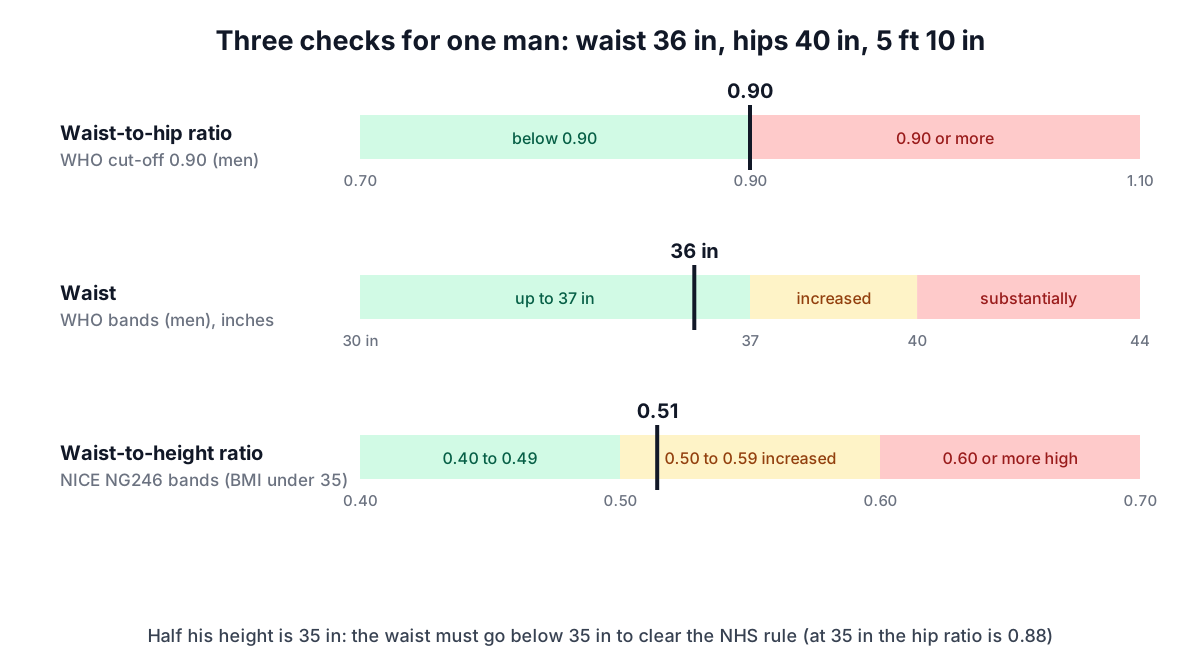
A man of 5 ft 10 in with a 36 in waist and 40 in hips. His waist-to-hip ratio is 36 ÷ 40 = 0.90, exactly on the WHO line for men, so the calculator labels it substantially increased. His waist of 91.4 cm is under the WHO 94 cm band. His waist-to-height ratio is 36 ÷ 70 = 0.51, in the NICE increased band by a whisker. Half his height is 35 inches, so he needs to get below 35 inches to clear the NHS rule; at 35 inches his hip ratio would already be 0.88.
A woman of 5 ft 4 in with a 32 in waist and 40 in hips. Her ratio is 0.80, comfortably below 0.85. But 32 inches is 81.3 cm, just over the WHO 80 cm line, and 32 ÷ 64 is exactly 0.50: the point the NHS asks you to stay under. A pear shape flatters the hip ratio; the waist measures tell the more useful story.
A British South Asian man of 5 ft 8 in with a 35 in waist and 38 in hips. His ratio is 0.92, over 0.90. His waist is 88.9 cm, so even the lower 90 cm IDF line is not crossed, yet 35 ÷ 68 = 0.51 puts him in the increased band. For him, the waist-to-height reading and the NICE BMI line of 23 are the two to watch, and narrow hips are making the hip ratio look worse than the waist alone would.
Who these numbers do not suit
The NHS calculator lists the cases where its waist-to-height result should not be used:
- children under 5, and anyone aged 5 to 17 without a parent or carer and a BMI check first;
- pregnancy;
- an eating disorder, diagnosed or suspected;
- a growth disorder or any condition that affects height;
- adults with a BMI over 35.
Add to that anything that swells the abdomen, such as a large hernia or fluid, and very recent big weight changes, when a single reading can mislead. Two readings taken a minute apart rarely match exactly, so take two and use the average, at the same time of day each time.
What to do with a high reading
The NHS obesity page suggests seeing a GP if your BMI is in the overweight or obese range and your waist is more than half your height, or you have a condition such as pre-diabetes, high blood pressure or high cholesterol. NICE recommendation 1.9.5 asks clinicians to encourage adults whose ratio shows increased risk to seek further assessment, such as a check of cardiometabolic risk factors. A blood pressure reading and blood tests for sugar and cholesterol tell you far more about what is actually happening than a tape can.
Waist fat responds to the same things as fat elsewhere: eating a little less than you burn, regular activity and less alcohol. The UK calorie deficit planner works out a daily target, and our UK calorie deficit guide explains how big a deficit is sensible. Re-measure every few weeks rather than every day.
Tools for this job
- Waist-to-Hip Ratio Calculator (UK): waist-to-hip, waist-to-height and the WHO waist band from inches or centimetres, with the South Asian option.
- BMI Calculator (UK): BMI from stones and pounds, with the NICE lower thresholds.
- Body Fat Calculator (UK): uses the same tape measurements to estimate body fat percentage.
Frequently asked questions
Is waist to height ratio better than BMI?
NICE does not ask you to choose. For adults with a BMI under 35 it recommends using waist-to-height ratio as well as BMI, because BMI is not a direct measure of fat around the middle. The NICE bands and the NHS tool are for adults with a BMI under 35, so above that, BMI and a clinical assessment take over.
What waist size should a 5 ft 6 in woman aim for?
Under 33 inches. Five foot six is 66 inches, and half of that is 33. A waist of 39.6 inches or more would put her in the NICE high band (0.6).
Do I need to measure my hips at all?
Not for the NHS check, which only needs waist and height. The hip measurement is for the waist-to-hip ratio, which the WHO still publishes and some researchers and clinics use. Current NHS and NICE advice is built on waist-to-height, so treat the hip ratio as a second opinion.
Why does the calculator flag my waist at 36 inches if I am South Asian?
Because 36 inches is 91.4 cm, over the 90 cm line the International Diabetes Federation sets for South Asian men. It applies by ethnic group wherever you live. A man of European background would need to pass 94 cm (37 in) for the same flag.
Should children use waist-to-height ratio?
NICE uses the same three bands for children and young people aged 5 and over, and the NHS calculator accepts them, but anyone aged 5 to 17 should use it with a parent or carer and check their BMI first. For a child under 5, ask a health visitor or GP.
Sources and further reading
- Overweight and obesity management (NG246): identifying and assessing overweight, obesity and central adiposity, National Institute for Health and Care Excellence. Recommendations 1.9.5, 1.9.11, 1.9.14 and 1.9.15, and Box 1.
- Calculate your waist to height ratio, NHS. The half-your-height rule and who the tool is not for.
- Obesity, NHS. When to see a GP and the lower BMI thresholds by ethnic background.
- Waist circumference and waist-hip ratio: report of a WHO expert consultation, World Health Organization. The measuring protocol and the 94/102 cm, 80/88 cm and 0.90/0.85 cut-offs.
- The IDF consensus worldwide definition of the metabolic syndrome, International Diabetes Federation. Table 2, ethnic-specific waist values, applied by ethnic group rather than country of residence.
Open the Waist-to-Hip Ratio Calculator
More Fitness Calculators
Every tool in the Fitness Calculators section, free and in your browser.
- BMI Calculator
- Calorie Calculator
- Protein Calculator
- Hydration Calculator
- Calorie Deficit Planner
- Body Fat Calculator
- Ideal Weight Calculator
- Running Pace Calculator
- Target Heart Rate Calculator
- One Rep Max Calculator
- Barbell Plate Calculator
- RPE Calculator
- Interval Timer
- Calories Burned Calculator
- Body Surface Area Calculator
- Waist-to-Hip Ratio Calculator
- VO2 Max Calculator
- Steps to Distance & Calories Calculator