
Mortgage Term Ireland: 25, 30 or 35 Years Compared
An Irish €360,000 mortgage over 25, 30 and 35 years: monthly repayments, interest, the balance when your fix ends, and overpaying under Irish breakage rules.
By Redbison Dev · · 10 min read
Ireland edition. Written for Irish borrowers: the choice is the mortgage term within the Central Bank's income and deposit limits, with € examples at the average Irish new fixed rate, 3- and 5-year fixes, breakage fees and overpayments. US edition
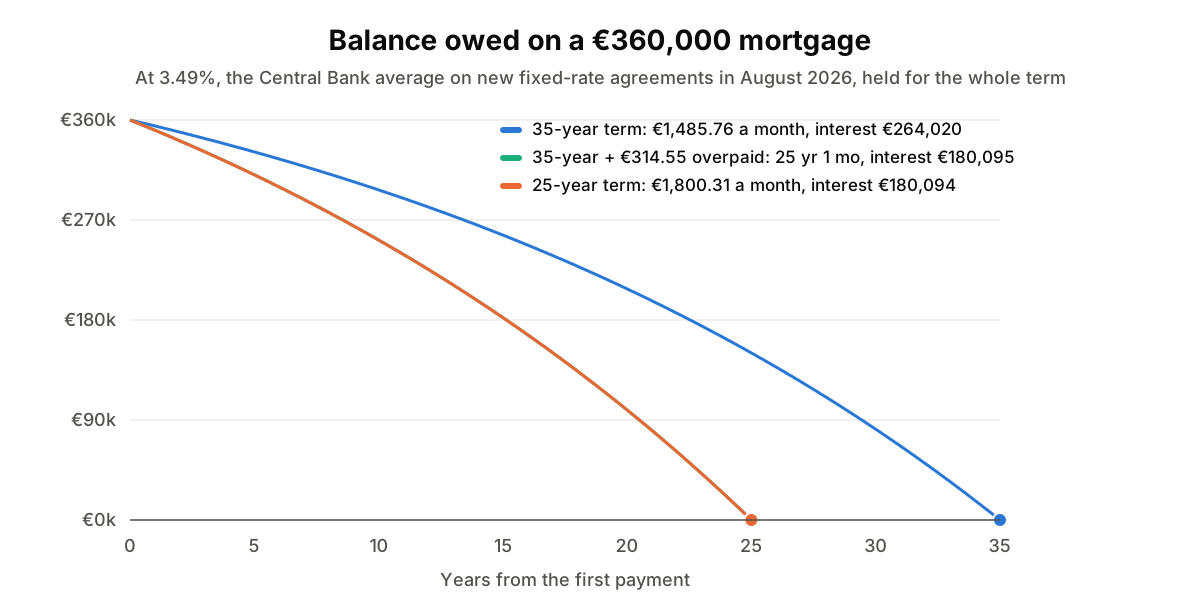
Irish buyers are not choosing between a 15-year and a 30-year fixed loan the way Americans are. Most Irish mortgages fix the rate for a few years, then move to a variable rate or a new fix, while the term decides how long the whole loan runs: usually 20 to 35 years, according to the Competition and Consumer Protection Commission (CCPC). On a €360,000 first-time buyer mortgage at 3.49%, choosing 35 years instead of 25 lowers the repayment by €314.55 a month but adds €83,925 of interest if that rate held throughout. A 35-year term with the difference overpaid ends up almost exactly where the 25-year term does, but only if your rate lets you overpay.
The figures come from the Irish Mortgage Repayment Calculator, so you can repeat them with your own offer.
What the Central Bank rules mean for the term
The Central Bank of Ireland's mortgage measures cap borrowing by income and deposit, not by repayment:
| Buyer | Loan-to-income limit | Minimum deposit |
|---|---|---|
| First-time buyer | 4 times gross income | 10% |
| Second and subsequent buyer | 3.5 times gross income | 10% |
Buy-to-let buyers need a 30% deposit. Lenders can go above the limits for 15% of first-time buyer lending, 15% of second and subsequent buyer lending and 10% of buy-to-let lending.
This is the biggest difference from the US and UK picture. A longer term lowers the monthly repayment, but it does not raise the 4-times-income ceiling. A couple earning €90,000 between them can borrow €360,000 as first-time buyers whether they choose 25 or 35 years. The term changes what the loan costs each month and in total; the income multiple sets how big it can be. The lender still checks that the repayment is affordable, so a longer term can help you pass that check, but not past the cap.
The same mortgage at 25, 30 and 35 years
The Central Bank's retail interest rate statistics put the weighted average rate on new fixed-rate mortgage agreements at 3.49% in August 2026, with fixed rates making up 94% of new agreements by volume. The average on new variable-rate agreements was 4.16%. Use these as realistic examples; your offer depends on the lender, the fix length and your loan-to-value.
Take a €400,000 home with the minimum 10% deposit, a €360,000 mortgage. In the mortgage calculator, enter a price of 400000, a deposit of 10%, a rate of 3.49 and a term of 25, then change the term to 30 and 35.
| €360,000 at 3.49% | 25 years | 30 years | 35 years |
|---|---|---|---|
| Monthly repayment | €1,800.31 | €1,614.55 | €1,485.76 |
| Balance after a 3-year fix | €331,453.80 | €338,493.12 | €343,373.53 |
| Balance after a 5-year fix | €310,695.86 | €322,853.95 | €331,283.26 |
| Interest over the term at 3.49% | €180,094.41 | €221,238.72 | €264,019.71 |
The last row assumes 3.49% for the whole term, which a 3- or 5-year fix does not give you. The balance at the end of the fix is the more useful number: after three years the 35-year borrower owes €11,920 more, and the next rate applies to that larger balance.
The CCPC's own example makes the same point the other way round: extending a €200,000 mortgage at 4% APRC from 20 to 25 years lowers the repayment by about €150 a month and adds about €25,000 in interest.
When the fix ends
Your lender must give you at least 60 days' notice before a fixed rate ends, the CCPC says, and if you do not choose, you may be moved to its standard variable rate. Here is the repayment after a three-year fix at three possible rates:
| Rate after the fix | 25-year term (22 years left) | 35-year term (32 years left) |
|---|---|---|
| 3.49% (same as before) | €1,800.31 | €1,485.76 |
| 4.16% (August 2026 average new variable) | €1,918.49 | €1,619.03 |
| 5.49% | €2,165.29 | €1,900.22 |
Moving from 3.49% to the 4.16% variable average adds €118.18 a month on the 25-year term and €133.27 on the 35-year term. The longer term starts lower and stays lower, but it is slightly more sensitive to the rate because more of each repayment is interest.
Paying a 35-year mortgage like a 25-year one
Set the term to 35 and add 314.55 as an extra monthly payment:
- The mortgage clears in 301 months, 25 years and 1 month, if 3.49% held throughout.
- Total interest is €180,095.03, 62 cent more than the 25-year term and €83,925 less than the 35-year term without overpayments.
- After three years you owe €331,453.93, the same as the 25-year borrower.
Whether your rate allows it
This is where Irish rules matter. The CCPC explains that variable-rate mortgages usually allow overpayments without penalties, while on a fixed rate "overpaying can trigger significant charges": some fixed deals allow limited overpayments, others charge a fee or do not allow overpayments at all during the fixed period.
The charge on a fixed rate is a breakage fee, which compensates the lender for funding or hedging losses and depends on how much you repay early, how long the fix has left and how market rates have moved. The CCPC says penalties should reflect the lender's actual loss, not exceed it, and gives an example of €1,000 to €2,000 for repaying €100,000 with two years left.
Here the overpayment is €3,774.60 a year, about 1.05% of the starting balance. If your fixed rate has an annual overpayment allowance, check that this fits inside it. If not, you could take the longer term, save the difference while fixed, and pay it off as a lump sum when the fix ends. Either way, tell your lender in writing to apply the money to the capital: the CCPC warns that an overpayment without that instruction can sit in a credit or suspense account and save you nothing.
Long fixes: the closest thing to a US loan
The CCPC notes that most lenders offer fixes of 2, 3 or 5 years, that 7- and 10-year fixes exist, and that some lenders offer 20 to 30 years fixed, though these are less common and usually at higher rates. A fix that lasts most of the term is the nearest Irish equivalent to a US 30-year fixed loan: certainty on the repayment, but breakage fees if you overpay above the allowance, switch or sell early. Compare the total cost over the fix, not just the rate.
Which term fits
25 years suits you if the repayment fits at a rate a couple of points higher than your fix, you want the larger drop in the balance at each renewal, and you would not keep up voluntary overpayments.
30 or 35 years suits you if the lower repayment matters now and you have a plan: overpaying within your fixed-rate allowance, or in lump sums once you are on a variable rate. Check where the term ends against your retirement age; the CCPC notes lenders may look at your age and retirement date when you ask to extend later.
Two Irish details follow the term: mortgage protection insurance, which most lenders require, should match it, and if you later extend the term you may need to update the policy. This guide covers repayment mortgages at one rate per period; it does not fit trackers, interest-only arrangements or restructured mortgages in arrears. For free, independent help with a mortgage you are struggling to pay, the CCPC points to the Money Advice and Budgeting Service (MABS).
Tools for this job
- Irish Mortgage Repayment Calculator: monthly repayments at any term, with monthly or yearly overpayments and the full schedule.
- Mortgage Switching Calculator: whether a cheaper rate pays back any breakage fee and switching costs.
- How Much Can I Borrow calculator: what the 4 and 3.5 times income limits and the 10% deposit allow you to borrow.
For deposits, the measures and how a repayment is worked out, read how mortgages work in Ireland. For why the early repayments are mostly interest, see EMI and loan amortisation.
Frequently asked questions
Does a longer mortgage term let me borrow more in Ireland?
Not past the Central Bank limits. First-time buyers can borrow up to 4 times gross income and second and subsequent buyers 3.5 times, whatever the term. A longer term lowers the repayment, which can help with the lender's affordability check, but the income multiple still caps the loan.
Can I overpay my mortgage on a fixed rate in Ireland?
Sometimes. The CCPC says some fixed rates allow limited overpayments without a penalty, while others charge a breakage fee or do not allow overpayments during the fixed period. Variable rates usually allow them without penalty. Confirm the terms with your lender first, and ask for the payment to go to the capital.
How much more interest does a 35-year mortgage cost?
On €360,000 at 3.49%, a 35-year term costs €264,019.71 in interest against €180,094.41 over 25 years, about €83,925 more, if the rate never changed. Overpaying €314.55 a month brings it back to €180,095.03.
What is a breakage fee?
It is the charge for ending a fixed rate early, for example by repaying more than the allowed limit, switching rate or lender, or selling. It compensates the lender's funding or hedging loss, depends on market rates and the time left on the fix, and the CCPC says it should reflect the lender's actual loss.
Sources and further reading
- What are the mortgage measures?, Central Bank of Ireland. Loan-to-income and loan-to-value limits and the allowances above them.
- Retail interest rates, Central Bank of Ireland. Average rates on new fixed (3.49%) and variable (4.16%) mortgage agreements, August 2026.
- Understanding mortgages, Competition and Consumer Protection Commission. Usual terms, fixed periods, breakage fees and the 60-day notice at the end of a fix.
- Paying extra off your mortgage, CCPC. Overpayments on fixed and variable rates and instructing your lender to reduce the capital.
- Extending the term of your mortgage, CCPC. The cost of a longer term, fees, mortgage protection and retirement age.