
Home Loan Tenure 15 vs 20 vs 30 Years: EMI and Interest
A ₹50 lakh home loan over 15, 20 and 30 years: EMI, total interest, what a repo-linked rate rise does to each tenure, and prepaying a long loan free of charges.
By Redbison Dev · · 10 min read
India edition. Written for Indian home loan borrowers: ₹ with lakh grouping, floating rates linked to an external benchmark, tenure elongation at reset, RBI's ban on prepayment charges for individuals, and the old and new tax regimes. US edition
A floating-rate home loan from a bank in India resets with an external benchmark such as the RBI repo rate, so the US question of locking a rate for 15 or 30 years does not arise. What you choose is the tenure, and it decides two things: the EMI today, and how much room the loan has when rates rise. On a ₹50 lakh loan at an example 8.0%, a 30-year tenure cuts the EMI from ₹47,782.60 (15 years) to ₹36,688.23 but adds ₹46,06,894 of interest if the rate never moved. Because the RBI bars prepayment charges on floating-rate loans to individuals for non-business purposes sanctioned or renewed from 1 January 2026, you can take the longer tenure and still repay at the 15-year pace, at no extra cost.
The figures come from the EMI Calculator, so you can repeat them with your own sanction letter.
Why the tenure matters more on a floating rate
The RBI's Interest Rate on Advances Directions, which apply to commercial banks, require all floating-rate retail loans, housing included, to be benchmarked to an external benchmark rate, which includes the RBI policy repo rate, and the rate must be reset at least once every three months. The RBI's website shows the policy repo rate at 5.50%. Your rate is the benchmark plus a spread, so when the repo rate moves, your loan moves with it within a quarter. Housing finance companies and NBFCs are not covered by those Directions, so check how your lender sets its floating rate, but the 2023 reset rules below are addressed to them too.
When the rate changes, the lender must adjust either the EMI or the tenure. The RBI's 2023 circular on resetting floating rates on EMI loans says lenders must:
- tell you at sanction how a benchmark change can affect your EMI, tenure or both, and tell you immediately when either goes up;
- give you the choice of a higher EMI, a longer tenure or a mix, and the choice to prepay in part or in full at any time;
- make sure a longer tenure does not result in negative amortisation, meaning the EMI must at least cover the interest;
- send a statement every quarter showing principal and interest recovered, the EMI, the EMIs left and the annualised rate.
Since 1 October 2025 lenders may, at their option, offer a switch to a fixed rate at reset.
The same loan over 15, 20 and 30 years
Take a ₹62.5 lakh flat with ₹12.5 lakh paid from savings, leaving a ₹50 lakh loan. In the EMI calculator, enter a price of 6250000, a down payment of 1250000, a rate of 8 and a tenure of 180 months, then try 240 and 360. The 8.0% rate is only an example; use the rate in your sanction letter.
| ₹50,00,000 at 8.0% | 15 years | 20 years | 30 years |
|---|---|---|---|
| EMI | ₹47,782.60 | ₹41,822.00 | ₹36,688.23 |
| Interest in the first year | ₹3,93,498.90 | ₹3,96,180.73 | ₹3,98,490.55 |
| Outstanding after 2 years | ₹46,25,284.32 | ₹47,79,861.71 | ₹49,12,996.86 |
| Total interest at 8.0% throughout | ₹36,00,868.76 | ₹50,37,280.83 | ₹82,07,762.33 |
On the 30-year loan, two years of EMIs worth ₹8,80,518 reduce the principal by only ₹87,003. Over the full tenure you would pay ₹82 lakh of interest on a ₹50 lakh loan if the rate never changed.
What a rate rise does to each tenure
Suppose the benchmark rises and your rate goes from 8.0% to 9.0% after two years. If you keep your EMI and let the tenure stretch, this is what happens:
| Loan | EMI kept | Interest due each month at 9.0% | Tenure left before | Tenure left after |
|---|---|---|---|---|
| 15 years | ₹47,782.60 | ₹34,689.63 | 156 months | 174 months |
| 20 years | ₹41,822.00 | ₹35,848.96 | 216 months | 261 months |
| 30 years | ₹36,688.23 | ₹36,847.48 | 336 months | not possible |
A one-point rise adds 18 months to the 15-year loan and 45 months to the 20-year loan. On the 30-year loan the EMI no longer covers the interest, so the tenure cannot simply be stretched; under the RBI rule against negative amortisation the EMI has to rise. Keeping the remaining 28 years, the new EMI is ₹40,104.78, ₹3,416.55 more a month.
This is the hidden risk of the longest tenure in India: it leaves no headroom for the tenure to absorb a rate rise, so a rise lands straight on your monthly budget. A shorter tenure gives the lender room to elongate instead.
Taking 30 years and repaying like 15
Because prepayment is free on these loans (see below), you can take the 30-year tenure and pay the 15-year EMI, sending the extra ₹11,094.38 a month as a part-prepayment. The schedule then ends in 180 months with ₹36,00,868.02 of interest, the same as a 15-year loan, since the rate is the same. In bad months you pay only the ₹36,688.23 EMI.
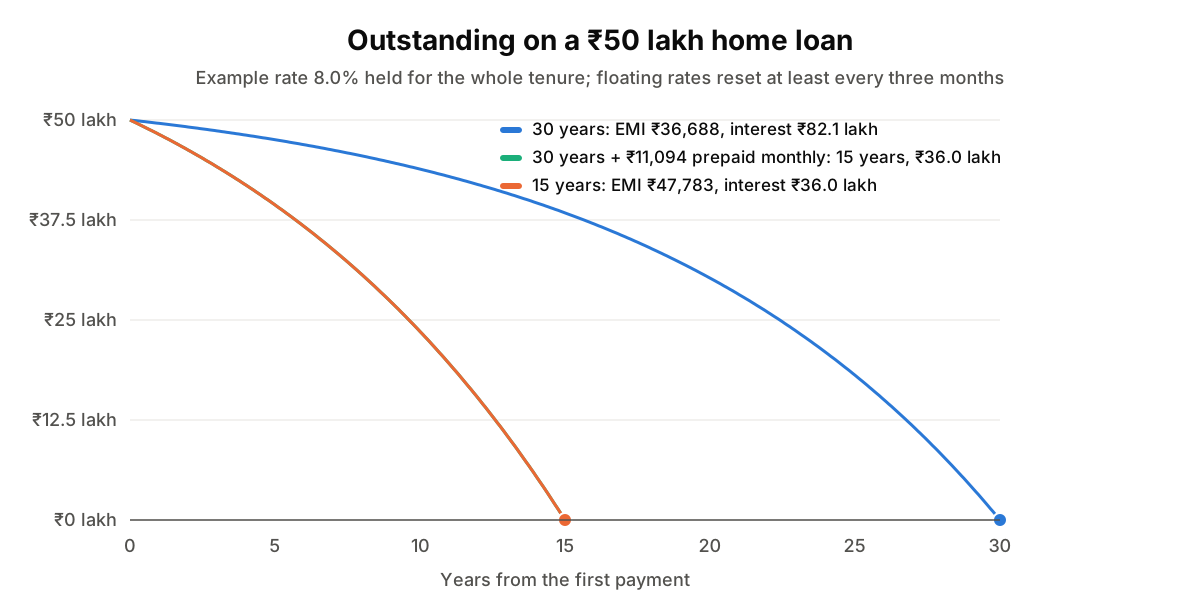
Lump sums work too. A single ₹5 lakh part-prepayment after two years on the 30-year loan, with the EMI unchanged, ends the loan in 268 months instead of 360 and cuts total interest to ₹53,19,619.07, about ₹28.9 lakh less. Ask the lender to reduce the tenure rather than the EMI after a prepayment if you want the larger saving.
The plan has two weaknesses. A 30-year EMI is the one that breaks first when rates rise, as the table above shows, and the prepayments only happen if you keep making them.
RBI rules on prepayment charges
Under the Reserve Bank of India (Pre-payment Charges on Loans) Directions, 2025, for floating-rate loans sanctioned or renewed on or after 1 January 2026:
- no regulated lender (banks, co-operative banks, NBFCs including housing finance companies) may charge a prepayment penalty on loans to individuals for purposes other than business;
- this applies whatever the source of the money, for part or full prepayment, with no minimum lock-in period;
- on a loan that combines fixed and floating periods, it depends on whether the loan is floating at the time you prepay;
- whether charges apply must be disclosed in the sanction letter, the loan agreement and the Key Facts Statement.
Fixed-rate home loans are outside that ban, so check the charges before you choose a fixed rate. Loans sanctioned before 2026 are covered by the earlier RBI circulars on foreclosure charges that the Directions list as repealed; check your loan agreement and KFS.
Tax: does a longer tenure save tax?
Only under the old regime. The Income Tax Department's FAQ confirms that under the new regime, the default since AY 2024-25, interest on borrowed capital for a self-occupied property is not deductible; you must opt out to the old regime to claim the deduction of up to ₹2,00,000 a year. On this loan first-year interest is about ₹3.9 lakh under every tenure, so the cap binds either way, and a longer tenure only keeps you near the cap for more years. Paying ₹46 lakh of extra interest to keep a deduction worth at most a fraction of ₹2 lakh a year rarely makes sense; confirm your own position with a tax adviser.
Which tenure fits
15 to 20 years suits you if the EMI fits with room for a rate rise of one or two points, and you want a rise to be absorbed by a longer tenure rather than a bigger EMI.
30 years suits you if you need the lower EMI to qualify or to keep a cash buffer, and you will prepay whenever you can. Keep an emergency fund, because a rate rise will push your EMI up rather than your tenure.
This guide covers floating-rate home loans to individuals. It does not fit business loans, loans against property or fixed-rate loans, and it ignores processing fees and insurance. Read the Key Facts Statement for the APR and all charges before you sign.
Tools for this job
- EMI Calculator: EMI, total interest and the month-by-month schedule in rupees for any rate and tenure, so you can read the outstanding balance at a reset.
For down payment limits, balance transfers and the KFS, read how home loans work in India. For why the early EMIs are mostly interest, see EMI and loan amortisation in India.
Frequently asked questions
Is a 30-year home loan better than 20 years?
It gives a lower EMI, ₹36,688.23 against ₹41,822.00 on ₹50 lakh at 8.0%, but costs about ₹31.7 lakh more interest if you only pay the EMI, and leaves no room for the tenure to stretch when rates rise. It works best if you prepay regularly.
Should I reduce EMI or tenure when the repo rate rises?
The RBI requires lenders to offer you the choice of a higher EMI, a longer tenure or both. Raising the EMI keeps the total interest down; stretching the tenure keeps the budget steady but costs more. On a long loan the tenure may not be stretchable at all, because the EMI must cover the interest.
Can the bank charge a penalty if I prepay my home loan?
Not on a floating-rate loan to an individual for a non-business purpose. The RBI's 2025 Directions bar prepayment charges on such loans sanctioned or renewed from 1 January 2026, for part or full prepayment from any source, with no lock-in.
Does prepaying reduce my tax benefit?
Under the old regime the interest deduction for a self-occupied home is capped at ₹2,00,000 a year, so prepaying reduces it only once your yearly interest falls below that cap. Under the default new regime there is no deduction for it at all.
Sources and further reading
- Reserve Bank of India (Pre-payment Charges on Loans) Directions, 2025, Reserve Bank of India. No prepayment charges on floating-rate loans to individuals for non-business purposes, from 1 January 2026.
- Reset of floating interest rate on EMI based personal loans, Reserve Bank of India. The choice of higher EMI, longer tenure or prepayment at reset, no negative amortisation, quarterly statements.
- Reserve Bank of India (Commercial Banks – Interest Rates on Advances) Directions, 2025, Reserve Bank of India. External benchmarks for floating-rate retail loans and resets at least every three months.
- Reserve Bank of India home page, Reserve Bank of India. Current policy repo rate.
- FAQs on new tax vs old tax regime, Income Tax Department. No interest deduction for a self-occupied property under the new regime; ₹2,00,000 under the old.