
25 vs 35 Year Mortgage Term UK: Repayments and Interest
The same UK mortgage over 25, 30 and 35 years: monthly repayment, interest, balance when the fix ends, and overpaying a 35-year term within your allowance.
By Redbison Dev · · 10 min read
United Kingdom edition. Written for UK borrowers: the choice is the mortgage term, not a 15- or 30-year fixed loan, with £ examples at the Bank of England's new-mortgage rate, two- and five-year fixes, early repayment charges and the Mortgage Charter. US edition
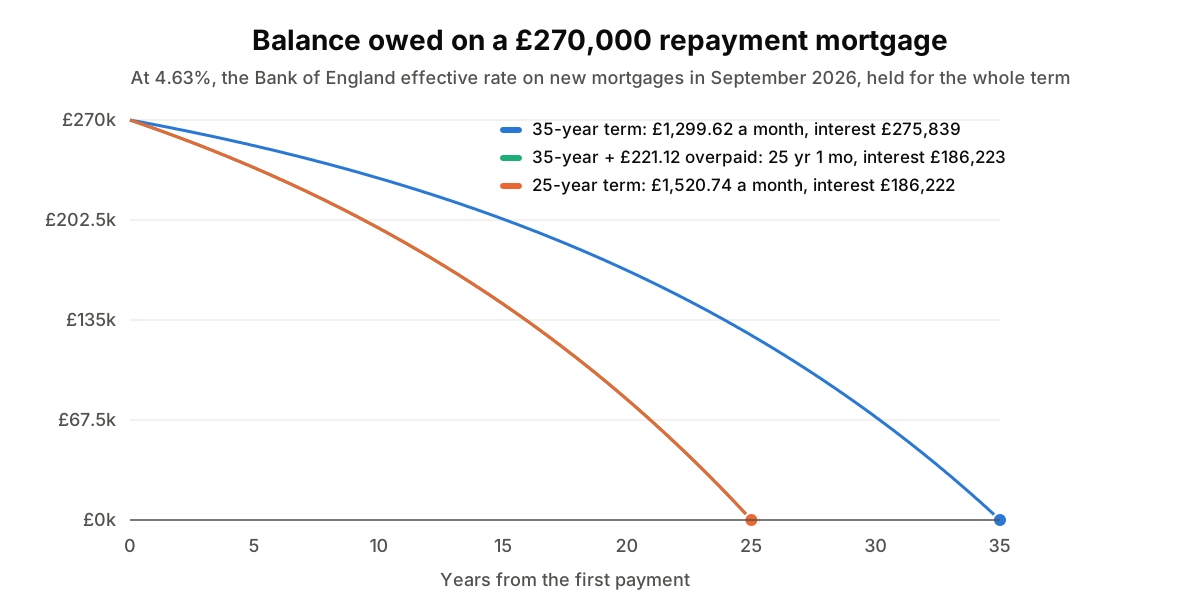
British borrowers do not choose between a 15-year and a 30-year fixed-rate loan, because UK fixes usually last two or five years and then end. What you do choose is the mortgage term: 25 years, or 30 or 35 years to bring the monthly repayment down. On a £270,000 repayment mortgage at 4.63%, stretching from 25 to 35 years cuts the repayment by £221.12 a month but adds £89,617 of interest if the rate stayed the same throughout. Take the 35-year term and overpay the difference, and you end up almost exactly where the 25-year borrower is, with the right to stop overpaying if money gets tight.
The figures come from the UK Mortgage Repayment Calculator, so you can repeat them with your own deal.
The term and the fix are different things
A UK mortgage has two dates on it:
- The term: how long until the loan is fully repaid, for example 25 or 35 years.
- The deal or initial rate period: how long the rate is fixed or discounted, usually two or five years. When it ends, the Financial Conduct Authority (FCA) explains, you automatically move onto the lender's reversion rate, often its standard variable rate (SVR), unless you arrange a new deal.
The examples below use the same rate for every term, because the deal you pick sets the rate for the fix, and the term only sets how fast the balance falls. If a lender quotes you a different rate for a longer term, enter that instead. With one rate, the cost of a longer term is the extra years of interest, not the higher rate on every pound that makes a US 30-year loan dearer than a 15-year one.
The same mortgage at 25, 30 and 35 years
The Bank of England's Money and Credit release puts the effective interest rate on newly drawn mortgages at 4.63% in September 2026. Use it as a realistic example; your rate depends on your deposit, the fix length and the lender.
Take a £300,000 house with a 10% deposit, a £270,000 mortgage at 90% LTV. In the mortgage calculator, enter a property price of 300000, a deposit of 10%, a rate of 4.63 and a mortgage term of 25, with council tax and insurance at 0 so you see the loan alone. Then change the term to 30 and 35.
| £270,000 at 4.63% | 25 years | 30 years | 35 years |
|---|---|---|---|
| Monthly repayment | £1,520.74 | £1,388.98 | £1,299.62 |
| Interest in the first five years | £58,975.83 | £59,946.60 | £60,605.05 |
| Balance when a five-year fix ends | £237,731.44 | £246,607.51 | £252,628.05 |
| Balance when a two-year fix ends | £257,979.44 | £261,285.92 | £263,528.67 |
| Interest over the whole term at 4.63% | £186,221.98 | £230,034.52 | £275,839.02 |
The last row assumes 4.63% for the whole term, which nobody can promise you. The row you can rely on is the balance when your fix ends: after five years the 35-year borrower has paid £13,267 less but owes £14,897 more, and that larger balance is what the next deal is priced on.
When the fix ends: the remortgage test
At the end of a five-year fix both borrowers remortgage with 20 or 30 years left. The new rate sets the new repayment:
| New rate after five years | 25-year term (20 years left) | 35-year term (30 years left) |
|---|---|---|
| 4.63% | £1,520.74 | £1,299.62 |
| 5.63% | £1,652.83 | £1,455.07 |
| 6.63% | £1,790.70 | £1,618.44 |
If rates are two points higher, the 25-year borrower's repayment rises by £269.96 a month; the 35-year borrower's is still £172.26 lower than that, and only £97.70 above the 25-year borrower's original repayment. That margin is what the longer term buys.
Lenders know this too. The FCA says that where a fixed rate lasts less than five years, the lender must check whether you could still afford the payments if rates rose: the stress test. A longer term lowers the repayment in that test, which is one reason 35-year terms help people borrow more. The Bank of England also limits how many new mortgages lenders can approve at 4.5 times income or more, so the term cannot stretch your borrowing without limit.
Paying a 35-year mortgage like a 25-year one
Take the 35-year term and overpay the difference. In the calculator, set the term to 35 and put 221.12 in Overpayment every month:
- The mortgage is repaid in 301 months, 25 years and 1 month, if 4.63% held throughout.
- Total interest is £186,222.83, 85p more than the 25-year term and £89,616 less than the 35-year term with no overpayments.
- After five years you owe £237,731.65, the same as the 25-year borrower to within 21p.
With the same rate on both, the 35-year route with overpayments costs almost nothing extra and leaves you a lower required repayment to fall back on. Two UK rules decide whether it works.
Early repayment charges and overpayment allowances
During a fixed or discounted deal, paying off more than your deal allows can trigger an early repayment charge (ERC). The FCA describes it as normally a percentage of the remaining balance that usually falls as you near the end of the deal, and notes that some lenders charge none. If your deal has an overpayment allowance, your mortgage offer states it and the charge for going over it.
Here the overpayment is £2,653.44 a year, just under 1% of the £270,000 starting balance. Check that your allowance covers it, and ask your lender how overpayments are treated if you move onto its reversion rate between deals.
Discipline
The plan only works if you keep overpaying. A 25-year term makes the higher repayment compulsory, which is the better choice if you know you would let a voluntary overpayment lapse.
Extending later instead of now
If you start on 25 years and money gets tight, you can ask to extend. The government's Mortgage Charter, signed by the principal UK lenders, lets borrowers who are up to date with payments extend their term to reduce monthly payments and revert to the original term within six months, without a new affordability check or an effect on their credit score. The FCA adds that a longer term increases the total you repay, and that if the extension runs past your expected retirement age your lender may carry out an affordability check.
That is the same question at the start: a long term that ends after you stop working needs a plan for repayments from pension income. If you are 35 now, a 35-year term runs to 70.
Which term fits
25 years suits you if the repayment fits comfortably at a rate two points higher than your deal, and you value being mortgage-free sooner without relying on your own discipline.
30 or 35 years suits you if you need the lower repayment to pass affordability, or you want a cushion and will overpay within your allowance when you can. Check where the term ends against your planned retirement.
This guide covers repayment mortgages. It does not fit interest-only or part-and-part mortgages, offset mortgages, or shared ownership, and it ignores stamp duty and fees. A mortgage broker or adviser regulated by the FCA can test your own numbers.
Tools for this job
- UK Mortgage Repayment Calculator: monthly repayments at any term, with monthly or yearly overpayments and the full repayment schedule.
- Remortgage Calculator: compare the repayment on your balance when your fix ends against a new deal and its fees.
- Mortgage Affordability Calculator: how the term and income multiple change what you can borrow.
For deposits, LTV bands and how a UK repayment is worked out, read how mortgages work in the UK. For why early repayments are mostly interest, see EMI and loan amortisation.
Frequently asked questions
Is a 35-year mortgage a bad idea?
Not on its own. On £270,000 at 4.63% it lowers the repayment by £221.12 a month compared with 25 years, but it costs £89,617 more interest if you only ever pay the minimum at that rate. Overpaying the difference within your allowance brings the total back to almost the 25-year figure.
Can I shorten my mortgage term later?
Usually yes, by asking your lender when you remortgage or by overpaying so the loan clears early. A formal change of term is a change to your mortgage, and the lender may check affordability for a shorter, more expensive term.
Will overpaying trigger an early repayment charge?
Only if you overpay more than your deal's allowance during a fixed or discounted period. The FCA says the charge is normally a percentage of the remaining balance and usually falls over the deal. Your mortgage offer states the allowance and the charge.
How much does a longer term lower my monthly repayment?
Less than people expect, because the extra years are mostly interest. At 4.63%, £270,000 costs £1,520.74 a month over 25 years, £1,388.98 over 30 and £1,299.62 over 35. The step from 30 to 35 years saves £89.36 a month and adds £45,805 of interest at a constant rate.
Sources and further reading
- Money and Credit, September 2026, Bank of England. Effective interest rate of 4.63% on newly drawn mortgages.
- Support with your mortgage and interest rates, Financial Conduct Authority. Reversion rates, the stress test for fixes under five years, term extensions and early repayment charges.
- Mortgage Charter, HM Treasury, GOV.UK. Term extensions with the option to revert within six months, and locking in a new deal up to six months ahead.
- Financial stability, Bank of England. The limit on new mortgages at 4.5 times income or more.
- Effective interest rates, September 2026, Bank of England. Table A: 4.63% on new secured lending to individuals.