
25 vs 30 Year Mortgage NZ: Repayments, Interest, Splits
A NZ$640,000 home loan over 20, 25 and 30 years, and how to pay a 30-year loan off in 25 with a floating split, within the extra-repayment limits on fixed rates.
By Redbison Dev · · 10 min read
New Zealand edition. Written for New Zealand borrowers: loan terms up to 30 years with short fixed periods, NZ$ examples, fixed and floating splits, break fees and the extra-repayment limits on fixed rates. US edition
New Zealanders do not pick between a 15-year and a 30-year fixed-rate loan, because no NZ bank fixes a rate for 30 years. Sorted, the Retirement Commission's money guide, says most mortgages here have a 25 to 30-year term, with most lenders allowing up to 30 years on a table loan, while the rate is fixed for anywhere from six months to five years at a time. So the real questions are which term to take and how to pay the loan off faster than the term, given that fixed rates limit extra repayments. On a NZ$640,000 loan at an example 5.0%, a 30-year term costs NZ$305.72 a month less than 25 years but NZ$114,424 more interest if the rate never changed. Put that NZ$305.72 back in as extra repayments and the 30-year loan finishes in 25 years.
The figures come from the Home Loan Repayment Calculator, so you can rerun them with your own rate.
How an NZ home loan is put together
Sorted describes six main mortgage types in Aotearoa: table loans (fixed repayments, the most common), revolving credit, offset, reducing balance, interest-only and split loans across fixed and floating rates. Two facts from it shape this comparison:
- The term is how long you have to repay the whole loan. "By increasing your repayment amounts, that term can shrink."
- The rate is set in pieces. Around 86% of borrowers choose fixed rates, Sorted says, with two-year fixes accounting for nearly half of new mortgages. At the end of each fix you re-fix or float.
That makes a US-style comparison misleading. A 30-year US loan usually carries a higher rate than a 15-year one; in New Zealand both terms get whatever fixed rate is on offer when you fix, so the term mostly decides how fast the balance falls.
The same loan at 20, 25 and 30 years
Take an NZ$800,000 home with a 20% deposit, the minimum Sorted says most lenders want, so you borrow NZ$640,000. In the mortgage calculator, enter a price of 800000, a deposit of 20%, an example rate of 5 and a term of 30, then change the term to 25 and 20. The 5.0% rate is only an example: check lenders' current carded rates before you rely on the numbers.
| NZ$640,000 at 5.0% | 20 years | 25 years | 30 years |
|---|---|---|---|
| Monthly repayment | NZ$4,223.72 | NZ$3,741.38 | NZ$3,435.66 |
| Balance after a two-year fix | NZ$600,784.26 | NZ$612,932.45 | NZ$620,632.24 |
| Interest over the term at 5.0% | NZ$373,692.02 | NZ$482,412.88 | NZ$596,837.02 |
The interest row assumes 5.0% for 30 years, which no NZ fix provides. The two-year balance is the useful figure: when the most popular fix ends, the 30-year borrower owes NZ$7,700 more than the 25-year borrower, and the next rate applies to that larger balance.
Paying a 30-year loan off in 25
Set the term to 30 and add 305.72 as an extra monthly repayment, the difference between the 25- and 30-year repayments:
- The loan clears in 300 months, exactly 25 years, if the rate held at 5.0%.
- Total interest is NZ$482,412.25, the same as the 25-year loan to within a dollar, and NZ$114,425 less than the 30-year loan without extras.
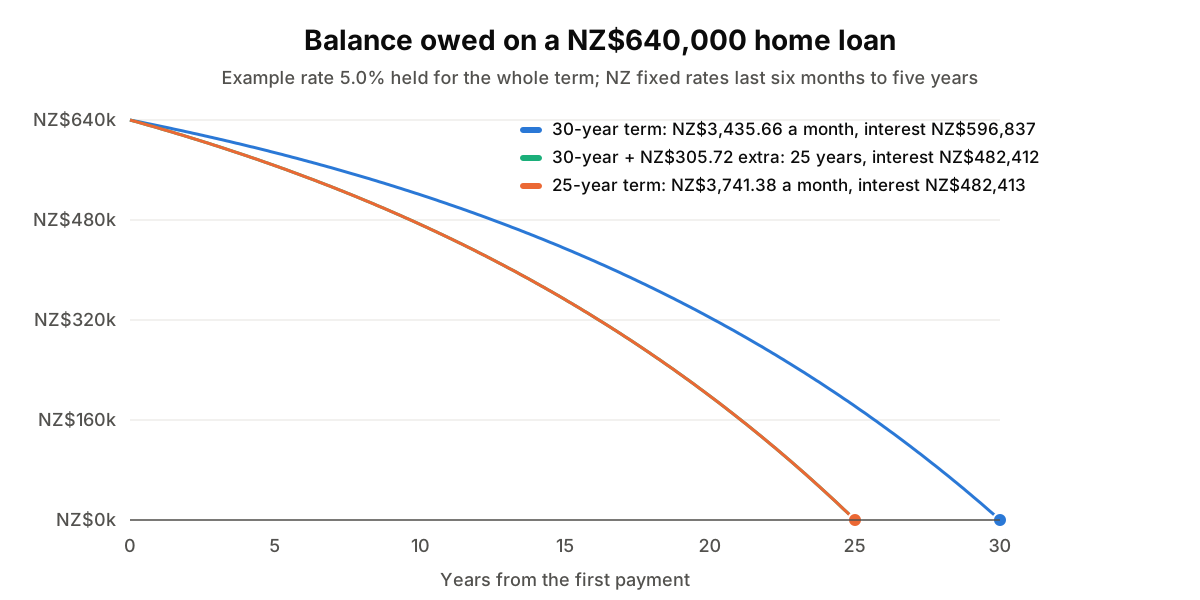
Because the rate does not depend on the term, the longer term with extra repayments costs nothing extra here, and you keep the right to fall back to the lower repayment. The catch is that extra money has to be allowed onto the loan.
Extra repayments on a fixed rate
Sorted is plain about the limits. Fixed rates "often have limits on how much you can raise repayments or make extra payments without paying charges", and breaking a fixed loan or selling can bring a break fee. It also notes that even on a fixed rate you can typically increase your repayments somewhat above the required amount without a penalty, and gives the example of a NZ$3,000 repayment that can be raised to NZ$3,500. Check your own lender's allowance.
Under the Credit Contracts and Consumer Finance Act, early repayment fees must be reasonable and cover costs closely related to the reason for the fee, such as losses from early repayment, and lenders cannot profit from them, according to Consumer Protection at MBIE. That limits the fee's size, but it can still be large when wholesale rates have fallen since you fixed.
In this example the extra NZ$305.72 is 8.9% of the 30-year repayment. If your fixed-rate allowance is smaller, the usual NZ answer is a split.
The split: fixed for certainty, floating for extra repayments
Sorted explains that you can split a loan between fixed and floating rates and make extra repayments without a charge on the floating portion; many New Zealanders do this. Here is the NZ$640,000 loan split in two, both on 30-year terms:
| Portion | Example rate | Required monthly repayment |
|---|---|---|
| NZ$540,000 fixed | 5.0% | NZ$2,898.84 |
| NZ$100,000 floating | 5.9% | NZ$593.14 |
| Total | NZ$3,491.97 |
The floating rate here is an example 0.9 points above the fixed rate; Sorted notes floating rates have historically been higher than fixed. Now put the same extra NZ$305.72 a month on the floating portion only:
- The floating NZ$100,000 is cleared in 162 months, 13 years and 6 months.
- Its interest falls from NZ$113,529.14 to NZ$45,119.66.
- At that point the fixed portion still owes NZ$390,308.59, and your whole required repayment plus the extra can go towards it at the next re-fix.
Keep the floating slice no larger than the extra repayments and lump sums you expect to make while fixed, since it usually costs more. When a fix ends, you can also re-fix with a shorter remaining term or a higher repayment.
Revolving credit and offset
Two NZ structures do the same job without a set repayment. A revolving credit loan works like a large overdraft that your pay goes into; because interest is calculated daily, keeping the balance low saves interest, but Sorted warns it needs discipline. An offset mortgage links your savings and everyday accounts to the loan and charges interest only on the difference, for example on NZ$380,000 if you owe NZ$400,000 and hold NZ$20,000. Both usually sit on floating rates, so compare their rate with your fixed options.
Which term fits
25 years or less suits you if the repayment fits comfortably at a rate a couple of points above your fix, and you would rather be forced to repay faster than rely on extra repayments.
30 years suits you if you need the lower required repayment, for example to pass a lender's affordability test, and you have a plan for the difference: a floating split, a revolving credit facility, or raising repayments at each re-fix.
This guide covers owner-occupied table loans. It does not fit interest-only investor loans or loans in hardship. If repayments become hard to meet, MBIE's Consumer Protection explains your right to apply for hardship changes under the CCCFA. A mortgage adviser can compare lenders for you; Sorted notes that brokers are often paid by the lenders, so ask how yours is paid.
Tools for this job
- Home Loan Repayment Calculator: repayments at any term, with extra monthly or yearly repayments and the full schedule. Run each portion of a split as its own loan.
- Mortgage Refinance Calculator: whether moving lender or breaking a fix pays back the break fee and costs.
For how a repayment is worked out and what changes at each re-fix, read how mortgages work in New Zealand. For why early repayments are mostly interest, see EMI and loan amortisation.
Frequently asked questions
Is a 30-year mortgage a bad idea in NZ?
Not if you use the flexibility. On NZ$640,000 at 5.0%, the 30-year term costs NZ$114,424 more interest than 25 years if you pay only the minimum, but adding the NZ$305.72 difference clears it in 25 years at the same total cost.
Can I make extra repayments on a fixed home loan?
Usually up to a limit. Sorted notes that fixed rates often limit extra repayments and that you can typically raise your repayment somewhat without a penalty; above the limit a break fee can apply. Check the allowance with your lender, or keep part of the loan floating.
How much of my loan should be floating?
Enough to take the extra repayments and lump sums you expect before your fix ends, and no more, because floating rates have historically been higher. In the example, NZ$100,000 floating with NZ$305.72 extra a month is cleared in 13 years and 6 months.
Does a shorter term get a better interest rate in NZ?
Not in the way US loans do: NZ lenders quote fixed rates by fixed period, from six months to five years, rather than by the length of the loan. The term changes the repayment and how fast the balance falls; the fixed period and the lender decide the rate.
Sources and further reading
- Types of mortgages in New Zealand, and how to choose, Sorted, Te Ara Ahunga Ora Retirement Commission. Terms up to 30 years, fixed periods, splits, revolving credit and offset loans.
- How to manage your mortgage and pay off your home loan early, Sorted. Raising repayments on a fixed rate and paying half the monthly amount each fortnight.
- How much can we borrow?, Sorted. Lending up to 80% of value and the costs of a higher loan-to-value ratio.
- Mortgages and home loans, Consumer Protection, MBIE. Loan structures, break fees and hardship.
- Credit Contracts and Consumer Finance Act, Consumer Protection, MBIE. Early repayment fees must be reasonable and lenders cannot profit from fees.