
ETF MERs, Distributions and US Withholding Tax in Canada
What MERs, reinvested distributions, US withholding tax and inflation do to a monthly ETF plan in a TFSA, RRSP or taxable account over 25 years, in CA$.
By Redbison Dev · · 6 min read
Canada edition. Written for Canadian investors: CA$ amounts, the management expense ratio (MER), the 2026 TFSA dollar limit, US withholding tax under the Canada-US tax treaty, adjusted cost base on reinvested distributions, and the Bank of Canada's 2% target. US edition
Put CA$500 a month into an equity ETF for 25 years and assume 6% a year before fees. With no fee it would reach CA$339,063. At a 0.06% MER it reaches CA$336,114; at 0.25%, CA$326,965; at 1%, CA$293,522; at 2%, CA$254,873. The same CA$150,000 goes in every time, and the 2% plan ends CA$84,190 behind the no-fee case after paying CA$52,436 in fees.
For Canadians the fee is only part of the picture: where the ETF sits, TFSA, RRSP or a non-registered account, decides whether US dividends lose 15% to withholding tax and whether distributions are taxed every year. This edition works through each with the Canadian ETF investment calculator. It uses steady returns to show the mechanics, not a forecast, and a fee-only planner or tax professional can weigh the accounts for your income.
The MER and what it costs over 25 years
A Canadian ETF's management expense ratio comes out of the fund's assets, so its published returns are already net of it. The calculator treats your return as before fees and deducts the MER from the average balance each year:
| MER | Value after 25 years | Fees deducted | Lost against no fee |
|---|---|---|---|
| 0% | CA$339,063 | CA$0 | CA$0 |
| 0.06% | CA$336,114 | CA$1,880 | CA$2,949 |
| 0.25% | CA$326,965 | CA$7,694 | CA$12,098 |
| 1.0% | CA$293,522 | CA$28,704 | CA$45,541 |
| 2.0% | CA$254,873 | CA$52,436 | CA$84,190 |
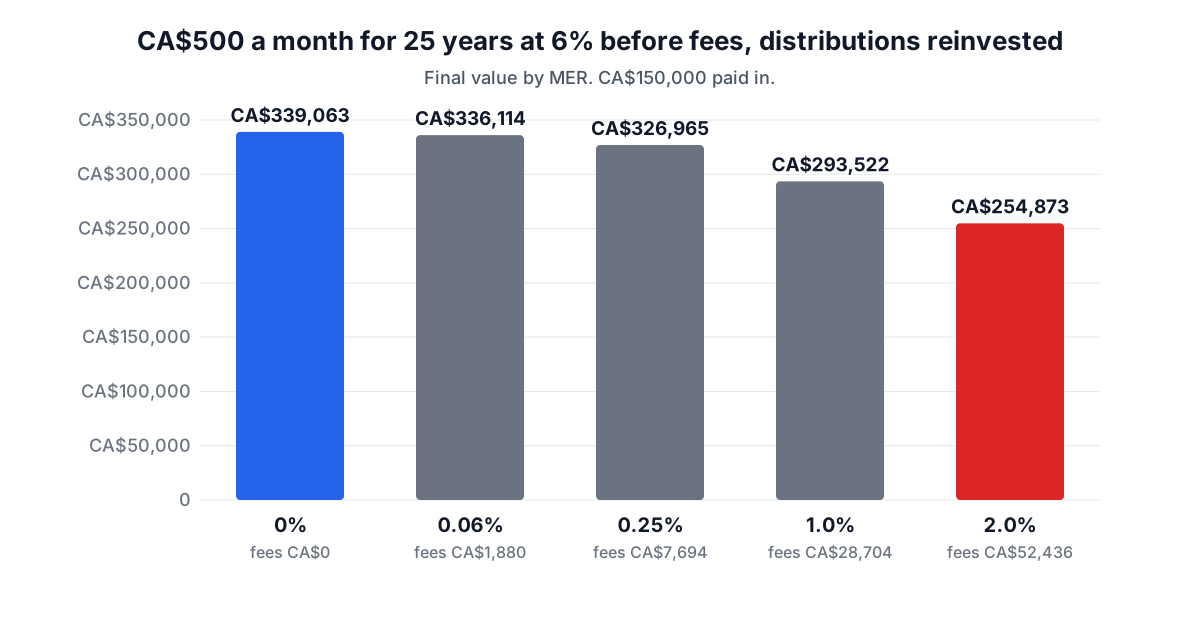
The lost value is about 1.6 times the fees paid, because every dollar of fee also stops compounding. Among low-cost index ETFs the differences are small; the big jump is from a fraction of a percent to a full percent or more. If your brokerage charges commissions, add them as a percentage to the MER box to see the all-in cost, and do not subtract an MER from a fund's published return, which already includes it.
US withholding tax: the hidden fee
Article X of the Canada-US tax treaty caps US tax on dividends paid to a Canadian resident at 15% of the gross dividend, for anyone holding less than 10% of the company. Article XXI(2) exempts dividends received by a trust or other entity operated exclusively to provide pension or retirement benefits. The US Treasury's technical explanation of the treaty names RRSPs and RRIFs as eligible, provided they are operated exclusively to provide pension, retirement or employee benefits. A TFSA is not named, so do not count on the exemption there: plan on US dividends paid into a TFSA losing up to 15% that cannot be recovered.
Model it as an extra fee. Take a US-equity ETF with a 1.5% yield inside the 6% return and a 0.06% MER. Losing 15% of a 1.5% yield costs 0.225% a year:
| Where the US ETF is held | Effective yearly cost | Value after 25 years |
|---|---|---|
| RRSP, US-listed ETF held directly (treaty exemption) | 0.06% | CA$336,114 |
| TFSA (15% withheld on the dividends) | 0.285% | CA$325,311 |
That is CA$10,803 over 25 years on CA$150,000, more than three times what the 0.06% MER itself costs (CA$2,949 against no fee). Note who receives the dividends: the exemption belongs to the retirement trust that owns the US shares. When a Canadian-listed ETF holds the US shares, the fund is the shareholder, so the withholding is taken inside the fund whatever account you hold the ETF in. The tool does not deduct any of this automatically; lower the yield or add to the MER to model it.
TFSA, RRSP or non-registered
TFSA. The dollar limit for 2026 is CA$7,000, the same as for 2024 and 2025. Unused room carries forward, and a withdrawal comes back as new room on 1 January of the following year. CA$500 a month uses CA$6,000 of a year's limit. Canadian-dividend and growth returns grow tax-free; US dividends lose the withholding above.
RRSP. Contributions are deducted now and withdrawals taxed later as income. The treaty exemption makes it the natural home for US-listed ETFs held directly.
Non-registered. Distributions are taxed in the year they are paid, even when reinvested, and are reported on your T3 or T5 slip. Eligible Canadian dividends get the gross-up and dividend tax credit; foreign income does not. Each reinvested distribution raises your adjusted cost base. The CRA's capital gains guide (T4037, chapter 3) has a worked example of a fund bought at CA$18.00 a unit where reinvested distributions at CA$19.55 lift the average cost to CA$18.10. Without those additions you would be taxed twice on the same money, so keep the records.
Reinvesting distributions or taking the cash
At a 2% yield and a 0.25% MER, CA$500 a month for 25 years reaches CA$326,965 with distributions reinvested, and CA$61,553 of distributions are paid along the way. The calculator's "Reinvest Dividends" switch shows the alternative: taking them as cash leaves the holding smaller and the cash outside the plan. If your brokerage offers a DRIP on ETFs, check whether it buys whole units only; any leftover cash then sits uninvested until the next payment.
Inflation: today's dollars
The Bank of Canada targets 2% inflation, the midpoint of a 1% to 3% range, and the framework has been renewed for January 2027 to December 2031. Over 25 years at 2%, prices rise by a factor of 1.02^25, or 1.641. The 0.25% plan's CA$326,965 is about CA$199,295 at today's prices; the 2% plan's CA$254,873 is about CA$155,353. Compare any retirement target in the same terms.
Common mistakes
- Holding US-dividend ETFs in a TFSA without counting the withholding. It acts like an extra 0.2% to 0.3% fee on a typical US yield.
- Double counting the MER by subtracting it from a published return.
- Forgetting ACB on reinvested distributions in a non-registered account.
- Over-contributing to a TFSA by assuming a withdrawal frees room the same year; it comes back on 1 January.
Tools for this job
- The Canadian ETF investment calculator runs the MER, withholding and inflation scenarios above.
- The Canadian dividend calculator applies the gross-up and dividend tax credit to a Canadian holding, explained in the Canadian dividend yield guide.
- The Canadian compound interest calculator compares the same savings in a GIC.
- The Canadian retirement calculator and the Canadian FIRE planner set the result against a spending target, and the Canadian retirement savings guide covers RRSP and TFSA together.
Frequently asked questions
Do I pay US withholding tax on ETFs in my TFSA?
On US dividends, yes, up to 15% under Article X of the Canada-US treaty, and it cannot be recovered in a TFSA. The Article XXI(2) exemption covers arrangements operated exclusively to provide pension, retirement or employee benefits. The US Treasury's technical explanation names RRSPs and RRIFs as eligible, which is why US-listed ETFs held directly in an RRSP avoid the withholding; a TFSA is not named.
How much does a 1% MER cost over 25 years?
On CA$500 a month at 6% before fees, a 1% MER ends at CA$293,522 against CA$336,114 at 0.06%, a gap of CA$42,592 on CA$150,000 contributed.
Are reinvested ETF distributions taxable?
In a non-registered account, yes, in the year they are paid, and they are reported on your T3 or T5. Each reinvestment adds to your adjusted cost base. In a TFSA or RRSP nothing is reported when they are paid.
What is the TFSA limit for 2026?
CA$7,000, the same as for 2024 and 2025. Unused room carries forward, and withdrawals are added back on 1 January of the next year; CRA My Account shows your exact room.
Sources and further reading
- TFSA: calculate your contribution room, Canada Revenue Agency. The CA$7,000 limit for 2026 and how room carries forward.
- Canada-United States tax convention (consolidated), Department of Finance Canada. Article X (15% limit) and Article XXI(2) (pension and retirement trusts).
- Technical explanation of the Canada-US tax convention and protocols, US Department of the Treasury. Article 10 of the 1995 Protocol: RRSPs and RRIFs eligible under Article XXI(2).
- T4037, Capital Gains 2025, Canada Revenue Agency. Chapter 3, reinvested distributions and adjusted cost base.
- Inflation-control target, Bank of Canada. The 2% target and its renewal to 2031.
- T4015, T5 Guide, Canada Revenue Agency. How dividends are reported each year.
- Expense ratio, US Securities and Exchange Commission. How ongoing fund costs reduce returns.
Open the ETF Investment Simulator
More Analysis Tools
Every tool in the Analysis Tools section, free and in your browser.