
Column Buckling to CSA S16: Euler Load to Cr for HSS Columns
From the Euler load to the CSA S16 factored compressive resistance Cr: λ, the n = 1.34 and 2.24 curves for Class C and Class H HSS, and the CISC worked example.
By Redbison Dev · · 11 min read
Canada edition. Canadian edition built on CSA S16 clause 13.3.1 (n = 1.34 or 2.24), CSA G40.21 350W HSS in Class C and Class H, and the Canadian Institute of Steel Construction's worked example. US edition
A steel column in Canada is designed to CSA S16, and the number that goes on the calculation is the factored compressive resistance Cr from clause 13.3.1, not the Euler load. Euler's formula is still the first step, because it gives the elastic buckling stress Fe that sets the slenderness parameter λ. S16 then reduces the squash load with a single formula whose exponent n depends on how the section was made. For the Canadian Institute of Steel Construction's own example, an HSS 203 × 203 × 6.4 Class C in 350W steel over 4.8 m, the Euler load is 2,680 kN and Cr is 1,112 kN.
This edition follows that chain with the Column Buckling Calculator (CSA S16), which shows Fe, λ, n, Cr/A and Cr and reproduces the CISC example. The American version of this article, built on AISC 360, is here.
Where S16 sits in the building code
The National Building Code of Canada, Part 4, calls up CSA S16 for structural steel, and the provincial codes adopt it the same way. The British Columbia Building Code, for instance, says in Article 4.3.4.1 that buildings and structural members made of structural steel shall conform to CSA S16. Check which edition of S16 your province's current code references, since the factors below have been stable but clause numbers can move between editions.
Step 1: Euler's elastic buckling stress
For a pin-ended column:
Fe = π² E / (KL / r)²
S16 uses E = 200,000 MPa. For the CISC example, A = 4,900 mm² and r = 79.9 mm, so I = A r² = 3,128 cm⁴. Over KL = 4,800 mm:
- KL/r = 4,800 / 79.9 = 60.1.
- Fe = π² × 200,000 / 60.1² = 546.9 MPa.
- Euler load = 546.9 × 4,900 = 2,680 kN.
Fe is far above the 350 MPa yield stress. A column that stocky would yield long before it buckled elastically, which is why Euler alone overstates its capacity.
Step 2: effective length
The K factor converts actual length to effective length. Theoretical values are 0.5 (both ends fixed), 0.7 (fixed and pinned), 1.0 (pinned) and 2.0 (flagpole). In practice, columns in braced frames are usually designed with K = 1.0, because real end connections rarely give the full theoretical fixity. Columns in sway frames need K above 1.0, or a second-order analysis with notional loads under S16's stability requirements.
Bracing is the cheapest way to add capacity. Using K = 0.8 on the CISC column (KL/r = 48.1) raises Cr from 1,113 to 1,267 kN; adding a brace that halves the unbraced length does much more.
Step 3: λ and the S16 resistance formula
λ  = √(Fy / Fe)
Cr = φ A Fy (1 + λ²ⁿ)^(−1/n)
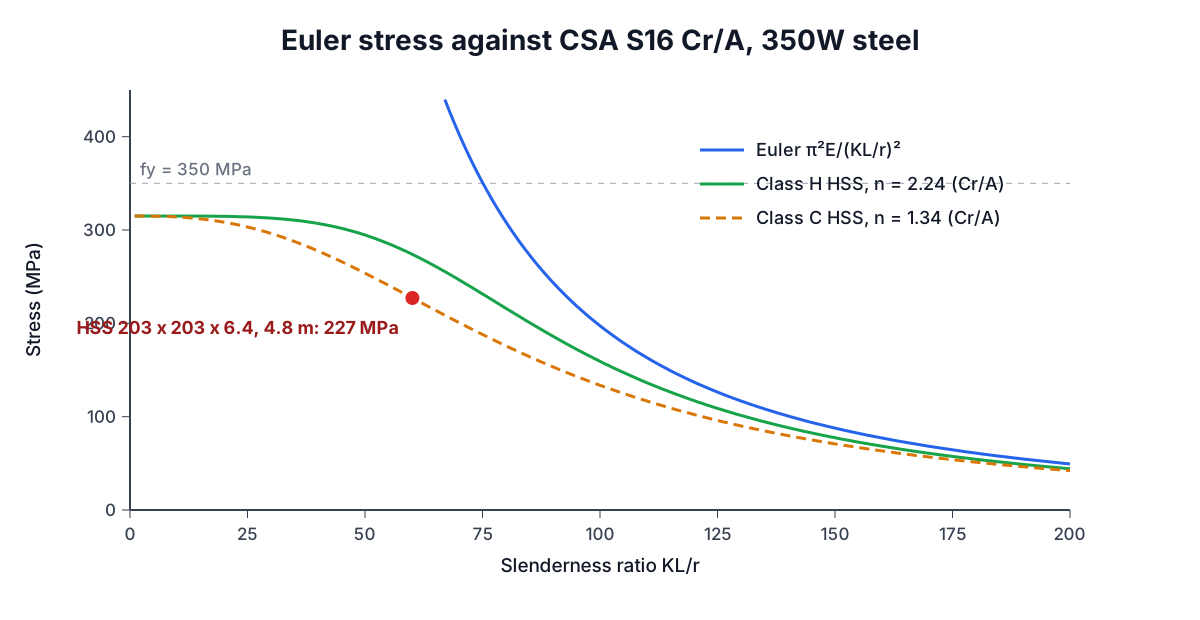
where φ is the resistance factor for steel that S16 sets; take its value from the standard. The calculator applies it, and its result for this column matches CISC's tabulated 227 MPa (below). For the example, λ = √(350 / 546.9) = 0.80.
The exponent n captures residual stress and initial crookedness:
| n | Applies to (CISC tables) |
|---|---|
| 1.34 | Hot-rolled and fabricated shapes; HSS to CSA G40.21 Class C (cold-formed non-stress-relieved), ASTM A500 or ASTM A1085 (Table 4-3) |
| 2.24 | HSS to CSA G40.21 Class H (hot-formed, or cold-formed stress-relieved) and doubly symmetric welded three-plate members with oxy-flame-cut flange edges (Table 4-4) |
A higher n gives a curve that stays closer to Fy at moderate slenderness, because those sections carry less residual stress.
Worked example: the CISC column, Class C and Class H
Enter I = 3,128 cm⁴ and A = 49.0 cm² directly, K = 1.0, L = 4.8 m, Fy = 350 MPa, E = 200 GPa, code CSA S16:
| Class C (n = 1.34) | Class H (n = 2.24) | |
|---|---|---|
| KL/r | 60.1 | 60.1 |
| λ | 0.80 | 0.80 |
| Cr/A | 227.1 MPa | 273.9 MPa |
| Cr | 1,113 kN | 1,342 kN |
CISC's Table 4-3 gives Cr/A = 227 MPa and Cr = 227 × 4,900 = 1,112 kN; the calculator's 1,113 kN differs only by rounding. Ordering the same size in Class H gives 21% more resistance. On a drawing, "HSS 203×203×6.4" says nothing about the class, so specify it, and check the mill certificate before substituting.
The Euler load of 2,680 kN is 2.4 times Cr. Treating Euler as a design value would be badly unconservative.
How length erodes Cr
The same HSS 203 × 203 × 6.4 Class C, pinned, at increasing lengths:
| L | KL/r | Cr |
|---|---|---|
| 4.8 m | 60.1 | 1,113 kN |
| 6.0 m | 75.1 | 920 kN |
| 8.0 m | 100.1 | 654 kN |
| 12.0 m | 150.2 | 346 kN |
| 16.0 m | 200.3 | 206 kN |
At 6.0 m the Class H version still gives 1,133 kN, about the same as the Class C column at 4.8 m. At 16 m the column has passed a KL/r of 200, beyond the range of CISC's unit-resistance tables (KL/r 1 to 200). Check the slenderness limit in S16 itself before relying on a member this slender.
A smaller column: HSS 102 × 102 × 6.4
A common post size for canopies, mezzanines and storage racks. Taking a sharp-cornered section (A ≈ 2,419 mm², r = 38.97 mm) over 3 m, pinned, KL/r = 77.0:
- Class C: Cr = 443 kN.
- Class H: Cr = 545 kN.
Published HSS tables give a slightly smaller area because of the rounded corners, so use the tabulated A and r for the final check by choosing "Enter I and A directly".
Common mistakes
- Using E = 210 GPa from a European reference. S16 uses 200,000 MPa.
- Applying φ twice. The resistance factor is built into Cr; adding another safety factor double-counts.
- Assuming Class H when the supplier ships Class C. Class C is the usual cold-formed product, so design for it unless Class H is specified and confirmed.
- Checking only one axis of a W-shape. W columns usually buckle about the weak axis unless it is braced at closer spacing.
- Ignoring slender walls. HSS with high width-to-thickness ratios are Class 4 and need a reduced effective area.
- Ignoring bending. Eccentric beam connections and lateral load make the member a beam-column, checked with S16's interaction equations.
Tools for this job
- Column Buckling Calculator (CSA S16): Fe, λ, n, Cr/A and Cr alongside the Euler load, for HSS, pipe, solid and custom sections.
- Section Properties Calculator: A, I and r for shapes not in the tables; see the guide to moment of inertia and section modulus.
- Beam Deflection Calculator: the beams that load the column; see the beam deflection formulas guide.
- Steel Weight Calculator: member self-weight.
These calculations are for preliminary sizing. Columns support everything above them, so the final design should be sealed by a professional engineer licensed in your province, to CSA S16 and the building code that applies.
Frequently asked questions
What is the CSA S16 formula for compressive resistance?
Cr = φ A Fy (1 + λ²ⁿ)^(−1/n), with φ the S16 resistance factor, λ = √(Fy / Fe), Fe = π² E / (KL/r)² and n = 1.34 or 2.24. For an HSS 203 × 203 × 6.4 Class C over 4.8 m in 350W, Cr = 1,112 kN.
When do I use n = 2.24 instead of 1.34?
For HSS made to CSA G40.21 Class H and for doubly symmetric welded three-plate members with flame-cut flange edges (CISC Table 4-4). Hot-rolled shapes and Class C, A500 or A1085 HSS use n = 1.34 (Table 4-3).
What is the maximum slenderness ratio for a steel column in Canada?
CISC's unit-resistance tables for S16 cover KL/r from 1 to 200. Check the slenderness limit for compression members in CSA S16 itself.
Why is Cr so much lower than the Euler load?
Euler assumes a perfectly straight, centrally loaded column with no residual stress. S16's curve reflects tests on real members, and the resistance factor φ reduces it further. For the CISC example Cr is about 42% of the Euler load.
Sources and further reading
- A useful engineering tool to quickly calculate the compressive resistance of compression members, Canadian Institute of Steel Construction. Tables 4-3 (n = 1.34) and 4-4 (n = 2.24) of unit factored resistance Cr/A to S16-14 clause 13.3.1, for KL/r 1 to 200; HSS 203 × 203 × 6.4 example, Cr = 1,112 kN.
- National Building Code of Canada, National Research Council Canada. Part 4, structural design.
- British Columbia Building Code 2018, Section 4.3, Province of British Columbia. Article 4.3.4.1: structural steel shall conform to CSA S16.
- Methodus inveniendi lineas curvas, Euler Archive, University of the Pacific. Euler's 1744 buckling work.
- Solid Mechanics (course 1.050), MIT OpenCourseWare. Elastic stability lecture notes.
Open the Column Buckling Calculator
More Civil & Structural
Every tool in the Civil & Structural section, free and in your browser.