
Column Buckling to Eurocode 3: Euler, λ̄ and Curves a to d
From the Euler load to the BS EN 1993-1-1 buckling resistance Nb,Rd: λ̄, the buckling curves, χ and γM1 = 1.0 under the UK National Annex, worked in S355.
By Redbison Dev · · 11 min read

United Kingdom edition. UK edition built on BS EN 1993-1-1 clause 6.3.1 with the UK National Annex (γM1 = 1.0), E = 210 GPa, S355 hollow sections to EN 10210 and EN 10219, and Blue Book section data. US edition
A steel column in the UK is designed to BS EN 1993-1-1 with its UK National Annex, and the answer you take to a calculation sheet is the flexural buckling resistance Nb,Rd = χ A fy / γM1, not the Euler load. Euler's formula still starts the job, because it gives the elastic critical force Ncr that sets the non-dimensional slenderness λ̄. A buckling curve then turns λ̄ into the reduction factor χ. For a 100 × 100 × 5 SHS in S355 over 3.5 m with pinned ends, Euler says 485 kN, but Nb,Rd is 299 kN cold-formed and 366 kN hot-finished.
This edition works through that chain with the Column Buckling Calculator (UK, Eurocode 3), which shows Ncr, λ̄, the curve, χ and Nb,Rd. The American version of this article, built on AISC 360 and the Johnson parabola, is here.
Step 1: the elastic critical force Ncr
For a perfectly straight, pin-ended column the elastic buckling load is
Ncr = π² E I / Lcr²
where Lcr is the buckling length. Eurocode 3 takes E = 210,000 N/mm² for structural steel (the modulus steelconstruction.info lists for structural steel), about 5% stiffer than the 200 GPa in American tables, so every Euler load in this edition is 5% higher than the same column in the US version.
Use the minor-axis second moment of area unless the minor axis is restrained. For a square hollow section both axes are the same, which is one reason SHS and CHS are efficient columns.
For our 100 × 100 × 5 SHS, taking a sharp-cornered section: A = 1,900 mm², I = 2.866 × 10⁶ mm⁴, i = 38.84 mm. Over 3.5 m:
Ncr = π² × 210,000 × 2.866 × 10⁶ / 3,500² = 484.9 kN
Real rolled hollow sections have rounded corners, so their tabulated area and inertia are a little lower. For a final check, enter the Blue Book values with "Enter I and A directly".
Step 2: buckling length
Eurocode 3 leaves Lcr to the designer. For a column in a braced frame, UK practice usually takes Lcr equal to the storey height between restraints, sometimes reduced where the end connections provide real rotational restraint. The theoretical values for idealised ends are:
| End conditions | Theoretical K | Effect on Ncr against pinned |
|---|---|---|
| Both ends fixed | 0.5 | × 4 |
| One fixed, one pinned | 0.7 | × 2.04 |
| Both pinned | 1.0 | × 1 |
| Cantilever (flagpole) | 2.0 | × 0.25 |
Because Ncr falls with the square of Lcr, bracing is the most powerful lever you have. Take the same SHS over 7 m: Ncr drops to 121.2 kN and Nb,Rd (cold-formed) to 99.1 kN. Add a brace at mid-height about both axes and each half is a 3.5 m column again, at 299.3 kN, three times the capacity for one restraint.
Step 3: non-dimensional slenderness λ̄
Eurocode 3 compares the squash load with the elastic critical force:
λ̄ = √(A fy / Ncr) = (Lcr / i) / λ1
steelconstruction.info gives λ1 = 86 for S275 and 76 for S355. Our SHS gives λ̄ = √(1,900 × 355 / 484,900) = 1.179; with the rounded λ1, Lcr/i = 90.12 gives 90.12 / 76 = 1.19, the same to two figures. Clause 6.3.1.2(4) lets you ignore flexural buckling when λ̄ ≤ 0.2 or NEd / Ncr ≤ 0.04; above that, the reduction factor applies.
Step 4: the buckling curve and χ
Real columns are slightly bent, carry residual stresses from rolling, welding or cold-forming, and are never loaded exactly through the centroid. Eurocode 3 covers this with buckling curves, each with an imperfection factor α. For S275 and S355, the curves and factors are:
| Curve | a | b | c | d |
|---|---|---|---|---|
| α | 0.21 | 0.34 | 0.49 | 0.76 |
Table 6.2 picks the curve from the section type. For hollow sections in S275 and S355, the manufacturing route decides it: hot-finished (dimensions to BS EN 10210-2) is curve a, cold-formed (BS EN 10219-2) is curve c. Rolled I-sections are on a, b, c or d depending on the axis, the h/b ratio and the flange thickness. For S460, consult Table 6.2 itself.
Then:
Φ = 0.5 [1 + α (λ̄ − 0.2) + λ̄²]
χ = 1 / (Φ + √(Φ² − λ̄²))    and χ ≤ 1.0
Nb,Rd = χ A fy / γM1
The UK National Annex to BS EN 1993-1-1 gives γM1 = 1.00 for member buckling checks, so there is no further reduction once χ is known.
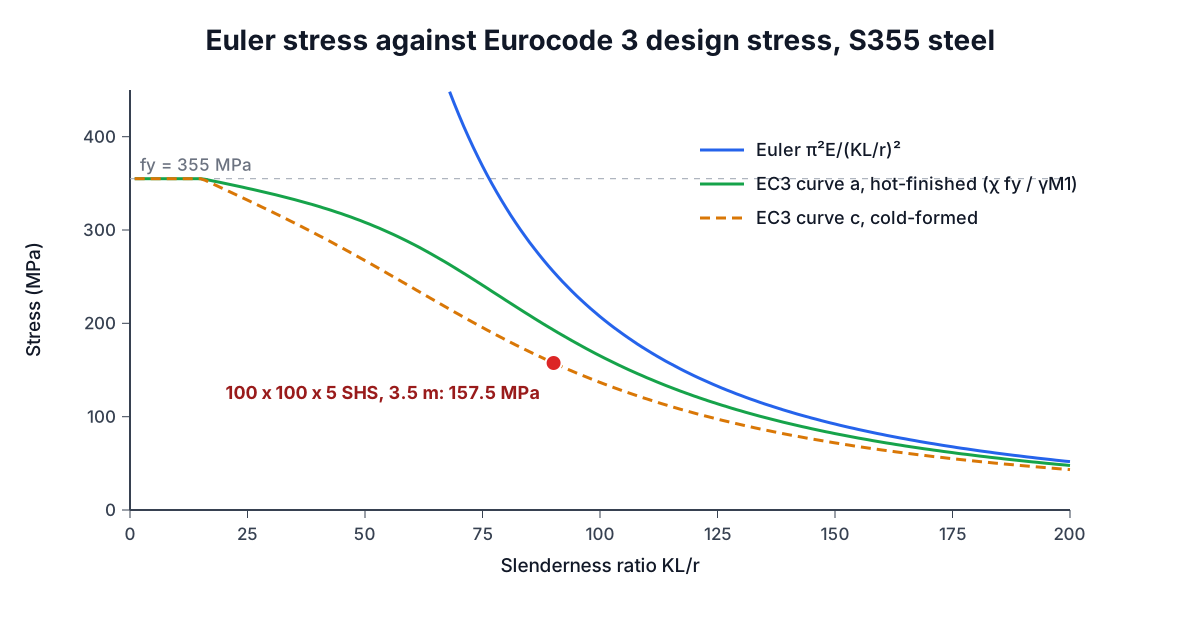
Worked example: the same SHS, two product standards
With the calculator set to Eurocode 3, enter a 100 × 100 × 5 SHS, 3.5 m, K = 1.0, E = 210 GPa and fy = 355 MPa:
| Step | Cold-formed, EN 10219 | Hot-finished, EN 10210 |
|---|---|---|
| Ncr | 484.9 kN | 484.9 kN |
| λ̄ | 1.179 | 1.179 |
| Curve and α | c, 0.49 | a, 0.21 |
| χ | 0.444 | 0.543 |
| χ fy | 157.5 MPa | 192.8 MPa |
| Nb,Rd | 299.3 kN | 366.3 kN |
Same size, same steel grade, same length, and the hot-finished tube carries 22% more. On a drawing an "SHS 100 × 100 × 5" does not say which it is, so specify the standard, and check delivery notes before swapping one for the other on site.
Euler's 484.9 kN is 1.6 times the cold-formed resistance. That gap is the imperfection allowance, and it is why the elastic load is never a design value.
A circular hollow section
A 114.3 × 5 CHS in S355 over 3 m, pinned:
- A = 1,717 mm², i = 38.68 mm, Lcr/i = 77.55, λ̄ = 1.015.
- Cold-formed, curve c: χ = 0.531, Nb,Rd = 323.8 kN.
- Hot-finished, curve a: χ = 0.655, Nb,Rd = 399.3 kN.
The gain from the better curve is largest at moderate slenderness, between about λ̄ 0.6 and 1.4, where imperfections and residual stress matter most. At very high slenderness all the curves converge on Euler, as the chart shows.
Grade: S275 or S355?
The same cold-formed SHS over 3.5 m in S275 gives λ̄ = 1.04, χ = 0.518 and Nb,Rd = 270.7 kN, against 299.3 kN in S355. That is 10.6% more resistance for 29% more yield strength, because a slender column's capacity depends on stiffness, and E is the same for both grades. The stockier the column, the more a higher grade pays.
Common mistakes on UK calculation sheets
- Using E = 200 GPa from an American source. Eurocode 3 uses 210 GPa.
- Taking partial factors from the wrong document. Use the UK National Annex values (γM0 = γM1 = 1.00, γM2 = 1.10), not the Eurocode's default recommendations; for γM2 the UK value differs from the default 1.25.
- Choosing the curve from the shape, not the product standard. A cold-formed SHS is curve c, not a.
- Checking only the strong axis of a UC or UB. Minor-axis buckling usually governs unless the minor axis is restrained.
- Ignoring Class 4 sections. Thin walls can buckle locally first; then A becomes Aeff in both the squash load and λ̄.
- Treating the result as the design. Lateral loads, eccentric connections and frame stability (clause 5.2) all add bending, and the interaction check of clause 6.3.3 then governs.
Tools for this job
- Column Buckling Calculator (UK, Eurocode 3): Ncr, λ̄, buckling curve, χ and Nb,Rd for SHS, CHS, solid bars and custom sections.
- Section Properties Calculator: I, A and the radius of gyration for shapes not in the tables; see the guide to moment of inertia and section modulus.
- Beam Deflection Calculator: the beams that load the column; see the beam deflection formulas guide.
- Steel Weight Calculator: self-weight of the member.
These calculations are for preliminary sizing. A column carries everything above it, so the final design should be checked by a chartered engineer to BS EN 1993-1-1 and the UK National Annex, within the Building Regulations.
Frequently asked questions
How do I calculate Nb,Rd for a steel column?
Find Ncr = π² E I / Lcr², then λ̄ = √(A fy / Ncr). Take α from the curve in Table 6.2, compute Φ = 0.5 [1 + α (λ̄ − 0.2) + λ̄²] and χ = 1 / (Φ + √(Φ² − λ̄²)). Nb,Rd = χ A fy / γM1, with γM1 = 1.0 in the UK.
Which buckling curve applies to a cold-formed SHS?
Curve c, with α = 0.49, for cold-formed hollow sections (EN 10219) in S275 or S355. Hot-finished sections (EN 10210) use curve a. At λ̄ = 1.18 that is the difference between 299 kN and 366 kN on a 100 × 100 × 5 SHS.
When can buckling be ignored in Eurocode 3?
Clause 6.3.1.2(4) allows flexural buckling to be ignored when λ̄ ≤ 0.2 or when NEd / Ncr ≤ 0.04. Only the cross-section resistance then needs checking. For S355 that is roughly Lcr/i below 15.
Why does a higher grade not add as much as expected?
Slender columns fail by elastic instability, which depends on E, not fy. Going from S275 to S355 raises the 3.5 m cold-formed SHS from 270.7 to 299.3 kN, about 11%.
Sources and further reading
- Eurocode 3: Design of steel structures, European Commission Joint Research Centre. EN 1993-1-1 clause 6.3.1, Tables 6.1 and 6.2.
- Structure: Approved Document A, Ministry of Housing, Communities and Local Government. Statutory guidance on the structural requirements of the Building Regulations in England.
- Member design, steelconstruction.info (SCI and BCSA). γM0 = γM1 = 1.00 and γM2 = 1.10 from the UK National Annex to BS EN 1993-1-1; λ1 = 86 (S275) and 76 (S355); α = 0.21, 0.34, 0.49 and 0.76 for curves a to d; the Table 6.2 curve selection, with hot-finished hollow sections on curve a and cold-formed on curve c.
- Steel material properties, steelconstruction.info. Modulus of elasticity E = 210,000 N/mm².
- Steel construction products, steelconstruction.info. Hollow section dimensions to BS EN 10210-2 (hot finished) and BS EN 10219-2 (cold formed).
- Steel section properties to BS EN 1993-1-1 and the UK National Annex (Blue Book), Steel for Life and the Steel Construction Institute. Tabulated section properties and resistances for UK sections.
- Methodus inveniendi lineas curvas, Euler Archive, University of the Pacific. Euler's 1744 work with the buckling load.
- Solid Mechanics (course 1.050), MIT OpenCourseWare. Elastic stability lecture notes.
Open the Column Buckling Calculator
More Civil & Structural
Every tool in the Civil & Structural section, free and in your browser.