
IS 800 Column Buckling: Euler Load to Design Stress fcd
Go from the Euler buckling load to the IS 800:2007 design compressive stress fcd: slenderness, buckling class, γm0 = 1.10, Table 9 checks and KL/r limits.
By Redbison Dev · · 11 min read

India edition. Indian edition built on IS 800:2007 clause 7.1.2: buckling classes from Table 10, effective lengths from Table 11, γm0 = 1.10, the KL/r limits of Table 3 and E250 steel to IS 2062. US edition
In India a steel column or strut is designed to IS 800:2007, and the number you design with is the design compressive stress fcd from clause 7.1.2.1, not the Euler load. Euler still comes first: it gives the elastic buckling stress fcc that sets the non-dimensional slenderness λ. The buckling class then turns λ into a stress reduction, and the partial safety factor γm0 = 1.10 does the rest. A 100 × 100 × 4 SHS in E250 steel, 3 m long with pinned ends, has an Euler load of 518 kN but a design compressive strength Pd of only 240 kN if it is cold-formed.
This edition works through IS 800 step by step with the Column Buckling Calculator (IS 800), and checks the results against the code's own Table 9. The American version of this article, built on AISC 360, is here.
Step 1: effective length from Table 11
IS 800 Table 11 gives the effective length KL for idealised end conditions:
| Ends (translation and rotation) | Effective length |
|---|---|
| Both ends restrained in translation and rotation | 0.65 L |
| One end fixed, the other restrained in translation only (pinned) | 0.80 L |
| Both ends restrained in translation only (pinned) | 1.0 L |
| Both ends restrained in rotation, one free to sway | 1.2 L |
| One end fixed, the other free (cantilever) | 2.0 L |
These are design values, deliberately higher than the theoretical 0.5 and 0.7, because a "fixed" base plate or a welded joint is never perfectly rigid. Since buckling capacity falls with the square of KL, the end condition is often the biggest single decision in the calculation.
Step 2: slenderness and the Euler stress
fcc = π² E / (KL / r)² λ = √(fy / fcc)
IS 800 takes E = 2 × 10⁵ N/mm². For a 100 × 100 × 4 SHS (sharp-cornered: A = 1,536 mm², I = 2.363 × 10⁶ mm⁴, r = 39.23 mm) over 3 m with KL = 1.0 L:
- KL/r = 3,000 / 39.23 = 76.48.
- fcc = π² × 200,000 / 76.48² = 337.5 MPa, so the Euler load is 337.5 × 1,536 = 518.3 kN.
- λ = √(250 / 337.5) = 0.861.
Euler's stress here is above the 250 MPa yield stress, which is already a sign it cannot be the answer: the column would yield before it buckled elastically.
Step 3: buckling class from Table 10
Real members are not straight and carry residual stresses from rolling, welding or cold-forming. IS 800 covers this with four buckling classes and imperfection factors (Table 7):
| Class | a | b | c | d |
|---|---|---|---|---|
| α | 0.21 | 0.34 | 0.49 | 0.76 |
Table 10 assigns the class by section:
- Hollow sections: hot-rolled class a, cold-formed class b, about any axis.
- Rolled I-sections (ISMB, ISHB and similar): class a, b, c or d by h/bf ratio, flange thickness and axis.
- Welded I-sections: b or c by axis; welded box sections generally b.
- Channels, angles, tees, solid sections and built-up members: class c.
Note that IS 800 is a little kinder to cold-formed hollow sections than Eurocode 3, which puts them on curve c.
Step 4: fcd and Pd
φ   = 0.5 [1 + α (λ − 0.2) + λ²]
fcd = (fy / γm0) / (φ + √(φ² − λ²))   ≤ fy / γm0
Pd  = Ae × fcd
γm0 = 1.10 from Table 5, for resistance governed by yielding and for buckling of members. The ceiling fy / γm0 = 227.3 MPa for E250.
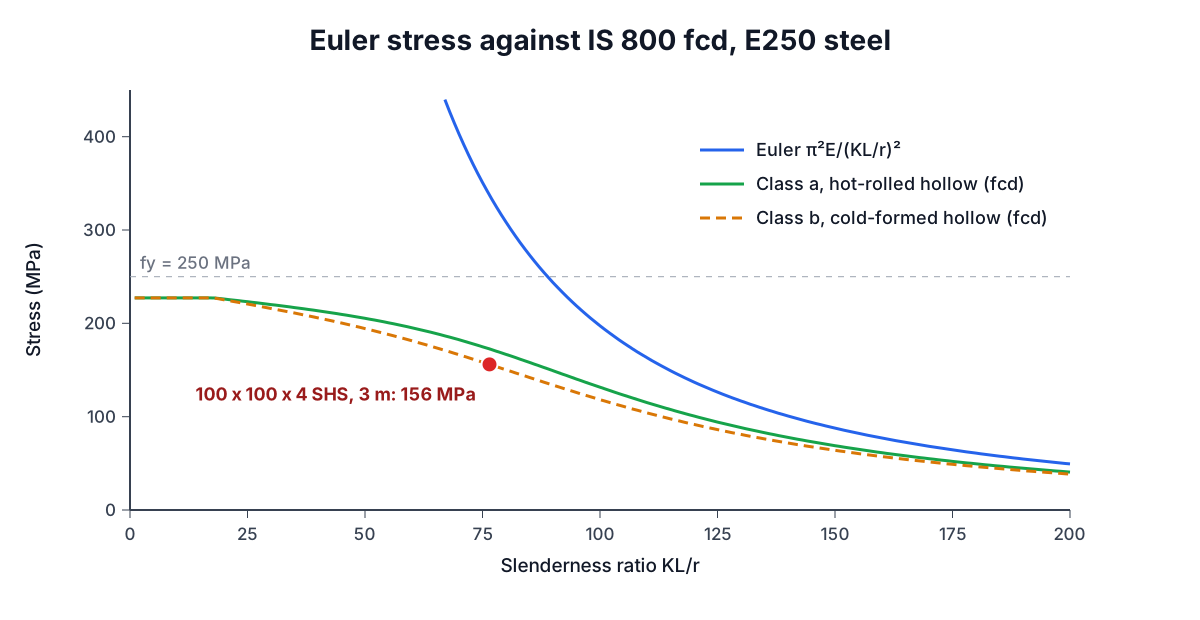
Worked example: 100 × 100 × 4 SHS, E250, 3 m
With the calculator set to IS 800, enter SHS 100 × 4 mm, L = 3 m, K = 1.0, E = 200 GPa and fy = 250 MPa:
| Cold-formed (class b) | Hot-rolled (class a) | |
|---|---|---|
| KL/r | 76.48 | 76.48 |
| λ | 0.861 | 0.861 |
| χ | 0.686 | 0.759 |
| fcd | 156.0 MPa | 172.6 MPa |
| Pd | 239.6 kN (about 24.4 t) | 265.0 kN (about 27.0 t) |
Check against Table 9(b). For fy = 250 MPa, Table 9(b) lists fcd = 166 MPa at KL/r 70 and 150 MPa at KL/r 80. Interpolating to 76.48 gives 155.6 MPa, matching the calculator's 156.0 MPa. Checking a hand calculation against Table 9 is a quick way to catch a wrong class or a units slip.
Euler's 518 kN is more than twice Pd. That margin is the code's allowance for imperfections plus the partial safety factor.
End conditions change everything
Keep the same SHS and 3 m length, and change only the ends:
| Ends | KL | KL/r | fcd (class b) | Pd |
|---|---|---|---|---|
| Fixed and pinned | 0.80 L = 2.4 m | 61.18 | 179.6 MPa | 275.8 kN |
| Both pinned | 1.0 L = 3.0 m | 76.48 | 156.0 MPa | 239.6 kN |
| Cantilever | 2.0 L = 6.0 m | 152.96 | 61.9 MPa | 95.0 kN |
A cantilever post, such as a canopy column fixed into a footing with nothing at the top, carries 40% of the pinned value. If the drawing shows a free top, design for 2.0 L.
A truss tube and the slenderness limits
The 88.9 × 4.0 mm tube is a common size for roof trusses and light columns. Pinned over 2.5 m (A = 1,067 mm², r = 30.05 mm, KL/r = 83.19):
- Cold-formed, class b: fcd = 145.0 MPa, Pd = 154.7 kN.
- Hot-rolled, class a: Pd = 172.1 kN.
- Cold-formed in a fy = 310 MPa grade: Pd = 171.5 kN, almost the same as the hot-rolled E250 tube.
Table 3 caps the effective slenderness ratio:
- 180 for a member carrying compression from dead and imposed loads;
- 250 for a member in compression only under wind or earthquake combinations, provided its deformation does not affect stresses elsewhere;
- 350 for a member normally acting as a tie in a roof truss or bracing system, not considered effective when wind or earthquake reverses its stress into compression.
A 48.3 × 3.2 mm tube over 3 m reaches KL/r 187.7, over the 180 limit for a gravity-load strut, even though the calculator can still give a number (Pd = 19.6 kN). Shorten it or choose a bigger tube.
Common mistakes
- Using the Euler load as capacity. It is an upper bound for a perfect column.
- Picking the class from the shape alone. A hollow section is class a only if hot-rolled; cold-formed tubes and SHS are class b.
- Forgetting γm0. IS 800 divides fy by 1.10 before applying χ; leaving it out overstates Pd by 10%.
- Using the major-axis r for an ISMB. Rolled I-sections nearly always buckle about the minor axis unless it is braced.
- Ignoring local buckling. Slender (Class 4) sections need the effective area in clause 7.3.2.
- Ignoring bending. Eccentric connections and lateral loads make it a beam-column, checked under section 9.3.
Tools for this job
- Column Buckling Calculator (IS 800): KL/r, λ, buckling class, χ, fcd and Pd, with a warning past KL/r 180.
- Section Properties Calculator: A, I and r for shapes not in the tables; see the guide to moment of inertia and section modulus.
- Beam Deflection Calculator: beams that load the column; see the beam deflection formulas guide.
- Steel Weight Calculator: self-weight in kg per metre.
These calculations are for preliminary sizing. Columns support everything above them, so the final design should be checked by a qualified structural engineer to IS 800 and the local building bye-laws.
Frequently asked questions
How is fcd calculated in IS 800?
fcd = (fy / γm0) / (φ + √(φ² − λ²)), where φ = 0.5 [1 + α (λ − 0.2) + λ²], λ = √(fy / fcc) and fcc = π² E / (KL/r)². The design compressive strength is Pd = Ae × fcd. For a cold-formed 100 × 100 × 4 SHS over 3 m in E250, fcd = 156 MPa and Pd = 239.6 kN.
What is the buckling class of a cold-formed hollow section?
Class b (α = 0.34), about any axis, under IS 800 Table 10. Hot-rolled hollow sections are class a (α = 0.21). Channels, angles, tees and solid sections are class c.
What is the effective length of a column fixed at both ends?
0.65 L under IS 800 Table 11, for both ends restrained in translation and rotation. The theoretical value is 0.5 L, but the code uses 0.65 because real end connections are never fully rigid.
What is the maximum slenderness ratio for a compression member?
180 for a member carrying compressive loads from dead and imposed loads (IS 800 Table 3). A member in compression only from wind or earthquake combinations may go to 250, with conditions.
Sources and further reading
- IS 800:2007 General construction in steel, code of practice, Bureau of Indian Standards (public copy). Clause 7.1.2.1; Tables 3, 5, 7, 9, 10 and 11.
- Handout on building materials, Bureau of Indian Standards. IS 2062 structural steel grades.
- Lok Sabha unstarred question 3149: quality control orders for steel products, Ministry of Steel. IS 2062 steel among the products that must carry the BIS mark.
- Methodus inveniendi lineas curvas, Euler Archive, University of the Pacific. Euler's 1744 buckling work.
- Solid Mechanics (course 1.050), MIT OpenCourseWare. Elastic stability lecture notes.
Open the Column Buckling Calculator
More Civil & Structural
Every tool in the Civil & Structural section, free and in your browser.