
How to Calculate Your Net Worth in Canada
Add up your TFSA, RRSP, home and savings in Canadian dollars, subtract the mortgage and HELOC, and compare the result with Statistics Canada medians by age.
By Redbison Dev · · 9 min read
Canada edition. Written for Canadian households: TFSA, RRSP and FHSA in Canadian dollars, RRSP withholding tax, a HELOC set against home equity, and the Statistics Canada Survey of Financial Security as the benchmark instead of US figures. US edition
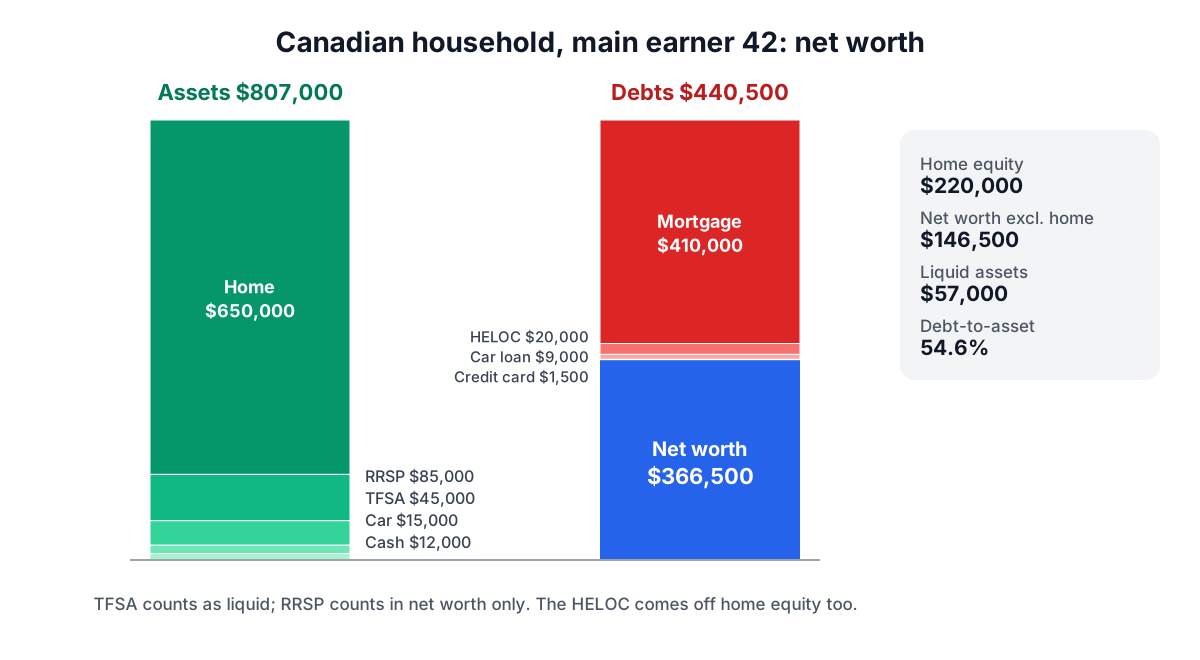
A household headed by a 42-year-old in Ontario, with $12,000 in chequing and a high-interest savings account, a $45,000 TFSA, an $85,000 RRSP, a $650,000 home and a $15,000 car, owing $410,000 on the mortgage, $20,000 on a HELOC, $9,000 on a car loan and $1,500 on a credit card, has a net worth of $366,500 (CAD). Statistics Canada puts the median for families whose main earner is 35 to 44 at $409,300 in 2023, so this household is a little below the middle of its age group. This edition works through a Canadian balance sheet with the Canadian net worth calculator: where a TFSA, an RRSP and an FHSA belong, what an RRSP is worth after tax, and how to read the Statistics Canada figures.
Where each Canadian account goes
The calculator sorts every line into a type. The type decides whether it counts as liquid: money you could reach within days without a penalty or a forced sale.
| What you hold | Enter it as | Liquid? |
|---|---|---|
| Chequing, high-interest savings, cashable GIC | Cash and savings | Yes |
| TFSA, non-registered investment account | Taxable investments | Yes |
| RRSP, RRIF, LIRA, defined contribution pension | Retirement accounts | No |
| FHSA | Retirement accounts (see below) | No |
| The home you live in | Primary home | No |
| Cottage or rental condo | Other real estate | No |
| Mortgage | Mortgage on primary home | Debt |
| HELOC | HELOC or home equity loan | Debt, also taken off home equity |
| Car loan or lease buyout balance, student loan, credit card | The matching debt type | Debt |
A TFSA is the easy one. The Canada Revenue Agency explains that any amount you withdraw is added back as contribution room on January 1 of the next calendar year, so taking money out does not lose the shelter for good. That makes a TFSA a usable reserve, even though the investments inside can fall.
An FHSA is built for one purpose: buying a first home, tax-free within its limits. CRA gives $8,000 of participation room in the first year you open one. It is filed under retirement accounts here so the liquid figure shows only money you could spend on anything; if your purchase is close, move it to investments.
What an RRSP is worth today
An RRSP balance is not spending money. When you withdraw, the financial institution withholds tax at source, and CRA lists the rates for residents:
| Amount withdrawn at one time | Withheld outside Quebec | Withheld in Quebec (plus Quebec provincial tax) |
|---|---|---|
| Up to $5,000 | 10% | 5% |
| Over $5,000 up to $15,000 | 20% | 10% |
| Over $15,000 | 30% | 15% |
The withdrawal is then added to your income for the year, so the final tax can be higher or lower than what was withheld. That is why the calculator keeps the RRSP in net worth but out of liquid net worth. If you want a cautious after-tax view, enter the RRSP at a reduced value. At 70% of its balance (as if 30% went in tax), the $85,000 RRSP counts as $59,500 and net worth falls from $366,500 to $341,000.
The worked example
| Assets | Value | Debts | Balance |
|---|---|---|---|
| Chequing and high-interest savings | $12,000 | Mortgage | $410,000 |
| TFSA | $45,000 | HELOC | $20,000 |
| RRSP | $85,000 | Car loan | $9,000 |
| Home | $650,000 | Credit card | $1,500 |
| Car | $15,000 | ||
| Total | $807,000 | Total | $440,500 |
- Net worth: $807,000 − $440,500 = $366,500.
- Home equity: $650,000 − $410,000 − $20,000 = $220,000. The HELOC comes off the house as well as off the total, because it is secured on the home. Net worth outside the home is $146,500.
- Liquid assets: chequing, savings and the TFSA, $57,000. Liquid net worth, with every debt subtracted, is −$383,500; for a family with a mortgage that is the usual result.
- Debt-to-asset ratio: 54.6%. The home is 80.5% of everything this household owns.
Use the market value of the home, what similar homes nearby have sold for, rather than the municipal property assessment, which is set for tax purposes. Leave out CPP and OAS: they are future income you cannot sell or borrow against.
Comparing with Statistics Canada
Statistics Canada's Survey of Financial Security is the Canadian benchmark. Its 2023 results, released October 29, 2024, give median net worth in 2023 constant dollars for families and unattached individuals in the 10 provinces:
| Age of major income earner | Median net worth, 2019 | Median net worth, 2023 |
|---|---|---|
| All families and unattached individuals | $381,100 | $519,700 |
| Under 35 | $56,400 | $159,100 |
| 35 to 44 | $270,800 | $409,300 |
| 45 to 54 | $602,000 | $675,800 |
| 55 to 64 | $797,000 | $873,400 |
| 65 and older | $627,500 | $738,900 |
Three things help you read it:
- Compare like with like. These figures count a couple or family together, so compare your household's combined net worth. Unattached individuals are counted as their own unit.
- Pensions and home ownership split the results. Among families whose main earner was 55 to 64, those who owned a home and had an employer-sponsored pension had a median net worth of $1.4 million in 2023, homeowners without one $914,000, and renters without one $11,900. If you have a defined benefit pension, the calculator only counts it if you enter a value, so your figure will look low against families like you.
- Mortgage debt is common. 39% of families held a mortgage in 2023, and the median mortgage among them was $205,000.
The calculator's comparison panel shows US Federal Reserve medians in US dollars. Use the Statistics Canada table instead.
A younger renter saving for a first home
A 31-year-old renting in Calgary on $78,000 has $9,000 in a high-interest savings account, a $31,000 TFSA, a $16,000 FHSA, a $22,000 RRSP and an $11,000 car, against a $14,000 student loan, a $7,000 car loan and $2,500 on a credit card. Net worth is $65,500, liquid assets $40,000 and liquid net worth $16,500. The Statistics Canada median for families under 35 is $159,100, but that group includes couples with two incomes and some who already own a home, so a single renter below it is not unusual. The useful test is whether next year's figure is higher.
The age-times-income rule
Thomas Stanley and William Danko's rule, age × pre-tax household income ÷ 10, gives 42 × $115,000 ÷ 10 = $483,000 for the Ontario household, so its $366,500 is 76% of the target. For the 31-year-old it gives $241,800; the rule was designed for established mid-career earners and is harsh on anyone in their twenties or early thirties.
Keeping the figure useful
Pick one date and keep it. December 31 works well in Canada: TFSA room for the new year starts on January 1, and most statements close at year end. Value the home the same way each time and look at what changed:
- savings and principal repaid, which you control;
- markets and house prices, which can outweigh a year of saving;
- new borrowing, such as drawing on the HELOC for a car.
Tools for this job
- Canadian net worth calculator: the balance sheet with TFSA, RRSP and HELOC handled the Canadian way.
- Canadian emergency fund calculator: how many months your cash and TFSA cover.
- Canadian debt payoff calculator: the order to clear cards, a car loan and a HELOC.
- Canadian retirement calculator and FIRE planner: whether the RRSP and TFSA are on course.
- Related reading: the Canadian edition of the emergency fund guide and of the retirement savings guide.
This guide explains the arithmetic and CRA's published rules; it is not tax or investment advice. Before a large RRSP withdrawal, check the tax effect with CRA or an accountant.
Frequently asked questions
What is the average net worth by age in Canada?
Statistics Canada reports medians rather than averages. In 2023 the median net worth was $159,100 for families whose main earner was under 35, $409,300 for 35 to 44, $675,800 for 45 to 54, $873,400 for 55 to 64 and $738,900 for 65 and older, in 2023 dollars.
Should my RRSP count in my net worth?
Yes, at its current balance, but not in liquid net worth. Withdrawals have 10%, 20% or 30% withheld outside Quebec and are then added to your income, so the money you could actually spend is less than the balance.
Is a TFSA a liquid asset?
Usually yes. You can withdraw at any time, and CRA adds the amount back as contribution room on January 1 of the next calendar year. The investments inside can still lose value, so a TFSA full of stocks is less certain than one in cash.
How do I count a HELOC?
Enter it as a separate debt of the HELOC type. It is taken off your total like any debt, and also off the home's value when the calculator works out home equity, because the line is secured on the house.
Should I include my CPP or a defined benefit pension?
Leave CPP and OAS out; they are future income. A defined benefit pension is also a future income stream. You can enter a commuted value from your plan if you want a fuller total, but label it, since Statistics Canada families with employer pensions show much higher net worth.
Sources and further reading
- Survey of Financial Security, 2023, Statistics Canada, The Daily, October 29, 2024. Median net worth, mortgages, and the role of home ownership and employer pensions.
- Median net worth by age group, 2019 and 2023 (Table 1), Statistics Canada. The age table above.
- Withdrawing from a TFSA, Canada Revenue Agency. When withdrawals are added back as contribution room.
- Tax rates on withdrawals, Canada Revenue Agency. RRSP withholding inside and outside Quebec.
- First home savings account (FHSA), Canada Revenue Agency. Purpose of the account and first-year participation room.
- Thomas J. Stanley and William D. Danko, The Millionaire Next Door, Longstreet Press, 1996. The age × income ÷ 10 rule.
More Planning Tools
Every tool in the Planning Tools section, free and in your browser.