
How to Calculate Your Net Worth in India
Add your FDs, mutual funds, EPF, PPF, NPS, gold and flat in rupees, subtract the home loan and other loans, and read what your net worth in lakh really means.
By Redbison Dev · · 9 min read
India edition. Written for Indian households: rupee figures in lakh, EPF, PPF and NPS kept apart from money you can reach, gold jewellery versus sovereign gold bonds, a plot bought on a loan, and the NPS exit rules PFRDA amended in December 2025. US edition
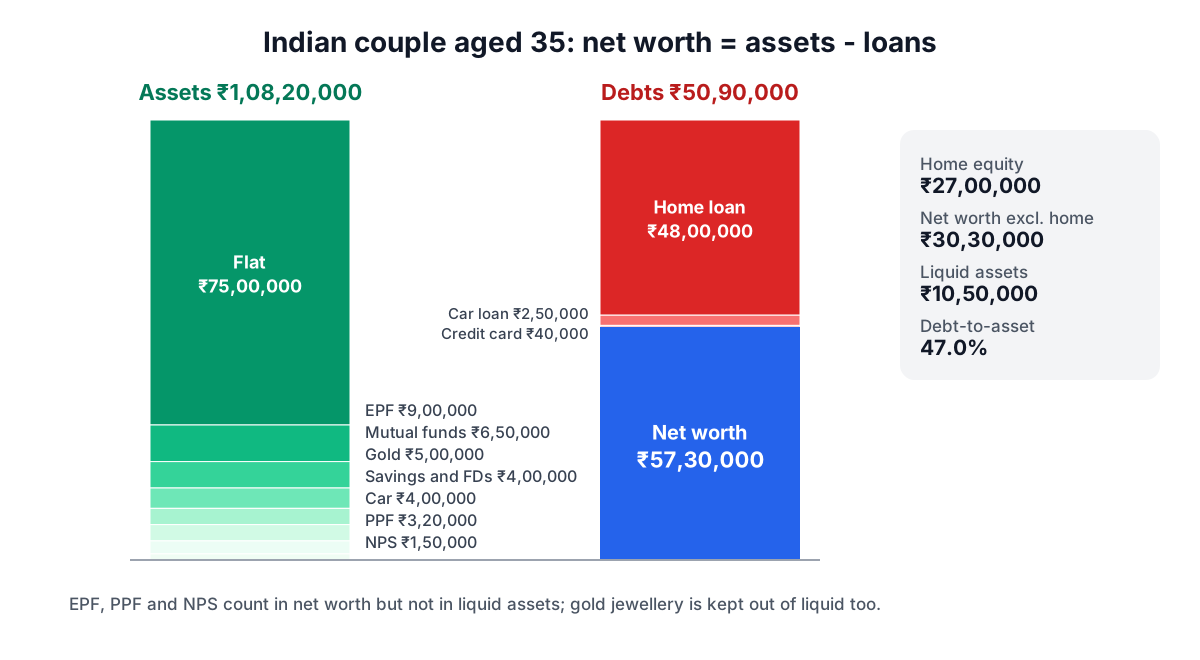
A salaried couple of 35 in a metro flat, with ₹4 lakh in savings and FDs, ₹6.5 lakh in mutual funds, ₹13.7 lakh across EPF, PPF and NPS, ₹5 lakh of gold jewellery, a ₹75 lakh flat and a ₹4 lakh car, owing ₹48 lakh on the home loan, ₹2.5 lakh on the car and ₹40,000 on a credit card, has a net worth of ₹57,30,000. Only ₹10,50,000 of that is money they could actually reach in an emergency. This edition works through an Indian balance sheet with the India net worth calculator: where EPF, PPF, NPS and gold belong, why a plot can make you richer on paper and no more liquid, and what to compare your figure with.
Where each Indian asset goes
The calculator puts every line into a type. The type decides whether it counts as liquid, meaning money you could raise within days without a penalty or a forced sale.
| What you hold | Enter it as | Liquid? |
|---|---|---|
| Savings account, FDs, recurring deposits | Cash and savings | Yes |
| Mutual funds, shares, ETFs, sovereign gold bonds in demat | Taxable investments | Yes |
| EPF, PPF, NPS | Retirement accounts | No |
| Gold jewellery kept in the family | Other assets | No |
| The flat you live in | Primary home | No |
| A plot, a second flat or ancestral land with a clear title | Other real estate | No |
| Car, two-wheeler | Vehicles | No |
| Home loan, top-up loan on the flat | Mortgage on primary home or HELOC | Debt |
| Car loan, education loan, personal loan, plot loan | The matching debt type | Debt |
An FD that you could break early with a small interest penalty still counts as cash. The retirement schemes do not, because their rules hold the money back.
The rules that lock the money in
PPF. The Public Provident Fund Scheme, 2019, as published by India Post, allows deposits of ₹500 to ₹1,50,000 a year. Partial withdrawals start only after five years from the end of the year the account was opened, and each is capped at 50% of the balance at the end of the fourth year before the withdrawal or the end of the previous year, whichever is lower. The account can be closed after fifteen years from the end of the year it was opened. So a ₹3.2 lakh PPF balance is real wealth, but most of it is not reachable this year.
NPS. PFRDA's press release of 19 December 2025 sets out the amended exit rules for the non-government sector (All Citizen Model and Corporate Sector):
| NPS exit, non-government subscriber | Lump sum allowed |
|---|---|
| Normal exit, corpus above ₹12 lakh | Up to 80%, with at least 20% used to buy an annuity |
| Normal exit, corpus above ₹8 lakh up to ₹12 lakh | Up to ₹6 lakh, the rest paid out in instalments (SUR in PFRDA's table) over at least 6 years or as an annuity (or the 80/20 split) |
| Normal exit, corpus up to ₹8 lakh | 100% (or the 80/20 split) |
| Premature exit, corpus above ₹5 lakh | Up to 20%, at least 80% to an annuity |
For All Citizen Model subscribers, normal exit now comes after 15 years or at 60, whichever is earlier. Government-sector subscribers keep the split of up to 60% lump sum and at least 40% annuity. The calculator counts the whole NPS balance in net worth, because the annuity part is still your money, paid out as income instead of a lump sum.
EPF. Take the balance from your latest EPFO passbook, not from the sum of your contributions; the passbook includes the interest credited and the employer's share.
The worked example in rupees
| Assets | Value | Debts | Balance |
|---|---|---|---|
| Savings account and FDs | ₹4,00,000 | Home loan | ₹48,00,000 |
| Mutual funds (SIP) | ₹6,50,000 | Car loan | ₹2,50,000 |
| EPF | ₹9,00,000 | Credit card | ₹40,000 |
| PPF | ₹3,20,000 | ||
| NPS | ₹1,50,000 | ||
| Gold jewellery | ₹5,00,000 | ||
| Flat | ₹75,00,000 | ||
| Car | ₹4,00,000 | ||
| Total | ₹1,08,20,000 | Total | ₹50,90,000 |
The calculator gives:
- Net worth: ₹1,08,20,000 − ₹50,90,000 = ₹57,30,000.
- Home equity: ₹75,00,000 − ₹48,00,000 = ₹27,00,000, so ₹30,30,000 sits outside the flat.
- Liquid assets: savings, FDs and mutual funds, ₹10,50,000. With every loan taken off, liquid net worth is −₹40,40,000, which is normal for anyone with a home loan.
- Debt-to-asset ratio: 47%. The flat is 69.3% of everything they own.
Gold: jewellery or bonds
Gold is where Indian balance sheets differ most from the US template. Count jewellery at what a jeweller would pay you today for the metal, not the bill price, which included making charges you will not get back. The default puts it under other assets, outside the liquid figure, because most families never sell it.
Sovereign gold bonds are a different case. The RBI's FAQ gives them an 8-year tenor, allows early redemption after the fifth year on coupon payment dates, and lets them trade on exchanges if held in demat form. If ₹2 lakh of the couple's ₹5 lakh of gold were bonds entered as investments, net worth would not change, but liquid assets would rise from ₹10,50,000 to ₹12,50,000. Gold ETFs and gold mutual funds belong with investments for the same reason.
A plot bought on a loan
Many families buy a plot or an under-construction flat as an investment. Suppose the same couple buys a ₹25 lakh plot with a ₹12 lakh loan. Net worth rises to ₹70,30,000 on paper, and net worth outside the home to ₹43,30,000, but liquid assets stay at ₹10,50,000 while the debts grow to ₹62,90,000. The plot also has costs the calculator does not see: the stamp duty and registration paid at purchase are gone, and a sale may take months. Enter it at a realistic resale value for the locality, not the builder's current launch price.
A young earner with an education loan
A 26-year-old software engineer on ₹9 lakh a year has ₹1.5 lakh in the bank, ₹2.2 lakh in mutual funds, ₹2.6 lakh in EPF and a ₹70,000 two-wheeler, against a ₹6 lakh education loan and ₹25,000 on a credit card. Net worth is ₹75,000, liquid assets ₹3,70,000 and the debt-to-asset ratio 89.3%. That is a normal start. The number to watch is next year's: if the education loan falls by ₹1.5 lakh and the SIP adds ₹1 lakh, net worth rises by ₹2.5 lakh before any market gain.
What to compare it with
We have not found an official Indian release of median household net worth by age like the US Federal Reserve's, and the US medians in the calculator's comparison panel (in dollars) mean little for an Indian household. Two comparisons are more useful:
- Your own figure last year. Use the same date, ideally 31 March at the end of the financial year, when FD interest certificates and the EPF passbook are up to date.
- The rule of thumb. Age × annual household income ÷ 10, from The Millionaire Next Door. For the couple on ₹18 lakh it gives 35 × ₹18,00,000 ÷ 10 = ₹63,00,000, so ₹57,30,000 is 91% of it. With the plot it would be 112%, which shows how much a property purchase can flatter the rule. For the 26-year-old it gives ₹23,40,000, which almost nobody that age reaches.
Tools for this job
- India net worth calculator: the balance sheet in rupees with EPF, PPF and NPS kept out of the liquid figure.
- India SIP calculator: how a monthly SIP adds to the investment line.
- India retirement calculator: whether EPF, PPF and NPS are on course.
- India inflation calculator: what today's net worth will buy in future rupees.
- Related reading: the India edition of the SIP versus lump sum guide and of the retirement savings guide.
This guide explains how to count and the scheme rules as published; it is not investment advice. For decisions about NPS annuities, property or tax, speak to a SEBI-registered adviser or a chartered accountant.
Frequently asked questions
Should EPF and PPF be included in net worth?
Yes, at the current balance from the EPFO passbook and the PPF statement. They count in total net worth but not in liquid net worth, because PPF allows only limited withdrawals after five years and closes after fifteen, and EPF is meant for retirement.
Is gold jewellery part of net worth?
Yes, at what a jeweller would pay for the metal today, without the making charges on the original bill. Keep it out of the liquid figure unless you would really sell it. Sovereign gold bonds in demat and gold ETFs can go under investments.
How much of my NPS can I take as a lump sum?
Under PFRDA's December 2025 amendments, a non-government subscriber can take up to 80% at normal exit with at least 20% used for an annuity, or the whole corpus if it is ₹8 lakh or less. Government-sector subscribers can take up to 60%.
Do I count the full home loan or only this year's EMIs?
The full principal outstanding on your latest loan statement. Net worth is a balance sheet on one date, so every loan counts at what it would take to close it today.
Does buying a plot increase my net worth?
On paper, yes, if the plot's resale value is higher than the loan you took for it. It does not make you more liquid, and the stamp duty and registration you paid are not recovered, so the gain is smaller than the purchase price suggests.
Sources and further reading
- Public Provident Fund Scheme, 2019, Ministry of Finance notification, published by India Post. Deposit limits (paragraph 4), withdrawals (paragraph 10) and closure after fifteen years (paragraph 11).
- Key amendments in PFRDA (Exits and Withdrawals under the NPS) Regulations, 2015, Pension Fund Regulatory and Development Authority, 19 December 2025. Lump sum and annuity shares by corpus size.
- Sovereign Gold Bond Scheme: FAQs, Reserve Bank of India. Tenor, early redemption and exchange trading.
- Changes in US Family Finances from 2019 to 2022, Federal Reserve Bulletin. The US medians in the calculator's comparison panel.
- Survey of Consumer Finances, Board of Governors of the Federal Reserve System. How the US survey defines net worth.
- Thomas J. Stanley and William D. Danko, The Millionaire Next Door, Longstreet Press, 1996. The age × income ÷ 10 rule.
More Planning Tools
Every tool in the Planning Tools section, free and in your browser.