
How to Calculate Your Net Worth in Australia
Add up super, shares, your offset account and home in Australian dollars, take off the home loan and HECS, and see how offset and redraw change the picture.
By Redbison Dev · · 9 min read

Australia edition. Written for Australian households: super counted but preserved until preservation age, offset accounts versus redraw, HECS-HELP debts, and the ABS household wealth survey as the benchmark instead of US figures. US edition
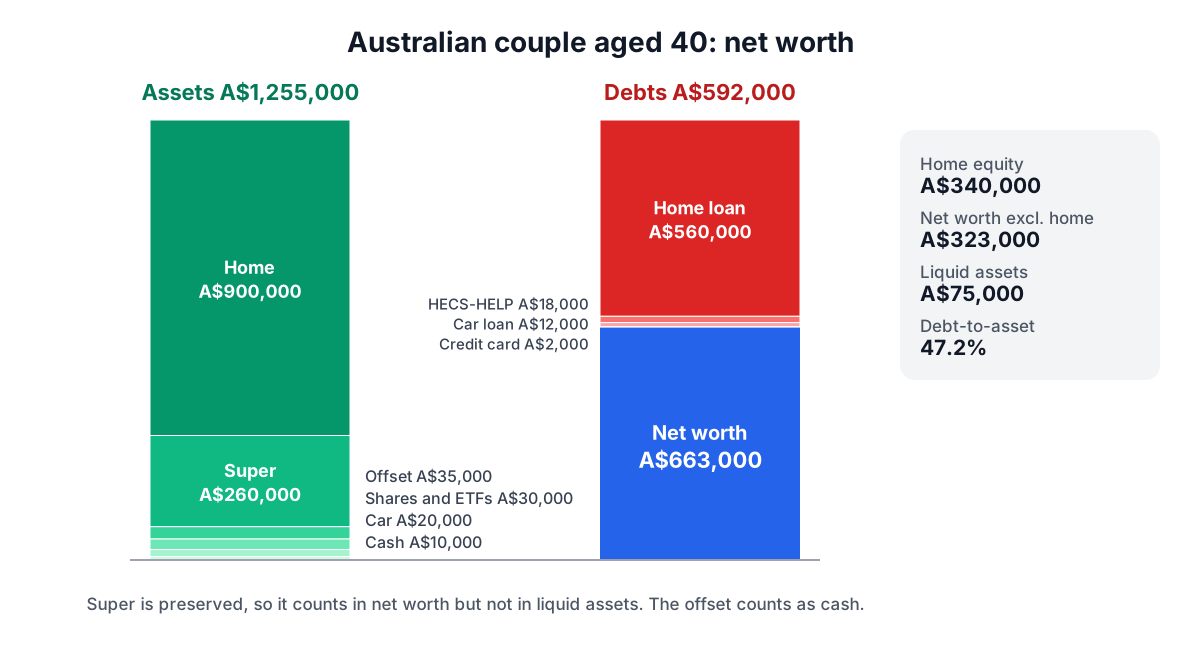
A couple aged 40 with A$10,000 in everyday accounts, A$35,000 in an offset account, A$30,000 of shares and ETFs, A$260,000 of super between them, a A$900,000 home and a A$20,000 car, owing A$560,000 on the home loan, A$12,000 on a car loan, A$2,000 on a credit card and A$18,000 in HECS-HELP, has a net worth of A$663,000. Most of it is the house and super, neither of which they can spend this year. This edition works through an Australian balance sheet with the Australian net worth calculator: where super sits, why an offset and a redraw facility give the same net worth but very different liquid figures, and how to read the ABS survey.
Where each Australian account goes
The calculator puts every line into a type, and the type decides whether it counts as liquid: money you could reach within days without a penalty or a forced sale.
| What you hold | Enter it as | Liquid? |
|---|---|---|
| Everyday account, high-interest savings, term deposit | Cash and savings | Yes |
| Offset account | Cash and savings | Yes |
| Shares, ETFs, managed funds outside super | Taxable investments | Yes |
| Super (each partner's balance) | Retirement accounts | No |
| The home you live in | Primary home | No |
| Investment property | Other real estate | No |
| Home loan (full balance) | Mortgage on primary home | Debt |
| Car loan or novated lease payout, credit card, personal loan | The matching debt type | Debt |
| HECS-HELP | Student loans | Debt |
Super and preservation age
Super is usually the second-biggest line, and it is yours, but it is preserved. Treasury's Retirement Income Review explains that super cannot generally be accessed until you reach your preservation age and meet a condition of release, usually retirement. The preservation age is 55 for people born before 1 July 1960 and rises to 60 for those born after 1 July 1964. Outside that, early release is limited to small exceptions such as severe financial hardship or compassionate grounds.
So the calculator counts super in total net worth and leaves it out of liquid net worth. For a 40-year-old that money is at least 20 years away. Take each partner's balance from the fund's latest statement or app, and enter them as one line or two.
The worked example
| Assets | Value | Debts | Balance |
|---|---|---|---|
| Everyday and savings accounts | A$10,000 | Home loan | A$560,000 |
| Offset account | A$35,000 | Car loan | A$12,000 |
| Shares and ETFs | A$30,000 | Credit card | A$2,000 |
| Super (both partners) | A$260,000 | HECS-HELP | A$18,000 |
| Home | A$900,000 | ||
| Car | A$20,000 | ||
| Total | A$1,255,000 | Total | A$592,000 |
- Net worth: A$1,255,000 − A$592,000 = A$663,000.
- Home equity: A$900,000 − A$560,000 = A$340,000, so A$323,000 sits outside the home.
- Liquid assets: cash, offset and shares, A$75,000. With every debt taken off, liquid net worth is −A$517,000, which is what most households with a home loan will see.
- Debt-to-asset ratio: 47.2%. The home is 71.7% of everything they own and super 20.7%.
Offset or redraw: same net worth, different picture
Australian home loans hide savings in two ways, and the calculator treats them differently.
Offset account. The money sits in a separate account in your name. Enter the offset balance as cash and the home loan at its full balance. The two cancel correctly, and the offset shows up as reachable money.
Redraw. Extra repayments go straight onto the loan, so the balance the bank reports is already lower. Enter the loan at that lower balance and do not list the redraw again. Suppose the couple had the same A$35,000 in redraw instead of an offset:
| Same couple | With an offset | With redraw |
|---|---|---|
| Home loan entered | A$560,000 | A$525,000 |
| Net worth | A$663,000 | A$663,000 |
| Liquid assets | A$75,000 | A$40,000 |
| Home equity | A$340,000 | A$375,000 |
| Net worth excluding home equity | A$323,000 | A$288,000 |
Net worth is identical, but with redraw the A$35,000 looks like home equity rather than cash, even though most lenders let you draw it back. If you rely on redraw as your emergency money, remember that it is there; the liquid figure will not show it, and some loans limit or charge for redraws.
HECS-HELP and the other judgement calls
A HECS-HELP balance is a debt you owe, though how quickly it is repaid depends on your income rather than on a fixed loan term. Run the calculator with it and without it: for the couple, dropping the A$18,000 lifts net worth to A$681,000. Leave the Age Pension out entirely; it is a future payment, not an asset. Value the home from recent sales of similar homes nearby rather than the council or state land valuation, which is set for rates and land tax.
A younger renter
A 29-year-old renting on A$92,000 has A$22,000 in savings, A$18,000 in ETFs, A$64,000 of super and a A$9,000 car, against a A$31,000 HECS-HELP debt and A$1,500 on a credit card. Net worth is A$80,500, liquid assets A$40,000 and liquid net worth A$7,500. Super is 56.6% of everything they own, which is typical for a renter: compulsory employer contributions build it whether or not anything else is saved.
Comparing with the ABS
The Australian Bureau of Statistics measures household wealth in its Survey of Income and Housing. The latest results, for 2019–20, give:
| Measure (Australia, 2019–20) | Figure |
|---|---|
| Median household net worth | A$579,200 |
| Mean household net worth | A$1.04 million |
| Owner-occupied dwellings, share of household assets | 40% |
| Superannuation, share of household assets | 18% |
| Loans on homes and other property, mean per household | A$182,800 of A$203,800 (about 90%) |
The mean is nearly twice the median because a minority of very wealthy households pulls it up, so compare yourself with the median. These are 2019–20 dollars across all ages, and prices and super balances have moved since, so treat them as a rough reference. The calculator's comparison panel shows US Federal Reserve medians in US dollars; they do not describe Australian households.
The age-times-income rule from The Millionaire Next Door works in any currency: 40 × A$150,000 ÷ 10 = A$600,000, so the couple is at 110.5% of it. For the 29-year-old it gives A$266,800, which few people that age reach.
Keeping the figure useful
Pick a date and keep it. 30 June works well: super funds report balances to the end of the financial year, and you will have the numbers in front of you for your tax return. Track the same lines each year and look at what moved the total: savings and principal repaid, market and property movements, and new borrowing.
Tools for this job
- Australian net worth calculator: the balance sheet with super and offset handled the Australian way.
- Australian emergency fund calculator: how many months your cash and offset cover.
- Australian debt payoff calculator: the order to clear cards and personal loans.
- Australian retirement calculator and FIRE planner: whether super and investments are on course.
- Related reading: the Australian edition of the emergency fund guide and of the retirement savings guide.
This guide explains how to count; it is not financial advice. For decisions about super, talk to a licensed financial adviser.
Frequently asked questions
Should super be included in net worth?
Yes, at its current balance. It is counted in total net worth but not in liquid net worth, because super is preserved until your preservation age and a condition of release such as retirement.
How does an offset account affect net worth?
It does not change net worth compared with paying the same money off the loan; it changes where the money shows up. Enter the offset as cash and the loan at its full balance, and the offset counts as money you can reach.
What is the average household net worth in Australia?
The ABS reported a median household net worth of A$579,200 and a mean of A$1.04 million for 2019–20. Owner-occupied homes made up 40% of household assets and super 18%.
Does a HECS-HELP debt count against net worth?
It is a debt, so including it gives the fuller picture. Because the pace of repayment depends on your income, run the figure with and without it and track both.
What is my preservation age?
Treasury gives 55 for people born before 1 July 1960, rising to 60 for people born after 1 July 1964. Reaching it is not enough by itself; you also need a condition of release, usually retirement.
Sources and further reading
- Household Income and Wealth, Australia, 2019–20, Australian Bureau of Statistics. Median and mean net worth, the shares of homes and super in assets, and mean home and other property loans (A$114,700 and A$68,100 of A$203,800).
- Retirement Income Review, Final Report: Outline of Australia's retirement income system, The Treasury. Preservation age and early release.
- Retirement Income Review, Final Report, The Treasury, 20 November 2020.
- Changes in US Family Finances from 2019 to 2022, Federal Reserve Bulletin. The US medians in the calculator's comparison panel.
- Survey of Consumer Finances, Board of Governors of the Federal Reserve System.
- Thomas J. Stanley and William D. Danko, The Millionaire Next Door, Longstreet Press, 1996. The age × income ÷ 10 rule.
More Planning Tools
Every tool in the Planning Tools section, free and in your browser.