
How to Work Out Your Net Worth in New Zealand
Add up KiwiSaver, savings, your home and car in NZ dollars, take off the home loan, revolving credit and student loan, and see why a first home barely moves it.
By Redbison Dev · · 9 min read

New Zealand edition. Written for New Zealand households: NZD, KiwiSaver counted but locked until 65 apart from Inland Revenue's early-withdrawal grounds, split home loans with revolving credit, the interest-free student loan, and what a first-home KiwiSaver withdrawal does to the figure. US edition
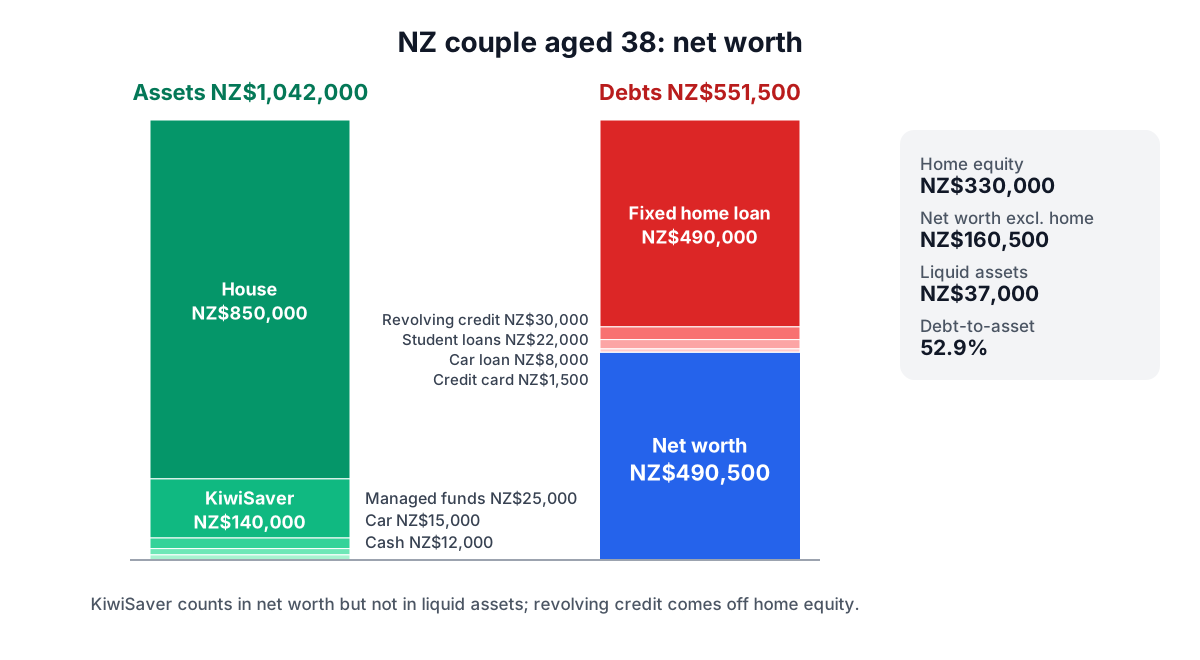
A couple aged 38 with NZ$12,000 in everyday and savings accounts, NZ$25,000 in managed funds and shares, NZ$140,000 of KiwiSaver between them, an NZ$850,000 house and an NZ$15,000 car, owing NZ$490,000 in fixed home loans, NZ$30,000 on revolving credit, NZ$8,000 on a car loan, NZ$1,500 on a credit card and NZ$22,000 in student loans, has a net worth of NZ$490,500. Only NZ$37,000 of it could be reached this week. This edition works through a New Zealand balance sheet with the NZ net worth calculator: where KiwiSaver belongs, how to enter a split home loan, and why buying a first home with KiwiSaver leaves net worth where it was.
Sorted, the government-backed money guide, puts the point well: what matters most about net worth is not how high it is but which direction it is heading, and reviewing it every year or so is enough.
Where each New Zealand account goes
The calculator sorts every line into a type, and the type decides whether it counts as liquid: money you could reach within days without a penalty or a forced sale.
| What you hold | Enter it as | Liquid? |
|---|---|---|
| Everyday account, savings, term deposit, offset credit balance | Cash and savings | Yes |
| Managed funds, shares, ETFs outside KiwiSaver | Taxable investments | Yes |
| KiwiSaver (each partner) | Retirement accounts | No |
| The home you live in | Primary home | No |
| A rental or bach | Other real estate | No |
| Fixed home loan portions | Mortgage on primary home | Debt |
| Revolving credit drawn on the home loan | HELOC or home equity loan | Debt, also taken off home equity |
| Car loan, credit card, buy now pay later | The matching debt type | Debt |
| Student loan | Student loans | Debt |
KiwiSaver: yours, but locked
Inland Revenue says you can withdraw all your KiwiSaver savings when you reach the age of eligibility, currently 65. Before that, it lists only these grounds:
- buying your first home, once you have been a member for 3 or more years, leaving at least NZ$1,000 in the account;
- moving overseas: after living overseas for 1 year (anywhere except Australia) you can take most of it, and if you move permanently to Australia you can transfer it to an Australian super scheme;
- significant financial hardship;
- serious illness and other health reasons;
- other cases such as bankruptcy, relationship property, paying a tax liability, and death.
So KiwiSaver counts in total net worth and stays out of liquid net worth. It still grows with outside help: IRD says employers must contribute at least 3.5% of your before-tax pay, and the government adds up to NZ$260.72 a year if you contribute at least NZ$1,042.86 between 1 July and 30 June (25 cents per dollar below that), provided you are 16 or over, live mainly in New Zealand and have taxable income of NZ$180,000 or less.
The worked example
| Assets | Value | Debts | Balance |
|---|---|---|---|
| Everyday and savings accounts | NZ$12,000 | Fixed home loan | NZ$490,000 |
| Managed funds and shares | NZ$25,000 | Revolving credit | NZ$30,000 |
| KiwiSaver (both partners) | NZ$140,000 | Car loan | NZ$8,000 |
| House | NZ$850,000 | Credit card | NZ$1,500 |
| Car | NZ$15,000 | Student loans | NZ$22,000 |
| Total | NZ$1,042,000 | Total | NZ$551,500 |
- Net worth: NZ$1,042,000 − NZ$551,500 = NZ$490,500.
- Home equity: NZ$850,000 less the fixed loan and the revolving credit together, NZ$520,000, leaves NZ$330,000. Net worth outside the house is NZ$160,500.
- Liquid assets: NZ$37,000 of cash and managed funds. Liquid net worth, with every debt subtracted, is −NZ$514,500, which is what most households with a mortgage will see.
- Debt-to-asset ratio: 52.9%. The house is 81.6% of everything they own.
Split loans and revolving credit
Many New Zealand home loans are split into fixed portions and a revolving credit or offset facility. Enter the fixed portions as the mortgage and the amount drawn on revolving credit as a separate HELOC line, so the calculator takes both off the house when it works out equity. If you have an offset account in credit, enter that balance as cash and leave the loan at its full amount. Value the house from recent sales of similar homes nearby, not the council rating valuation, which is set for rates.
A first home bought with KiwiSaver
A 29-year-old renting on NZ$85,000 has NZ$20,000 of savings and NZ$60,000 of KiwiSaver, against an NZ$18,000 student loan. Net worth is NZ$62,000, liquid assets NZ$20,000.
They buy an NZ$700,000 first home. KiwiSaver releases NZ$59,000 (leaving the NZ$1,000 IRD requires), the savings go in too, and an NZ$621,000 loan covers the rest. On settlement day:
| Same person | Before buying | After buying |
|---|---|---|
| Assets | NZ$80,000 | NZ$701,000 |
| Debts | NZ$18,000 | NZ$639,000 |
| Net worth | NZ$62,000 | NZ$62,000 |
| Liquid assets | NZ$20,000 | NZ$0 |
| Debt-to-asset ratio | 22.5% | 91.2% |
Net worth does not change: money moved from KiwiSaver and savings into the house. In practice it falls a little, because lawyer's fees and moving costs are spent and do not come back. What changes is the shape: no cash buffer and a much larger debt. That is why a first-home budget should keep some savings aside; the NZ emergency fund calculator sizes that buffer.
The student loan
A New Zealand student loan is interest-free while you live here, and it is repaid through your pay once you earn over the repayment threshold. Inland Revenue warns that if you leave New Zealand for around 6 months your loan may stop being interest-free, and overseas-based borrowers have repayments due by 31 March. Keep it in the list at its full balance; if you are planning an OE, check what moving would do to it first.
What to compare it with
Stats NZ publishes household net worth statistics from its Household Economic Survey, and those are the right national reference. This edition does not quote their medians: look up the latest Stats NZ household net worth release for the national median and the medians by age group, and note the year they cover, since house prices and KiwiSaver balances move quickly. The calculator's comparison panel shows US Federal Reserve medians in US dollars, which do not describe New Zealand households.
The rule of thumb from The Millionaire Next Door, age × pre-tax household income ÷ 10, works in any currency. For the couple on NZ$160,000 it gives NZ$608,000, so they are at about 81% of it. For the 29-year-old on NZ$85,000 it gives NZ$246,500, out of reach for most renters that age, which is why the trend matters more than the rule early on.
Keeping the figure useful
Pick one date and keep it. 31 March, the end of the tax year, works well because the rest of your paperwork is already gathered then. Record the same lines each year and look at what changed: savings and principal repaid, market and house price movements, and new borrowing. Sorted's advice to favour paying debt down over relying on rising asset values holds here: house prices can fall, a repaid loan stays repaid.
Tools for this job
- NZ net worth calculator: the balance sheet with KiwiSaver and revolving credit handled the New Zealand way.
- NZ emergency fund calculator: how many months your cash covers.
- NZ mortgage calculator: repayments on the loan that sits on the debt side.
- NZ retirement calculator and FIRE planner: whether KiwiSaver and investments are on course.
- Related reading: the New Zealand edition of the emergency fund guide and of the FIRE number guide.
This guide explains the arithmetic and Inland Revenue's published rules; it is not financial advice. For KiwiSaver fund choices or a first-home withdrawal, check with your provider or a financial adviser.
Frequently asked questions
Should KiwiSaver be included in net worth?
Yes, at its current balance from your provider. It counts in total net worth but not in liquid net worth, because you can generally withdraw it only at 65 or on IRD's early grounds: a first home, moving overseas, significant hardship, serious illness and a few others.
Does using KiwiSaver for a house deposit change my net worth?
Not on the day you buy. The money moves from KiwiSaver into the house, so assets and net worth stay the same, apart from fees you pay along the way. Your liquid savings and debt-to-asset ratio change a lot, though.
How do I enter revolving credit on a home loan?
Enter the amount drawn as a separate debt of the HELOC type. The calculator subtracts it from your total and also from the house value when it works out home equity, alongside the fixed loan.
Does an interest-free student loan count as debt?
Yes. It is still owed and repaid through your pay above the threshold. It is interest-free while you live in New Zealand, but Inland Revenue says it may stop being interest-free if you go overseas for around 6 months.
Can I count the government KiwiSaver contribution?
Once it is paid into your account, yes, as part of the balance. Do not add next year's contribution in advance: net worth counts what you hold today.
Sources and further reading
- Getting my KiwiSaver savings early, Inland Revenue. The early-withdrawal grounds.
- Getting my KiwiSaver when I retire, Inland Revenue. Full withdrawal at the age of eligibility, currently 65.
- KiwiSaver benefits, Inland Revenue. First-home withdrawal after 3 years leaving NZ$1,000, employer and government contributions.
- Getting my KiwiSaver funds when I move overseas, Inland Revenue. One year overseas, or transfer to Australian super.
- Going overseas or returning to New Zealand, Inland Revenue. When a student loan may stop being interest-free.
- About net worth, Sorted. Direction over size, and reviewing yearly.
- Household net worth statistics, Stats NZ. The national household wealth series (year ended June 2021 release); check the Stats NZ site for any later release.
More Planning Tools
Every tool in the Planning Tools section, free and in your browser.