
How to Work Out Your Net Worth in the UK
Add up ISAs, pensions, your home and savings in pounds, take off the mortgage, car finance and student loan, and compare the result with ONS household wealth.
By Redbison Dev · · 9 min read

United Kingdom edition. Written for UK households: ISAs, workplace pensions and the Lifetime ISA in pounds, the minimum pension age rising to 57, Plan 2 and Plan 5 student loans, and the ONS Wealth and Assets Survey as the benchmark instead of US figures. US edition
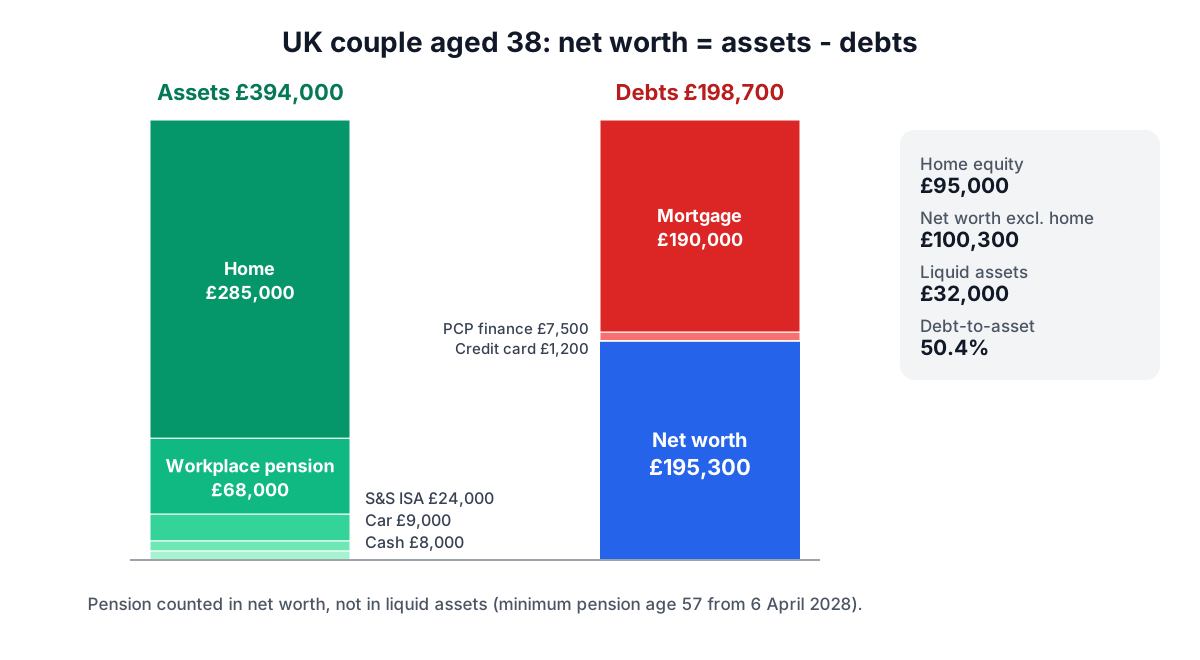
A 38-year-old couple with £8,000 in the bank, a £24,000 stocks and shares ISA, a £68,000 workplace pension, a £285,000 home and a £9,000 car, owing £190,000 on the mortgage, £7,500 on PCP car finance and £1,200 on a credit card, has a net worth of £195,300. Only £100,300 of it sits outside the house, and only £32,000 could be reached this month without selling the home or waiting for pension age. This edition works through a British balance sheet with the UK net worth calculator: which bucket each account belongs in, what to do about a Plan 2 student loan, and how to compare your figure with the Office for National Statistics rather than with American medians.
Where each UK account goes
The calculator sorts every line into a type, and the type decides whether it counts as money you can reach. For a UK household the mapping is:
| What you hold | Enter it as | Counted as liquid? |
|---|---|---|
| Current account, easy-access savings, cash ISA, Premium Bonds | Cash and savings | Yes |
| Stocks and shares ISA, general investment account | Taxable investments | Yes |
| Lifetime ISA | Retirement accounts | No |
| Workplace pension, personal pension, SIPP | Retirement accounts | No |
| The home you live in | Primary home | No |
| Buy-to-let or a second home | Other real estate | No |
| Car, van, motorbike | Vehicles | No |
| Mortgage, secured second-charge loan | Mortgage on primary home or HELOC | Debt |
| PCP or hire purchase balance | Auto loan | Debt |
| Plan 1, 2, 4 or 5 student loan | Student loans | Debt |
Two rows need judgement. A stocks and shares ISA goes under investments, not retirement, because you can sell and withdraw whenever you like; the price can fall, but nothing locks it. A Lifetime ISA is different: GOV.UK sets no withdrawal charge for a first home costing £450,000 or less, at 60 or with a terminal illness, a 20% charge if the first home costs more than £450,000, and 25% for any other withdrawal, so it behaves more like a pension than a savings pot.
The worked example in pounds
| Assets | Value | Debts | Balance |
|---|---|---|---|
| Current account and easy-access savings | £8,000 | Mortgage | £190,000 |
| Stocks and shares ISA | £24,000 | PCP car finance | £7,500 |
| Workplace pension | £68,000 | Credit card | £1,200 |
| Home | £285,000 | ||
| Car | £9,000 | ||
| Total | £394,000 | Total | £198,700 |
Net worth is £394,000 − £198,700 = £195,300. The calculator then splits it three ways:
- Home equity: £285,000 − £190,000 = £95,000, so net worth outside the home is £100,300.
- Liquid assets: the £8,000 of cash plus the £24,000 ISA, £32,000 in all. Liquid net worth takes every debt off that figure, mortgage included, which leaves −£166,700. For a household with a mortgage a negative figure here is normal; it answers "how short would we be if every debt fell due at once", not "are we in trouble".
- Debt-to-asset ratio: £198,700 ÷ £394,000 = 50.4%. The house is 72.3% of everything they own and the mortgage 95.6% of everything they owe.
Valuing the awkward lines
- The house: use what similar homes on your street have actually sold for, not the price you paid or an online estimate. Estate agent and conveyancing fees would come out of a sale, so a cautious figure sits below the asking prices you see.
- PCP finance: enter the settlement figure from your finance company, not the monthly payment and not the optional final payment on its own. The car itself goes in at what a dealer would offer today, which on a three-year-old car is often less than the settlement figure.
- A defined benefit pension: there is no pot to enter. Your scheme can quote a transfer value, which you may enter if you want a complete figure, but keep it labelled so you know the total includes it.
- The State Pension: leave it out. It is a future income you cannot sell or borrow against.
Pensions and the minimum pension age
The pension is in the total but not in the liquid figure because you normally cannot draw it before the normal minimum pension age. HMRC's policy paper sets that age rising from 55 to 57, with effect on and after 6 April 2028, unless you have a protected pension age from your scheme rules. So the £68,000 in the example is real wealth, but it is wealth for later. If your aim is a figure for an emergency, the UK emergency fund calculator looks only at what you could spend now.
The student loan question
A UK student loan is not like a car loan. GOV.UK sets repayment at 9% of income above a threshold (£29,385 a year on Plan 2, £25,000 on Plan 5, £26,900 on Plan 1) and writes the balance off at a fixed point: 30 years after the April you were first due to repay for Plan 2, 40 years for Plan 5, and 25 years for Plan 1 loans first paid on or after 1 September 2006. Plan 2 balances still owed 30 years after the April you were first due to repay are written off, so counting the loan in full can overstate what you will actually pay.
The honest approach is to run the calculator twice:
| Same couple | With no student loan | With a £42,000 Plan 2 loan |
|---|---|---|
| Net worth | £195,300 | £153,300 |
| Net worth excluding home equity | £100,300 | £58,300 |
| Debt-to-asset ratio | 50.4% | 61.1% |
A younger renter
The loan matters more early in a career. A 27-year-old renting, earning £34,000, has £6,000 in an easy-access account, £14,000 in a Lifetime ISA towards a first flat, £21,000 in a workplace pension and a £5,000 car, against a £48,000 Plan 2 loan and £900 on a credit card. Net worth is −£2,900, and without the student loan it would be £45,100. On £34,000 the loan costs (£34,000 − £29,385) × 9% = £415.35 a year in repayments, which is why the write-off date matters as much as the balance.
The Lifetime ISA also changes with its purpose. If the £14,000 goes on a first home costing £450,000 or less it is worth its full value; on a first home costing more, the 20% charge would leave £11,200; spent on anything else, the 25% charge would leave £10,500 (GOV.UK's own example: withdraw £160, pay £40, receive £120). Valued that way, net worth falls to −£6,400.
Comparing with the ONS
The UK benchmark is the ONS Wealth and Assets Survey, which covers Great Britain. For April 2020 to March 2022 it reports:
| Measure (Great Britain, April 2020 to March 2022) | Figure |
|---|---|
| Median household total wealth | £293,700 |
| Median household wealth excluding private pensions | £181,700 |
| Median, household head aged 16 to 24 | £15,200 |
| Median, household head aged 65 to 74 (the peak) | £502,500 |
Its four components were net property wealth (40% of the total), private pension wealth (35%), net financial wealth (14%) and physical wealth (10%).
Two differences stop a straight comparison. First, the ONS counts private pension wealth already accrued, defined benefit rights included, while the calculator counts only the pots you type in. Second, ONS physical wealth covers household contents and collectables as well as vehicles, which the calculator leaves out unless you add them. Your calculator figure will therefore sit below an ONS-style total for the same household. The comparison panel in the calculator shows US Federal Reserve medians in dollars; treat those as background only.
The age-times-income rule in pounds
Thomas Stanley and William Danko's rule of thumb, age × pre-tax household income ÷ 10, works in any currency. For the couple on £62,000 it gives 38 × £62,000 ÷ 10 = £235,600, so their £195,300 is 83% of it. For the 27-year-old renter it gives £91,800, which almost nobody that age with a student loan reaches; the rule was built for mid-career earners and says little in your twenties.
Keeping the figure useful
Pick one date and keep it. The end of the tax year, 5 April, works well: pension and ISA statements arrive around then and the ISA allowance resets. Record the same lines each year, value the house the same way, and look at what moved the total:
- money saved and debt repaid, which you control;
- markets and house prices, which can swamp a year's saving in either direction;
- new borrowing, such as a fresh PCP deal on a car that starts losing value at once.
Sorting debts out often lifts net worth fastest: the UK debt payoff calculator compares paying off a card first with clearing the smallest balance first.
Tools for this job
- UK net worth calculator: the balance sheet, home equity and liquid figure in pounds.
- UK emergency fund calculator: how many months your reachable cash covers.
- UK debt payoff calculator: the order to clear cards and loans.
- UK retirement calculator: whether the pension part is on course.
- Related reading: the UK edition of the emergency fund guide and of the retirement savings guide.
This guide explains the arithmetic and the rules; it is not personal financial advice. If you are weighing a pension transfer or a large decision, talk to a regulated financial adviser.
Frequently asked questions
Should I include my workplace pension in my net worth?
Yes, at its current fund value from your latest statement. It counts towards total net worth, but not towards liquid net worth, because you normally cannot draw it until the minimum pension age, which rises from 55 to 57 on 6 April 2028.
Does a Plan 2 student loan count as debt in net worth?
It is a debt you owe, so include it to see the full picture, but run the figure without it too. Plan 2 is repaid at 9% of income above £29,385 a year and written off 30 years after the April you were first due to repay, so anything still owed then is never paid.
What is the average household net worth in the UK?
The ONS measures household wealth for Great Britain. The median for April 2020 to March 2022 was £293,700 including private pensions and £181,700 without them. The ONS figure includes household contents and accrued pension rights, so it is not directly comparable with a calculator total.
How should I value a Lifetime ISA?
At full value if you will use it for a first home costing £450,000 or less or keep it until 60. Value it at 75% if you might withdraw it for something other than a home (80% if the home would cost over £450,000), because GOV.UK applies a 25% charge to other withdrawals and 20% to a first home over £450,000.
Do I count a car on PCP finance?
Count the car at what a dealer would pay today and the finance at the settlement figure from your agreement. Many PCP cars are worth less than the settlement figure in the first years, which lowers net worth.
Sources and further reading
- Household total wealth in Great Britain: April 2020 to March 2022, Office for National Statistics. Median wealth, the four components and wealth by age.
- Increasing normal minimum pension age, HM Revenue & Customs. From 55 to 57 on and after 6 April 2028, and protected pension ages.
- Repaying your student loan: what you pay, GOV.UK. Thresholds by plan and the 9% rate.
- When your student loan gets written off or cancelled, GOV.UK. Write-off terms for Plans 1, 2, 4 and 5.
- Lifetime ISA: withdrawing money, GOV.UK. The 25% withdrawal charge, the 20% charge on a first home over £450,000, and when no charge applies.
- Thomas J. Stanley and William D. Danko, The Millionaire Next Door, Longstreet Press, 1996. The age × income ÷ 10 rule.
More Planning Tools
Every tool in the Planning Tools section, free and in your browser.