
Canadian vs US Units: Gallons, Ounces, Tons and L/100 km
The Canadian gallon is the imperial one, the Canadian ton is the American one, and a US fluid ounce is larger. Exact factors from the Weights and Measures Act.
By Redbison Dev · · 5 min read
Canada edition. Built on Schedule II of Canada's Weights and Measures Act, CFIA rules for net quantity on food labels, L/100 km fuel figures, km/h against US mph, and cross-border gallon prices. US edition
Canada measures in metric, keeps a set of older units in its Weights and Measures Act, and lives next to a country that uses different units with the same names. The result is a set of traps peculiar to Canada: the Canadian gallon is the British imperial one, not the American one, while the Canadian ton is the American 2,000 lb ton, not the British one. A US fluid ounce is larger than a Canadian one even though every larger US liquid unit is smaller. This edition sets out the legal definitions, the conversions Canadians make at the border, at the pump and in the kitchen, and the exact factors behind them. Every figure can be checked in the Canadian unit converter.
What the law defines
Section 4(1) of the Weights and Measures Act says that all units of measurement used in Canada are determined on the basis of the International System of Units. Schedule II then defines the "Canadian units" in metric terms:
| Unit | Definition in Schedule II | Metric value |
|---|---|---|
| yard | 9 144/10 000 metre | 0.9144 m |
| mile | 1 760 yards | 1.609344 km |
| acre | 4 840 square yards | 4 046.8564224 m² |
| pound | 45 359 237/100 000 000 kilogram | 0.45359237 kg |
| ton | 2 000 pounds | 907.18474 kg |
| hundredweight (cental) | 100 pounds | 45.359237 kg |
| gallon | 454 609/100 000 000 cubic metre | 4.54609 L |
| quart | 1/4 gallon | 1.1365225 L |
| pint | 1/8 gallon | 568.26125 ml |
| fluid ounce | 1/160 gallon | 28.4130625 ml |
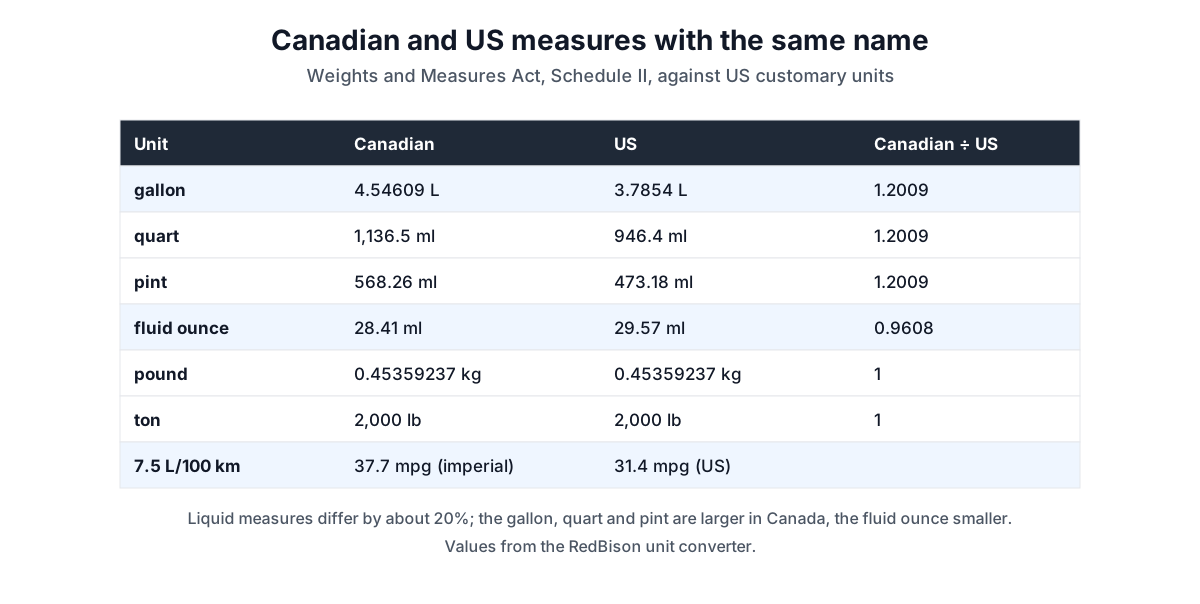
Two things stand out against other countries. The liquid units are imperial, identical to the British ones, so the converter lists them as Gallon (UK), Quart (UK), Pint (UK) and Fluid Ounce (UK). The ton and hundredweight are American: 2,000 lb and 100 lb, where the British ton is 2,240 lb and the British hundredweight 112 lb.
Section 7 limits trade to units in Schedule I or II or authorized by regulation, and section 10 lets regulations set a date after which Schedule II units may no longer be used in trade.
Food labels: metric first
The Canadian Food Inspection Agency says that on consumer prepackaged foods the net quantity must be declared on the principal display panel in metric units. Canadian units are permitted in addition, and US units may also be used as long as an accurate metric net quantity is declared. The CFIA spells out the difference: a Canadian gallon is 160 Canadian fluid ounces (4.55 L), a US gallon 128 US fluid ounces (3.78 L), and "the U.S. fluid ounce is slightly larger than the Canadian fluid ounce", 1 US fl oz being 1.041 Canadian fl oz.
In the converter, 20 US fl oz is 20.8169 Canadian (imperial) fl oz, and a 591 ml bottle is the same 591 ml whichever ounce the label also prints. When the units disagree, trust the metric figure; it is the one the law requires.
At the border: gallons, mph and prices
Speed and distance
US speed limits are in mph. 100 km/h is 62.14 mph, and 100 km is 62.1371 miles, by the exact 1.609344 km mile. Going the other way, a 65 mph limit is 104.6 km/h.
Fuel prices per gallon and per litre
US stations price fuel per US gallon. To compare with a Canadian price per litre, divide by 3.785411784, the litres in a US gallon. A price of 3.50 a US gallon is 0.9246 a litre in the same currency; convert the currency separately at the day's rate. Dividing by the imperial 4.54609 instead would understate the US price per litre by about 17%.
Tank sizes
A 50 L fill is 13.2086 US gallons or 10.9985 imperial gallons. A US manual's "13 gallon tank" is about 49.2 L; a British one's would be 59.1 L.
Fuel consumption: L/100 km and two kinds of mpg
Canada rates vehicles in litres per 100 km, while American sources quote miles per US gallon and British or older Canadian sources may use miles per imperial gallon. Because L/100 km is fuel per distance and mpg is distance per fuel, the conversion is a reciprocal:
mpg (US)       = 235.215 ÷ L/100 km     235.215 = 100 × 3.785411784 ÷ 1.609344
mpg (imperial) = 282.481 ÷ L/100 km     282.481 = 100 × 4.54609 ÷ 1.609344
Worked example. A sedan using 7.5 L/100 km gets 31.4 mpg in a US review and 37.7 mpg on the imperial gallon. Neither is wrong; they use different gallons. When you compare a US review with a Canadian rating, convert the US figure to L/100 km: 30 mpg (US) is 235.215 ÷ 30 = 7.84 L/100 km. The Canadian gas cost calculator turns L/100 km and cents per litre into a trip cost.
Weights: the same ton as the US
Because the Canadian ton is 2,000 lb, a "ton" of gravel, salt or hay from a Canadian or American supplier is 907.18 kg. A metric tonne is 1,000 kg, and a British long ton is 1,016.05 kg, or 1.12 Canadian tons. The pound is identical in all three countries: exactly 0.45359237 kg, so 200 lb is 90.7185 kg.
Kitchen and weather
- Cups. A US customary cup is 236.5882 ml. A 250 ml measuring cup holds 1.0567 US cups, close enough for soup, not for baking. Weigh flour and sugar when a recipe gives grams.
- Oven temperatures. 350 °F is 176.7 °C, and 180 °C is 356 °F. The conversion has an offset: °F = °C × 9/5 + 32.
- Weather. 22 °C is 71.6 °F and −20 °C is −4 °F. A temperature difference converts without the offset: a 10 °C drop is an 18 °F drop. Celsius and Fahrenheit meet at −40.
Common mistakes in Canada
- Using the US gallon for a Canadian figure. An older Canadian manual's "gallon" is imperial, 4.54609 L.
- Using the British ton for a Canadian one. Schedule II's ton is 2,000 lb.
- Treating ounces as interchangeable. Canadian and US fluid ounces differ by about 4%.
- Multiplying L/100 km to get mpg. It is a reciprocal.
Tools for this job
- Canadian unit converter: Canadian (imperial) gallons, pints and fluid ounces against US ones and metric, plus pounds, tons and miles.
- Canadian gas cost calculator: trip cost from L/100 km and cents per litre.
- Unit price calculator: price per 100 g or per litre when packages are labelled in different units.
The Canadian guide to comparing unit prices applies the same conversions on the shelf.
Frequently asked questions
Is a Canadian gallon the same as a US gallon?
No. Schedule II defines the Canadian gallon as 4.54609 litres, the imperial gallon. The US gallon is 3.785411784 litres, so one Canadian gallon is 1.2009 US gallons.
Is a Canadian ton the same as a US ton?
Yes. Schedule II defines the ton as 2,000 pounds, 907.18474 kg, the same as the US ton. The British long ton is 2,240 lb.
Why is a US fluid ounce bigger than a Canadian one?
The Canadian fluid ounce is 1/160 of a 4.54609 L gallon, 28.41 ml; the US fluid ounce is 1/128 of a 3.785 L gallon, 29.57 ml. The CFIA gives 1 US fl oz as 1.041 Canadian fl oz.
How do I convert L/100 km to mpg?
Divide 235.215 by L/100 km for US mpg, or 282.481 for imperial mpg. 7.5 L/100 km is 31.4 US mpg and 37.7 imperial mpg.
Sources and further reading
- Weights and Measures Act (R.S.C. 1985, c. W-6), Justice Laws Website. Section 4 (SI as the basis), section 7 (units allowed in trade) and Schedule II (Canadian units).
- Net quantity: food labelling requirements, Canadian Food Inspection Agency. Metric net quantity required, Canadian and US units allowed, and the US against Canadian fluid ounce and gallon.
- Guide for the Use of the International System of Units (SI), NIST Special Publication 811, NIST. US customary factors, including the 231 cubic inch gallon.
- Weights and Measures Act 1985, Schedule 1, legislation.gov.uk. The British definitions, for the 2,240 lb long ton and 112 lb hundredweight.
- The International System of Units (SI Brochure), BIPM. The SI that section 4 makes the basis of Canadian measurement.
More Converters
Every tool in the Converters section, free and in your browser.