
UK Imperial to Metric Conversions: Pints, Stone and mpg
Exact UK definitions of the pint, gallon, stone and ton, why UK mpg is not US mpg, converting stones and pounds, and the metric rules for shops.
By Redbison Dev · · 5 min read
United Kingdom edition. Built on the UK legal definitions in Schedule 1 of the Weights and Measures Act 1985, GOV.UK's metric trading rules, UK mpg on the 4.54609 litre gallon, stone for body weight and mph speed limits. US edition
The UK runs on two systems at once. Food is sold in grams and litres, but beer is poured by the pint, roads are signed in miles, cars are rated in miles per gallon while fuel is sold by the litre, and many people know their weight in stone. Every one of those imperial units has an exact metric definition in UK law, so converting them is arithmetic, not estimation. The catch is that several share a name with a smaller American unit. This edition gives the UK definitions, works through the conversions people in the UK actually make, and flags where an American converter or recipe will mislead you. Every figure can be checked in the UK unit converter.
The legal definitions
Schedule 1 of the Weights and Measures Act 1985 defines the imperial units in metric terms. The ones still in daily use:
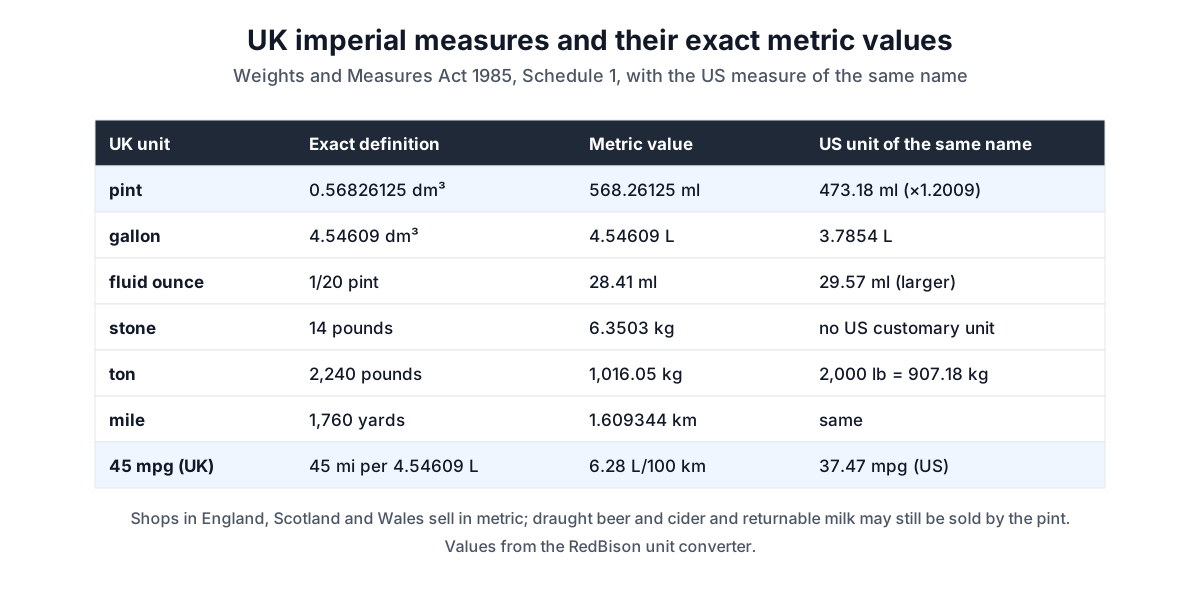
| Unit | Definition in Schedule 1 | Metric value |
|---|---|---|
| yard | 0.9144 metre | 0.9144 m |
| mile | 1,760 yards | 1.609344 km |
| pound | 0.45359237 kilogram | 453.59237 g |
| stone | 14 pounds | 6.35029318 kg |
| ton | 2,240 pounds | 1,016.0469088 kg |
| gallon | 4.54609 cubic decimetres | 4.54609 litres |
| pint | 0.56826125 cubic decimetre | 568.26125 ml |
| fluid ounce | 1/20 pint | 28.4130625 ml |
The definitions are changing home, not value. legislation.gov.uk notes that Schedule 1 is due to be omitted by section 11(3) of the Product Regulation and Metrology Act 2025, a subsection that is not yet in force. Until regulations replace it, Schedule 1 is the text to cite.
What shops and pubs may use
GOV.UK's guidance on units of measurement says that in England, Scotland and Wales you must use metric units for packaged and loose goods: grams, kilograms, millilitres and litres. Three things may still be sold in imperial: draught beer or cider by the pint, milk in returnable containers by the pint, and precious metals by the troy ounce. An imperial figure can appear next to the metric one, but it cannot stand out more. Northern Ireland has its own rules.
Two pints is 1,136.5225 ml, so a carton described as 2 pints has to show its metric quantity, about 1.136 litres, at least as prominently. A pub pint is a full 568 ml measure.
The conversions people actually make
Body weight in stones and pounds
The converter takes one unit at a time, so convert stones and pounds to pounds first: 12 st 7 lb is 12 × 14 + 7 = 175 lb, which is 79.3787 kg. In the other direction, 70 kg is 11.0231 st, or 11 st 0.3 lb.
Height in feet and inches
5 ft 10 in is 70 inches, exactly 177.8 cm, because the inch is exactly 2.54 cm (1/36 of the 0.9144 m yard).
A pint, in millilitres and units
One UK pint is 568.26125 ml, or 1.2009 US pints. The NHS formula for alcohol units is strength (ABV) × volume (ml) ÷ 1,000, and it uses 568 ml for a pint: a pint of 5.2% lager is 5.2 × 568 ÷ 1,000 = 2.95 units. Using the exact 568.26125 ml changes nothing that matters. The NHS guideline is to keep regular drinking to 14 units a week or less.
Miles and speed limits
GOV.UK lists the national limits in mph with km/h beside them: 30 mph (48 km/h) in built-up areas in England, Scotland and Northern Ireland, 20 mph (32 km/h) in Wales, 60 mph (96 km/h) on single carriageways and 70 mph (112 km/h) on dual carriageways and motorways. The exact conversions are 48.28, 32.19, 96.56 and 112.65 km/h: the published figures round down. Distance and speed convert by the same factor, so 70 miles is 112.6541 km.
Tons and tonnes
A UK ton is 2,240 lb, 1,016.05 kg, which the converter lists as Long Ton (UK). It is 1.12 American tons of 2,000 lb and about 1.6% more than a metric tonne. Older UK drawings, shipping documents and some trades say "ton" and mean this one; check before assuming the 1,000 kg tonne.
mpg: the UK conversion that trips people up
UK car brochures and dashboards quote miles per imperial gallon, while UK pumps sell by the litre and the metric measure of fuel use is litres per 100 km. Because mpg is distance per volume and L/100 km is volume per distance, the conversion is a division, not a multiplication:
L/100 km = 282.481 ÷ mpg (UK)        282.481 = 100 × 4.54609 ÷ 1.609344
L/100 km = 235.215 ÷ mpg (US)        235.215 = 100 × 3.785411784 ÷ 1.609344
Worked example. A car rated at 45 mpg (UK) uses 282.481 ÷ 45 = 6.28 litres per 100 km. The same car in an American review would be quoted at 45 × 3.785411784 ÷ 4.54609 = 37.47 mpg (US). Neither car got worse; the imperial gallon is 20% larger than the American one. In the converter, the factor comes from the Gallon (UK) and Mile rows: 1 imperial gallon is 4.54609 litres and 1 mile is 1.609344 km.
When you compare fuel economy from a US website with a UK brochure, convert both to L/100 km first. The UK fuel cost calculator does the journey cost from UK mpg and the pump price per litre.
Cooking: UK and US recipes
British recipes are mostly in grams and millilitres, but older ones and American ones are not.
- A US cup is 236.5882 ml, so 2 US cups are 0.8327 UK pints, not "a pint". A US pint is 473.18 ml.
- A UK fluid ounce is smaller than a US one (28.41 ml against 29.57 ml) even though the UK pint is bigger, because the UK pint has 20 fluid ounces and the US pint 16. A US recipe's 20 fl oz is 20.8169 UK fl oz.
- Oven temperatures convert with an offset: 180 °C is 356 °F, so an American recipe's 350 °F (176.7 °C) is close.
For recipe quantities, the cooking converter handles cups, spoons and grams for common ingredients.
Temperatures: the offset trap
UK forecasts are in Celsius, but °F still turns up in headlines and older recipes. Temperatures need an offset as well as a factor: °F = °C × 9/5 + 32, so 30 °C is 86 °F. Differences do not: a rise of 10 °C is a rise of 18 °F, not 50 °F. The two scales meet at −40.
Common mistakes in the UK
- Picking the US unit by default. US-built converters, including the default list in this one, put
Gallon (US)andPint (US)first. For UK figures, choose the units marked (UK). - Multiplying mpg to get L/100 km. It is a reciprocal: 282.481 ÷ mpg.
- Entering 11.4 for 11 st 4 lb. That is 11.4 stone, 11 st 5.6 lb. Convert to pounds first.
- Reading "ton" as tonne. In older UK documents it is 2,240 lb.
Tools for this job
- UK unit converter: stone, imperial pints and gallons, long tons and miles against metric, with exact UK factors.
- UK fuel cost calculator: journey cost from UK mpg and pence per litre.
- Cooking converter: cups, spoons and grams for recipes.
- BMI calculator: takes stones and pounds or kilograms.
The UK guide to comparing unit prices uses the same conversions on supermarket labels.
Frequently asked questions
How many ml are in a UK pint?
Exactly 568.26125 ml, the definition in Schedule 1 of the Weights and Measures Act 1985. The NHS rounds it to 568 ml for alcohol units.
How do I convert UK mpg to litres per 100 km?
Divide 282.481 by the mpg figure. 45 mpg (UK) is 6.28 L/100 km and 60 mpg is 4.71 L/100 km.
Why is a UK mpg figure higher than the US figure for the same car?
Because the imperial gallon is 4.54609 litres and the US gallon 3.785411784 litres. The same car covers about 20% more miles per imperial gallon, so 45 UK mpg is 37.47 US mpg.
How many kg is a stone?
Exactly 6.35029318 kg: 14 pounds of 0.45359237 kg each.
Sources and further reading
- Weights and Measures Act 1985, Schedule 1, legislation.gov.uk. The UK definitions of the yard, mile, pound, stone, ton, gallon, pint and fluid ounce, and the note on its future omission.
- Product Regulation and Metrology Act 2025, section 11, legislation.gov.uk. The consequential amendment that will omit Schedule 1, not yet in force.
- Weights and measures: the law, units of measurement, GOV.UK. Metric for trade, the pint and troy ounce exceptions, and supplementary imperial indications.
- Speed limits, GOV.UK. National limits in mph with km/h.
- Calculating alcohol units, NHS. The unit formula and the 568 ml pint.
- Guide for the Use of the International System of Units (SI), NIST Special Publication 811, NIST. The US customary factors behind the US gallon and pint.
More Converters
Every tool in the Converters section, free and in your browser.