
Concrete Mix Ratios UK: Bags of Cement, Sand and Ballast
How many 25 kg bags of cement and how much sand, gravel or ballast a shed base or footing takes, why dry volume beats wet, and when to order ready-mix.
By Redbison Dev · · 10 min read

United Kingdom edition. Uses 25 kg cement bags, the 1:2:3 and 1:4 ballast mixes a UK cement maker prints on its data sheet, BS 8500 ready-mix designations such as ST3 and GEN1, and UK rules on wet cement and front gardens. US edition
For a shed base, a path or a set of fence posts, most people in the UK mix concrete by volume: so many shovels of sand and gravel, or of all-in ballast, to one of cement, from 25 kg bags. Heidelberg Materials' data sheet for its general purpose cement gives two everyday concrete mixes: 1 part cement, 2 parts concrete sand and 3 parts 4/20 mm aggregate, or 1 part cement to 4 parts combined sand and aggregate (ballast). Turning either into an order needs one more number, the dry volume factor, and this guide works it through with the UK concrete mix calculator.
Why you need more dry material than concrete
Loose gravel is full of air. Sand runs into the gaps between the stones, and the cement paste fills the gaps between the sand grains, so the dry heaps shrink when they become concrete. To allow for that shrinkage, the calculator multiplies the finished volume by 1.54 to get the volume of loose dry material to buy. Skip the factor and you will be about a third short, running out roughly two-thirds of the way through the job.
The arithmetic for any ratio of cement : sand : aggregate (c : s : a):
- Dry volume = finished volume x 1.54.
- Cement volume = dry volume x c / (c + s + a); at a loose density of 1,440 kg/m³ that gives kilograms, and dividing by 25 gives bags.
- Sand and aggregate get their shares the same way. For ballast, put its parts in the sand box and 0 for aggregate.
- Water = water-cement ratio x cement mass. At 0.5, a 25 kg bag takes 12.5 litres in total, including the water already in damp sand.
Bags per cubic metre for common UK mixes
| Mix (by volume) | Typical use | 25 kg bags per m³ | Cement per m³ |
|---|---|---|---|
| 1 : 2 : 3 (sand, 4/20 mm) | general purpose concrete on the data sheet | 14.8 | 370 kg |
| 1 : 4 ballast | general purpose concrete on the data sheet | 17.7 | 444 kg |
| 1 : 2 : 4 | leaner general concrete, footings | 12.7 | 317 kg |
| 1 : 5 ballast | leaner ballast mix, often quoted for bases | 14.8 | 370 kg |
The 1 : 4 ballast mix uses the most cement because ballast already contains the sand; there is no separate aggregate part to dilute it. A 1 : 5 ballast mix has the same cement content as 1 : 2 : 3, because both have six parts of aggregate to one of cement.
Worked example: a shed base
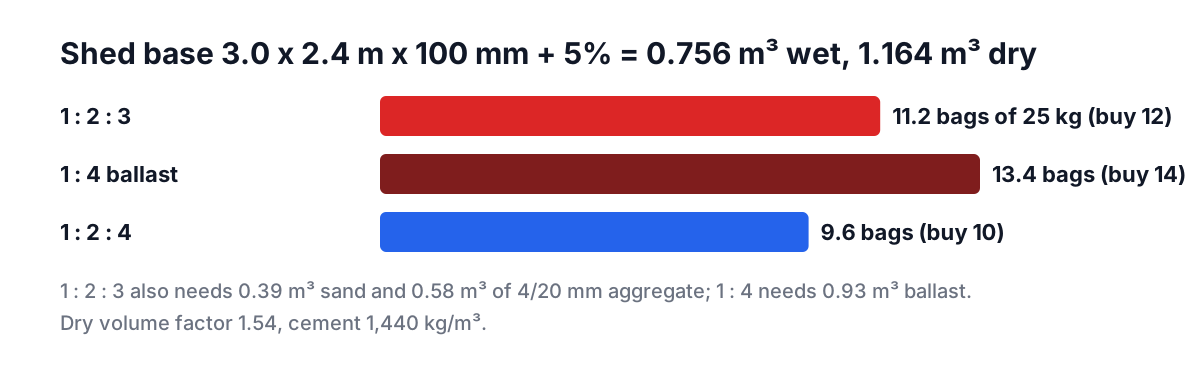
A 3.0 x 2.4 m base, 100 mm thick, with 5% extra for an uneven sub-base, is 0.756 m³ of concrete.
| 1 : 2 : 3 | 1 : 4 ballast | 1 : 2 : 4 | |
|---|---|---|---|
| Dry volume | 1.164 m³ | 1.164 m³ | 1.164 m³ |
| Cement | 279 kg, 11.2 bags (buy 12) | 335 kg, 13.4 bags (buy 14) | 240 kg, 9.6 bags (buy 10) |
| Sand or ballast | 0.39 m³ sand | 0.93 m³ ballast | 0.33 m³ sand |
| 4/20 mm aggregate | 0.58 m³ | none | 0.67 m³ |
| Water at w/c 0.5 | about 140 L | about 168 L | about 120 L |
Merchants sell sand, gravel and ballast in bulk bags by weight or by nominal volume, and a bag's weight depends on how damp the material is. Ask the merchant what one bulk bag yields in cubic metres and divide; the calculator also shows kilograms at a default bulk density you can change.
Heidelberg Materials lists ST3 and ST4 ready-mixed concrete for shed and workshop bases. If you would rather not mix 0.76 m³ yourself, that is what to ask for; 0.76 m³ is 10 to 14 bags of cement depending on the mix and well over a tonne of sand and stone to shovel, so ask local suppliers about their minimum load.
Worked example: fence posts and a garden wall footing
Ten fence posts set in holes 300 mm across and 600 mm deep take about 0.042 m³ each. With 5% extra that is 0.445 m³ in total, and at 1 : 2 : 3 it needs 165 kg of cement: 6.6 bags, so 7 to buy, with 0.23 m³ of sand and 0.34 m³ of aggregate.
A strip footing for a 6 m garden wall, 450 mm wide and 225 mm deep, is 0.608 m³, or 0.638 m³ with 5% extra. At 1 : 2 : 3 that is 236 kg of cement, 9.4 bags. For footings that carry a building, the mix is set by the structural design and checked by building control; Heidelberg lists ST2 for unreinforced strip footings and trench fill, and GEN1 for unreinforced domestic foundations in DC-1 soils.
Ready-mix names you will hear
Ready-mix suppliers do not sell ratios. They sell concretes defined in BS 8500 by strength and composition. Heidelberg Materials' descriptions give a practical map:
| Designation | Typical domestic use (Heidelberg Materials) | Strength given |
|---|---|---|
| ST1 | kerb bedding, blinding, haunching | assume 7.5 N/mm² |
| ST2 | unreinforced strip footings, trench fill, fence post footings | assume 10 N/mm² |
| ST3 | shed and workshop bases, patio paving, unreinforced bases | assume 15 N/mm² |
| ST4 | garage floors (not suspended or reinforced), shed bases, internal slabs with no embedded metal | assume 20 N/mm² |
| GEN1 | unreinforced domestic foundations in DC-1 soils, kerbing | |
| PAV1 | house driveways, patios, hard standings | 35 N/mm² at 28 days |
There is no exact hand-mix equivalent for any of them; a site mix depends on your sand, your bucket and your water. Use the ratios for small, non-structural pours, and order by designation for anything structural or large.
UK rules and good practice
- Wet cement burns. The Health and Safety Executive warns that wet cement is highly alkaline and a serious burn can develop if it is trapped against the skin, and that it can cause dermatitis. Wear waterproof gloves suitable for alkaline materials, boots tall enough to keep it out, and wash any off straight away.
- Weather. The data sheet says to place concrete between 5°C and 30°C, protect it from frost, and keep it from drying out (curing) for at least the first 7 days.
- Storage. Keep bags off the ground in a dry place. The data sheet gives a maximum shelf life of 6 months, stated on the bag.
- Front gardens. Under the guidance on permeable surfacing of front gardens, hard surfacing more than 5 m² of a front garden is permitted development only if the surface is permeable; impermeable concrete over that area needs planning permission.
- Damp sand. Wet sand takes up more space than dry sand, so a bucket of it holds less sand and more water. The Indian concrete code, IS 456, which still documents site volume batching, requires an allowance for this bulking; in practice, keep sand covered and use the same bucket for every part.
Tools for this job
- Concrete mix calculator (UK): bags, sand, aggregate or ballast and water for any ratio.
- Concrete calculator (UK): the volume of slabs, footings and posts before you split it.
- Rebar calculator (UK) and brick calculator (UK) for the steel and the wall that come next.
- The UK guide to estimating concrete and flooring covers premixed bags and ordering ready-mix.
Frequently asked questions
How many 25 kg bags of cement do I need for a cubic metre of concrete?
About 14.8 bags for a 1 : 2 : 3 mix, 17.7 for 1 : 4 ballast and 12.7 for 1 : 2 : 4, using the 1.54 dry volume factor and cement at 1,440 kg/m³. Round up and keep a spare in case a bag has gone hard.
What is the ratio of ballast to cement for concrete?
A UK cement maker's data sheet gives 1 part cement to 4 parts ballast for general purpose concrete. Leaner 1 : 5 or 1 : 6 ballast mixes are common for bases and blinding but contain less cement per cubic metre.
What is the difference between ST3 and GEN1 concrete?
Both are BS 8500 concretes ordered from a ready-mix supplier. ST3 is a standardised prescribed concrete that Heidelberg Materials lists for shed bases, patios and unreinforced bases; GEN1 is a designated concrete it lists for unreinforced domestic foundations in DC-1 soils, kerbing and haunching. Your designer or building control decides which a foundation needs.
How much water goes in a 25 kg bag of cement?
At a water-cement ratio of 0.5, about 12.5 litres in total, including the water already in damp sand. Add it gradually; a slightly stiff mix makes stronger concrete than a sloppy one.
Sources and further reading
- General Purpose Cement technical data sheet, Heidelberg Materials UK, 2025. Typical mixes, 25 kg bags, curing and storage.
- Types of concrete, Heidelberg Materials UK. GEN, ST, PAV and RC concretes and their uses.
- Construction hazardous substances: cement, Health and Safety Executive. Burns, dermatitis and controls.
- Permeable surfacing of front gardens: guidance, GOV.UK. The 5 m² permitted development rule.
- IS 456:2000 Plain and Reinforced Concrete: Code of Practice, Bureau of Indian Standards (copy at Public.Resource.Org). Clause 10.2.4 on volume batching and bulking.
Open the Concrete Mix Ratio Calculator
More Civil & Structural
Every tool in the Civil & Structural section, free and in your browser.