
Transformer Sizing UK: kVA, 11 kV to 400 V and IEC Sizes
Sizing an 11 kV to 400 V transformer in the UK: kW to kVA, full-load amps, the IEC 500, 630 and 800 kVA steps, Dyn11 ratios and what ecodesign loss limits mean.
By Redbison Dev · · 10 min read
United Kingdom edition. Uses IEC 60076 ratings at 50 Hz, 11 kV primaries and 400/230 V secondaries, the ESQCR supply tolerances, and the Tier 2 loss limits in Regulation (EU) No 548/2014, which remains in force in Great Britain as amended by the EU Exit regulations (SI 2019/539). US edition
A warehouse with 380 kW of maximum demand at power factor 0.9 needs 422 kVA. Add 20% for growth and the requirement is 507 kVA, which is just over a 500 kVA unit, so the IEC series takes you to 630 kVA, running at 67% of its rating. On an 11 kV to 400 V unit that rating means 33.1 A on the high-voltage side and 909 A on the 400 V side, and it is the 909 A that sizes the low-voltage switchboard and the cables from the transformer. This edition works through that decision for UK sites, including how the ecodesign loss limits change the comparison between 500 and 630 kVA. Every number comes from the UK transformer sizing calculator.
Rated in kVA because heat does not care about power factor
A transformer's limit is the temperature of its windings and oil. The core loss is fixed by the voltage, and the winding loss is set by the current squared. Neither depends on how much of that current does useful work, so the manufacturer rates the unit in kVA, not kW. A load given in kW must be divided by its power factor first: 380 kW at 0.9 is 422.2 kVA. Sizing on 380 would undersize the transformer by 10%, and by 20% at a power factor of 0.8. The UK three-phase power guide covers the kW to kVA step in detail.
Full-load current on both sides
I (three-phase) = kVA × 1000 ÷ (√3 × V line to line)
| Rating | 11 kV side | 400 V side |
|---|---|---|
| 500 kVA | 26.2 A | 721.7 A |
| 630 kVA | 33.1 A | 909.3 A |
| 1,000 kVA | 52.5 A | 1,443.4 A |
If your data sheet states the secondary voltage at no load, for example 433 V, calculate at that voltage when you compare with the maker's figures: the same 630 kVA gives 840.0 A at 433 V. Be consistent: the low-voltage incomer, busbars and tails must carry the full-load current at the voltage the board actually sees.
Ratios on a Dyn11 unit
A common arrangement for an 11 kV to 400 V unit is delta on the 11 kV side and star with a neutral on the 400 V side, shown in the vector group Dyn11: the low-voltage side leads the high-voltage side by 30°.
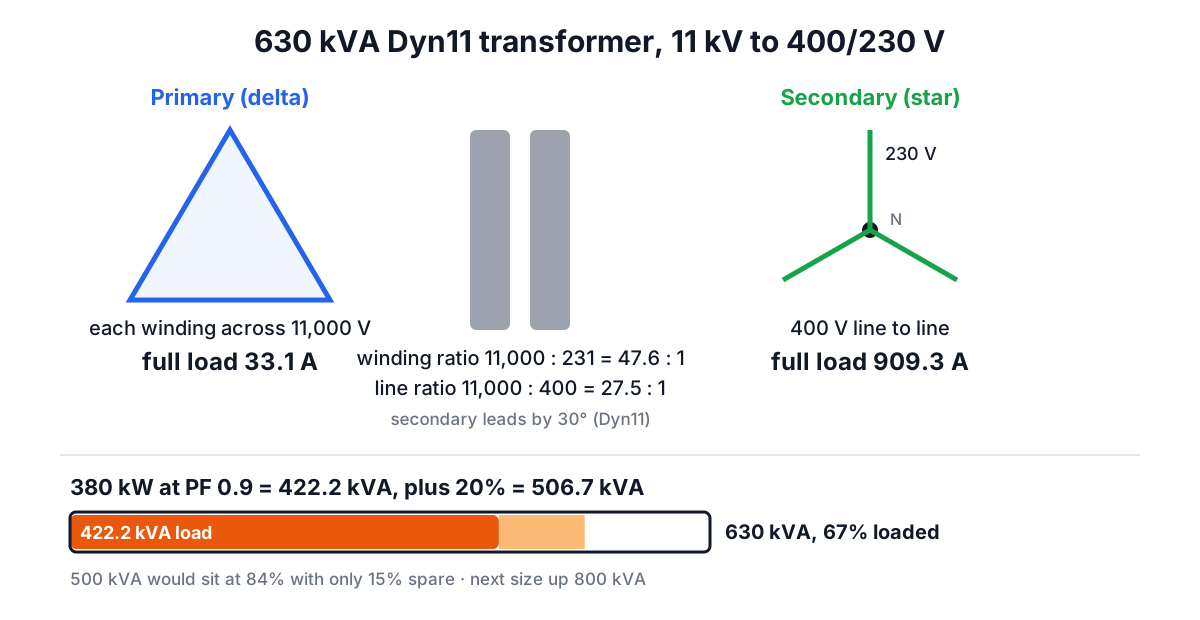
Two ratios matter, and they differ by √3. The line voltage ratio is 11,000 ÷ 400 = 27.5, which is what the calculator reports and what you use for currents. The winding ratio is 11,000 ÷ 230.9 = 47.6, because each delta winding sits across the full 11 kV while each star winding produces one phase-to-neutral voltage. Quote the vector group, not just the voltages, when you order a replacement or plan to run two transformers in parallel.
The high-voltage side has its own tolerance. ESQCR regulation 27 allows a high-voltage supply below 132 kV to vary 6% either way from its declared voltage, so an 11 kV supply may sit between 10.34 kV and 11.66 kV. Tappings on the transformer let the 400 V side be adjusted to suit the local high-voltage level.
Choosing the size
- Start from maximum demand. Add up the after-diversity demand of the installation, not the sum of every rating plate. For an existing site, half-hourly data from the meter gives the real peak in kVA.
- Convert to kVA at a realistic power factor, or at the corrected power factor if you are fitting a capacitor bank.
- Add a growth margin. 20 to 25% is common, more if heat pumps, EV chargers or new process lines are planned.
- Round up to an IEC rating. The IEC preferred ratings the calculator offers are 25, 50, 63, 100, 160, 200, 250, 315, 400, 500, 630, 800, 1,000, 1,250, 1,600, 2,000, 2,500 and 3,150 kVA.
For the warehouse, a 20% margin gives 506.7 kVA and 630 kVA. With a 15% margin the requirement is 485.6 kVA, which fits a 500 kVA unit at 84% loading. Which is right depends on how firm the growth plans are, and on losses.
Losses: why the larger unit can cost less to run
Regulation (EU) No 548/2014 on ecodesign for power transformers, in the version published on legislation.gov.uk, applies to transformers with a minimum power rating of 1 kVA used in 50 Hz transmission and distribution networks or for industrial applications, with exclusions such as instrument, traction and welding transformers. Its Annex I, Table I.1 sets maximum losses for three-phase liquid-immersed transformers with one winding up to 24 kV and the other up to 3.6 kV. The Tier 2 limits, from 1 July 2021, for the two candidate sizes are:
| Rating | Maximum load loss Pk | Maximum no-load loss Po |
|---|---|---|
| 500 kVA | 3,900 W | 459 W |
| 630 kVA | 4,600 W | 540 W |
Load loss scales with the square of the loading. At the warehouse's 422.2 kVA:
- 500 kVA: 459 + 3,900 × 0.844² = 3,240 W
- 630 kVA: 540 + 4,600 × 0.670² = 2,606 W
At this load, a 630 kVA unit built to the Tier 2 limits loses about 634 W less, every hour the site runs near its peak, while the no-load loss of either is paid around the clock. These are maximum permitted losses; compare the guaranteed figures on the tenders you receive.
When a bigger unit is justified
- Large motor starts. A direct-on-line start draws several times running current through the transformer's impedance and dips the voltage for every other load on the board.
- Harmonic loads. Drives, UPS units and LED drivers raise the winding losses. Ask the supplier about derating for the harmonic content you expect.
- Hot plant rooms. A rating assumes normal service conditions for ambient temperature; check the maker's derating for a poorly ventilated substation.
- One heavy phase. On the 400 V side, the most heavily loaded phase limits the transformer, not the average.
The 400 V side and the DNO
On the low-voltage side, cables and protection from the transformer to the main switchboard are designed to BS 7671, which the IET lists as BS 7671:2018+A4:2026. The high-voltage connection, protection settings and metering are agreed with the distribution network operator, so involve them early. A qualified engineer should confirm the final rating.
Frequently asked questions
What size transformer do I need for 380 kW?
At power factor 0.9 the load is 422.2 kVA. With 20% spare that is 506.7 kVA, so the next IEC rating is 630 kVA at 67% loading. With 15% spare a 500 kVA unit fits at 84%.
How many amps is a 630 kVA transformer at 400 V?
630,000 ÷ (√3 × 400) = 909.3 A on the 400 V side and 33.1 A on an 11 kV primary.
Why is the winding ratio of an 11 kV to 400 V transformer not 27.5?
27.5 is the ratio of line voltages. In a Dyn11 unit each delta winding sees 11,000 V and each star winding produces 230.9 V, so the windings are in a 47.6 to 1 ratio.
Do UK transformers have to meet loss limits?
Regulation (EU) No 548/2014, which remains in force in Great Britain as amended by the EU Exit regulations (SI 2019/539), sets maximum load and no-load losses by rating. The Tier 2 limits for a 630 kVA liquid-immersed unit are 4,600 W load loss and 540 W no-load loss. Ask suppliers to confirm compliance.
Is 80% loading the right target?
It is a common starting point. Firm growth plans, a hot plant room or heavy harmonic loads argue for more headroom; a flat, well-measured load may run closer to its rating. Compare the losses at your expected load before deciding.
Sources and further reading
- Commission Regulation (EU) No 548/2014, Article 1, legislation.gov.uk. Scope: power transformers of 1 kVA and above in 50 Hz networks and industry, with exclusions.
- Commission Regulation (EU) No 548/2014, Annex I, legislation.gov.uk. Table I.1 Tier 1 and Tier 2 maximum load and no-load losses.
- The Electricity Safety, Quality and Continuity Regulations 2002, regulation 27, legislation.gov.uk. 230 V low-voltage supply and ±6% for high voltage below 132 kV.
- IEC 60076-1: Power transformers, General, International Electrotechnical Commission.
- BS 7671: Requirements for Electrical Installations, The Institution of Engineering and Technology.
- Transformer sizing (US edition), for 480 V to 208Y/120 V units and the NEC.
Open the Transformer Sizing Calculator
More Electrical
Every tool in the Electrical section, free and in your browser.