
Transformer Sizing Australia: kVA for 11 kV and 22 kV Sites
Sizing a high-voltage customer's transformer in Australia: kW to kVA, 400 V full-load amps, IEC ratings, the 0.9 power factor rule and NSW HV rules.
By Redbison Dev · · 10 min read
Australia edition. Written for sites taking supply at 11 kV or 22 kV and stepping down to 230/400 V, with IEC ratings, the high-voltage customer obligations in Section 7 of the Service and Installation Rules of NSW, and the federal GEMS determination for power transformers. US edition
A commercial site with 450 kW of maximum demand at power factor 0.8 needs 562.5 kVA, and with 20% added for growth that is 675 kVA, so the IEC series takes it to an 800 kVA transformer. Correct the power factor to 0.9, which the NSW service rules ask a high-voltage customer to maintain anyway, and the load drops to 500 kVA; with the same 20% margin, a 630 kVA unit is enough. That one decision changes the transformer, the main switchboard and the cables. This edition works through sizing for Australian sites that take a high-voltage supply, using the Australian transformer sizing calculator for every figure.
Who needs their own transformer
Clause 1.11.3 of the Service and Installation Rules of NSW says electricity may be supplied at higher voltages if required, and Section 7 sets out what that means for supply above 1,000 V AC. A customer who takes supply at high voltage bears the costs of transformer energy losses, the high-voltage equipment and its operation, testing and maintenance, spare equipment, and compliance with the distributor's safety management system. The installation has to comply with the high-voltage section of AS/NZS 3000, AS 2067 (Substations and high voltage installations exceeding 1 kV a.c.), the rules themselves and the distributor's own requirements, and each customer needs a high-voltage installation safety management plan.
One practical warning in clause 7.3 is worth repeating: potential high-voltage customers are advised not to buy or install any high-voltage equipment until the design and construction programs have been accepted by both parties. Size the transformer, then agree it with the distributor before ordering.
kVA from kW, and why power factor matters here
A transformer is limited by the heat in its windings, which depends on current, not on how much of the current does useful work. So it is rated in kVA, and a kW load must be divided by power factor first.
Clause 7.4.10 requires the customer to keep the maximum demand power factor at all metering points as per the connection agreement or between 0.9 lagging and unity, and says to allow for power factor correction equipment in the initial design. Customers supplied above 50 kV are referred to the National Electricity Rules instead. For the 450 kW site:
| Power factor | Load | With 20% margin | IEC rating | Loading |
|---|---|---|---|---|
| 0.8 | 562.5 kVA | 675 kVA | 800 kVA | 70% |
| 0.9 | 500.0 kVA | 600 kVA | 630 kVA | 79% |
Designing the correction in from the start saves a rating step. The Australian power factor correction guide and the power factor calculator size the capacitor bank.
Full-load current at 11 kV, 22 kV and 400 V
I = kVA × 1000 ÷ (√3 × V line to line)
| Rating | 11 kV | 22 kV | 400 V |
|---|---|---|---|
| 160 kVA | 8.4 A | 4.2 A | 230.9 A |
| 630 kVA | 33.1 A | 16.5 A | 909.3 A |
| 800 kVA | 42.0 A | 21.0 A | 1,154.7 A |
Doubling the primary voltage halves the primary current; the 400 V side is unchanged. That 400 V full-load current sets the main switch and busbar rating at the main switchboard, and the low-voltage nominal supply is 230/400 V, as in clause 1.11.1 of the NSW rules.
Ratios on a delta-star unit
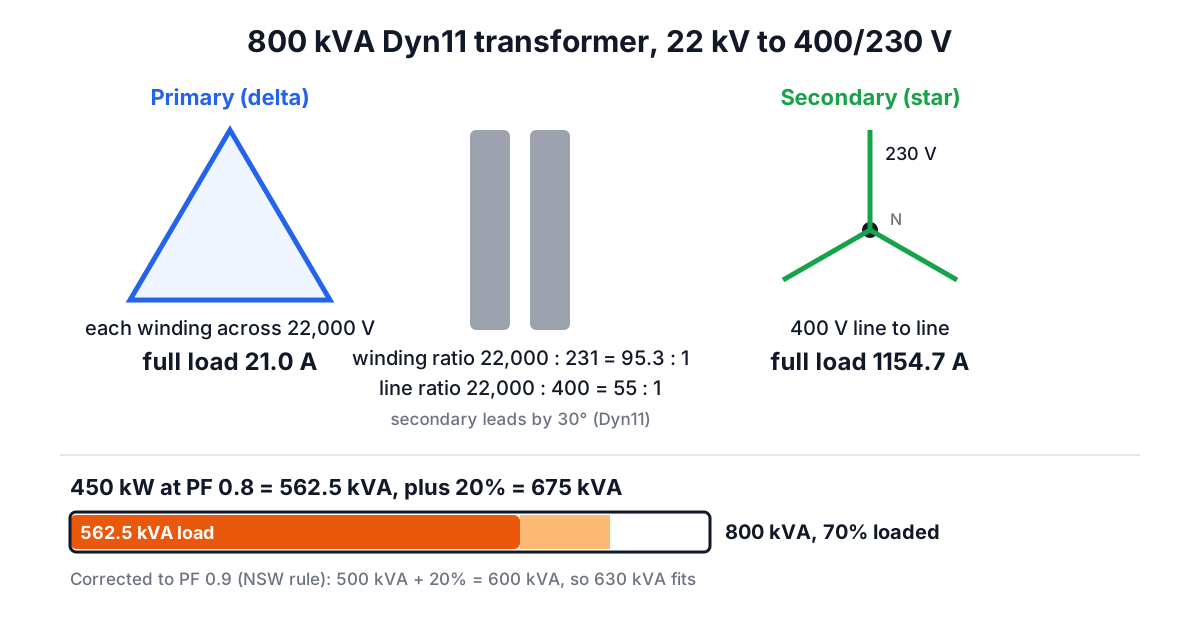
On a delta-star (Dyn11) unit each high-voltage winding is across the full line voltage and each low-voltage winding gives one active-to-neutral voltage. For 22 kV to 400/230 V, the windings are in a 22,000 ÷ 230.9 = 95.3 to 1 ratio, while the line voltages are in a 55 to 1 ratio, which is the ratio the calculator reports and the one that governs the currents. On an 11 kV unit the line ratio is 27.5 to 1. The star point provides the neutral for single-phase loads.
Sizing step by step
- Maximum demand, not connected load. The NSW rules tie maximum demand to AS/NZS 3000. For an existing site, logged data from the meter beats any estimate; a single clamp-meter reading can miss the peak.
- Convert to kVA at the power factor you will actually run at, after correction.
- Add a growth margin, commonly 20 to 25%.
- Round up to an IEC rating: 25, 50, 63, 100, 160, 200, 250, 315, 400, 500, 630, 800, 1,000, 1,250, 1,600, 2,000, 2,500 or 3,150 kVA in the calculator's list.
Two examples from site data:
- Measured 180 A per phase at 400 V. That is 124.7 kVA; with 20% it is 149.6 kVA, so a 160 kVA unit at 78%.
- 600 kVA after-diversity demand. With 20% it is 720 kVA, so 800 kVA at 75%, carrying 42.0 A at 11 kV or 21.0 A at 22 kV.
Losses are the customer's cost
Because a high-voltage customer bears the transformer's energy losses, the comparison between two sizes is not only about capital cost. No-load (core) loss is paid around the clock whatever the load, and load loss rises with the square of the loading. An oversized unit at 30% load wastes core loss every hour; an undersized one runs hot and loses more in its windings. Ask suppliers for guaranteed no-load and load losses and work out the total at your expected load profile.
There is also a federal instrument on power transformer energy performance: the Greenhouse and Energy Minimum Standards (Power Transformers) Determination 2012, which the Federal Register of Legislation lists as in force. Ask suppliers whether the unit you are buying falls under it and is registered.
When to allow more headroom
- Motor starts. The NSW rules limit motor starting current at the connection point (Table 1-3 and clause 1.17.2.4 for low-voltage installations); on a site with its own transformer, a large direct-on-line start still dips the voltage on every other load.
- Harmonics from drives, UPS units and LED drivers add winding losses.
- Hot switch rooms and poor ventilation reduce the rating; check the maker's derating for your room's ambient temperature.
- Unbalanced single-phase load on the 400 V side: the heaviest phase limits the unit.
The Australian three-phase power guide shows how to turn a load list into kVA per phase. The high-voltage design, protection and earthing should be done by a qualified engineer and agreed with the distributor.
Frequently asked questions
What size transformer do I need for 450 kW?
At power factor 0.8 the load is 562.5 kVA; with 20% margin that is 675 kVA and an 800 kVA unit. Corrected to 0.9, the load is 500 kVA, the requirement 600 kVA and a 630 kVA unit fits at 79%.
How many amps is an 800 kVA transformer?
1,154.7 A at 400 V, 42.0 A at 11 kV and 21.0 A at 22 kV.
What power factor must a high-voltage customer maintain in NSW?
Clause 7.4.10 of the Service and Installation Rules of NSW requires the maximum demand power factor at all metering points as per the connection agreement or between 0.9 lagging and unity; customers supplied above 50 kV follow the National Electricity Rules.
Who pays for transformer losses on a high-voltage supply?
The customer. Section 7.2 of the NSW rules lists transformer energy losses among the costs borne by customers who take supply at high voltage.
Can I buy the transformer before the distributor approves the design?
The NSW rules advise potential high-voltage customers not to purchase or install any high-voltage equipment until the design and construction programs have been accepted by both parties.
Sources and further reading
- Service and Installation Rules of NSW (April 2026), NSW Government. Clauses 1.11.1 and 1.11.3, Section 7 (7.2 costs, 7.3 proposals, 7.4.2 compliance, 7.4.10 power factor).
- Service and Installation Rules, NSW Government. Current edition and summary of changes.
- Greenhouse and Energy Minimum Standards (Power Transformers) Determination 2012, Federal Register of Legislation.
- IEC 60076-1: Power transformers, General, International Electrotechnical Commission.
- IEC 60038: IEC standard voltages, International Electrotechnical Commission.
- Transformer sizing (US edition), for North American ratings and the NEC.
Open the Transformer Sizing Calculator
More Electrical
Every tool in the Electrical section, free and in your browser.