
Transformer kVA Calculation: IS 1180 Sizes and 433 V Amps
How to calculate distribution transformer size in India: kW to kVA, IS 1180 ratings from 16 to 2,500 kVA, 11 kV and 433 V full-load current, losses and CPWD advice.
By Redbison Dev · · 10 min read
India edition. Uses the BIS IS 1180 ratings, energy efficiency levels and 433/250 V secondaries for Indian distribution transformers, with CPWD planning guidance on power factor, standby units and load growth. US edition
A commercial building with 120 kW of demand at power factor 0.9 needs 133.3 kVA. With 20% added for growth that becomes 160 kVA, which is exactly an IS 1180 standard rating, so a 160 kVA, 11 kV to 433 V distribution transformer fits at 83% loading. It carries 8.4 A on the 11 kV side and 213.3 A on the 433 V side, and that 213 A is the figure your LT panel builder will size the incomer around. This edition explains each step for Indian sites, where the rating list, the secondary voltage and the loss levels all come from BIS standards rather than the North American or European ones. The figures come from the IS 1180 transformer calculator.
Indian distribution voltages
BIS, in its summary of transformer standards, gives the distribution circuit voltages in India as 3.3, 6.6, 11, 22 and 33 kV, and the power supply for end users as 415 V, 3 phase (240 V, 1 phase), 50 Hz. Transformers with a primary of 3.3 to 33 kV and a secondary of 433 V, 3 phase (and 250 V single phase) are what it calls distribution transformers.
Why 433 V and not 415 V? It is about 4% above the 415 V that consumers are meant to receive, which leaves room for the voltage drop inside the transformer and along the LT cables when the load comes on. It also matters for your arithmetic: the same 100 kVA is 133.3 A at 433 V but 139.1 A at 415 V. Use the voltage your transformer data sheet uses when you compare figures.
kVA, not kW
A transformer heats up according to the current through its windings and the voltage on its core. Whether that current does useful work does not change the heating, so the rating is in kVA. Divide kW by power factor before anything else.
Power factor changes the answer. CPWD's General Specifications for Electrical Works ask consumers to keep a power factor of not less than 0.95 lagging at the point of connection. For an office block with 300 kW of demand and 25% growth margin:
| Power factor | Load | Required | IS 1180 rating | Loading |
|---|---|---|---|---|
| 0.80 | 375.0 kVA | 468.8 kVA | 500 kVA | 75% |
| 0.95 | 315.8 kVA | 394.7 kVA | 400 kVA | 79% |
Correcting to 0.95 with an APFC panel saves one rating step. The power factor correction guide for India sizes the capacitors.
Full-load current on each side
I = kVA × 1000 ÷ (√3 × V)
| Rating | 11 kV side | 433 V side |
|---|---|---|
| 100 kVA | 5.25 A | 133.3 A |
| 160 kVA | 8.40 A | 213.3 A |
| 400 kVA | 21.0 A | 533.3 A |
The quick rule on the LT side: each kVA is 1.333 A at 433 V. The three phase power guide for India explains the √3.
Turns ratio of a delta-star unit
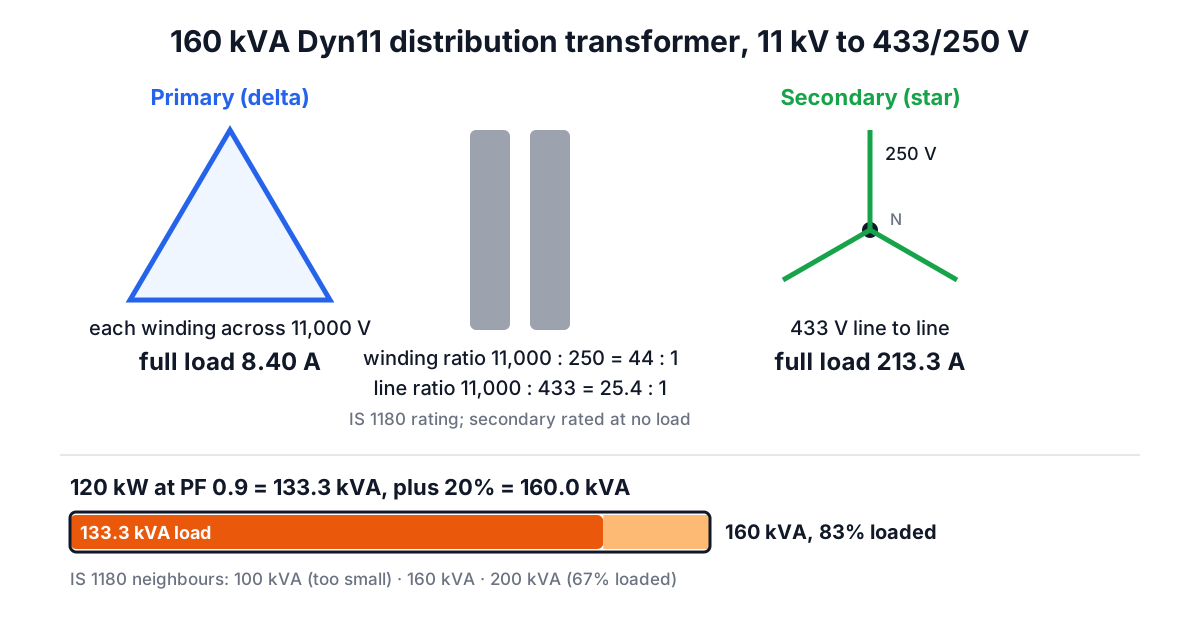
With a delta primary and a star secondary, each HT winding sits across the full 11 kV and each LT winding gives one phase-to-neutral voltage, 250 V at no load. The windings are therefore in a 44 to 1 ratio, while the line voltages are in an 11,000 ÷ 433 = 25.4 to 1 ratio. The star point gives the neutral for 240 V single phase loads. When ordering a replacement, quote the vector group on the nameplate, not just the voltages.
IS 1180 ratings and why 50 kVA is not on the list
IS 1180 is published with Part 1 for mineral oil immersed and Part 2 for natural or synthetic ester filled distribution transformers. It covers three phase units up to 2,500 kVA and single phase units up to 100 kVA, for systems up to and including 33 kV. Its standard ratings are:
| Type | Preferred ratings (kVA) | Non-preferred |
|---|---|---|
| Three phase | 16, 25, 63, 100, 160, 200, 250, 315, 400, 500, 630, 800, 1,000, 1,250, 1,600, 2,000, 2,500 | 6.3, 10, 20, 40 |
| Single phase | 5, 10, 16, 25 | 50, 75, 100 |
The gap between 25 and 63 kVA matters for small sites. A site with 40 kVA of load and 20% margin needs 48 kVA; the IEC R10 series would offer 50 kVA, but the next IS 1180 preferred rating is 63 kVA, which would run at 63%. The calculator rounds to the IS list so the answer is a size you can actually specify.
Losses: choose the efficiency level, not just the size
BIS notes that distribution transformers stay energised 24 hours a day whatever the load, so they are designed for minimum iron loss and maximum efficiency at lower loads. IS 1180 sets maximum total losses at 50% and 100% load for five energy efficiency levels, along with the percentage impedance. For a 160 kVA unit (impedance 4.5%):
| Energy efficiency level | Max total loss at 50% load | At 100% load |
|---|---|---|
| Level 1 | 670 W | 1,950 W |
| Level 3 | 513 W | 1,547 W |
| Level 5 | 416 W | 1,281 W |
At half load, the maximum permitted loss for Level 5 is 254 W lower than for Level 1; run at that load all year, that is about 2,225 kWh a year, every year of the transformer's life. Multiply by your tariff to see what a better level is worth. Impedance rises with size: 4.5% up to 630 kVA, 5% from 800 to 1,250 kVA and 6.25% from 1,600 to 2,500 kVA, which affects fault level and the voltage dip when large motors start.
CPWD planning advice that changes the answer
CPWD's specifications include several points that sit outside the arithmetic but often decide the design:
- Two transformers for reliable supply. Where reliable power is intended, plan a minimum of two transformers so that one can stand by if the other fails. For full standby each unit must carry the whole load, so the office above would need two 400 kVA units; two 200 kVA units share it at 79% each but give only partial backup.
- Night and holiday load. In a typical office the peak is between 10 am and 5 pm, and demand after hours is hardly 5% of peak, so CPWD suggests planning a smaller transformer for that period to cut core loss.
- Growth. CPWD says experience indicates 5 to 10% growth of electrical load every year, and that the building should have space for augmentation. At 5% a year, today's 133.3 kVA becomes about 217 kVA in ten years; at 10% it is about 346 kVA. A 20% margin covers only the first few years, so leave space for a second unit even if you buy one now.
- Location. A substation inside the main building should be on the ground floor with easy access; basements should be avoided because of flooding and fire risk, and where a substation is in the building, only dry type transformers and switchgear are to be used unless they are in a separate service building.
When to go up a size
Large motor starts, harmonic loads from drives and UPS systems, hot substation rooms and one heavily loaded phase on the LT side can each justify more headroom than the 20 to 25% growth margin. Check them before rounding.
Frequently asked questions
What is the formula for transformer kVA?
kVA = kW ÷ power factor for the load, then add a growth margin and round up to an IS 1180 rating. For 120 kW at 0.9 with 20% margin, 133.3 kVA becomes 160 kVA.
How many amps is a 100 kVA transformer?
133.3 A on a 433 V secondary and 5.25 A on an 11 kV primary. At 415 V the same rating would be 139.1 A.
Why is the LT side of a distribution transformer 433 V?
The roughly 4% above 415 V leaves room for the voltage drop inside the transformer and in the LT cables under load. BIS describes Indian distribution transformers as having a 433 V three phase (250 V single phase) secondary.
What are the standard transformer sizes in India?
The IS 1180 preferred three phase ratings are 16, 25, 63, 100, 160, 200, 250, 315, 400, 500, 630, 800, 1,000, 1,250, 1,600, 2,000 and 2,500 kVA. Single phase preferred ratings are 5, 10, 16 and 25 kVA.
Should I install one transformer or two?
CPWD calls for a minimum of two transformers where reliable supply is intended, so one can stand by. Two units can also let you run only one at night and on holidays, in line with CPWD's advice to plan for the smaller off-peak load and cut core loss.
Sources and further reading
- Transformers: summary of Indian Standards (IS 1180 and others), Bureau of Indian Standards. Distribution voltages, 433/250 V secondaries, standard ratings, energy efficiency levels and maximum losses.
- General Specifications for Electrical Works, Part I: Internal (2013), Central Public Works Department. Section 2.3 (substation location, load growth, standby transformers, off-peak loads) and 2.6 (power factor).
- IEC 60076-1: Power transformers, General, International Electrotechnical Commission.
- IEC 60038: IEC standard voltages, International Electrotechnical Commission.
- Commission Regulation (EU) No 548/2014, Annex I, legislation.gov.uk. The European approach of capping load and no-load losses separately, for comparison with IS 1180's total-loss levels.
- Transformer sizing (US edition), for North American ratings and the NEC.
Open the Transformer Sizing Calculator
More Electrical
Every tool in the Electrical section, free and in your browser.