
Transformer Sizing in South Africa: kVA, NMD and 11 kV Amps
Size a transformer for an 11 kV or 22 kV Eskom supply: kW to kVA, IEC ratings from 100 to 1 000 kVA, full-load amps at 400 V, and how NMD and power factor fit in.
By Redbison Dev · · 10 min read
South Africa edition. Uses Eskom's 11 and 22 kV medium-voltage networks, standard kVA ratings with a 400/230 V secondary at 50 Hz, NMD and maximum demand from the 2026/27 tariff booklet, and SANS 10142-1 and -2. US edition
A South African site gets its own transformer when its load outgrows a low-voltage supply. The sizing is simple arithmetic: turn the maximum demand into kVA, add a margin, round up to an IEC rating, and read the full-load current on each side. The South African decisions sit around that arithmetic: whether the Eskom feeder is 11 or 22 kV, what notified maximum demand (NMD) to contract, and whether correcting power factor to Eskom's 0.96 threshold lets you buy one size smaller. This edition works through all three, and every figure can be repeated in the transformer sizing calculator for South Africa.
When a site needs its own transformer
The largest LV supply sizes in Eskom's tariff booklet are 100 kVA: the 2026/27 booklet lists three-phase supplies of 25, 50 and 100 kVA for Businessrate, Landrate and Homepower. A packhouse, cold store, workshop or mine plant needing more than that generally moves to a time-of-use tariff and a transformer of its own, fed from the medium-voltage network. Eskom's connection charges procedure describes the medium-voltage reticulation network as "normally at 11 or 22 kV", with some rural networks at 33 kV designated as rural reticulation, and low-voltage networks as normally 400/230 V three-phase.
That decides the two voltages you enter: 11 000 V or 22 000 V on the primary, and 400 V on the secondary. The tariff is the other half. In the booklet, the urban time-of-use tariff for an NMD from 16 kVA up to 5 MVA is Miniflex, and the one for an NMD above 1 MVA is Megaflex; rural customers with a supply voltage up to 22 kV (or 33 kV where designated) use Ruraflex.
Step 1: maximum demand in kVA
A transformer's rating is in kVA because its heating depends on current, not on how much of that current does useful work. A 200 kVA unit runs equally hot feeding 200 kW of heaters at unity power factor or 170 kW of motors at 0.85.
Start from demand, not from the sum of nameplates. Eskom defines maximum demand as the highest average demand in kVA or kW "during a 30-minute integrating period in a billing month", so a motor start lasting seconds does not set it, while a long compressor run does. For an existing site, a month of logged 30-minute kVA data is the best input. For a new one, add the loads that can run together and convert to kVA with a realistic power factor:
kVA = kW ÷ PF
Step 2: margin and an IEC rating
The calculator adds a spare-capacity percentage and rounds up to the standard rating series the calculator lists (100, 160, 200, 250, 315, 400, 500, 630, 800, 1 000 kVA and up). Twenty per cent spare is a common starting point; it keeps the unit near 80% loading today.
Worked example: packhouse on an 11 kV rural line. Cold rooms, graders and lighting give a 30-minute maximum demand of 150 kW at PF 0.9. In the calculator choose three-phase, enter 150 kW, PF 0.9, 20% spare, 11 000 V primary and 400 V secondary, IEC ratings.
- Load: 150 ÷ 0.9 = 166.7 kVA
- Required with 20% spare: 200.0 kVA
- Selected: 200 kVA, loaded to 83%
- Full-load current: 10.50 A at 11 kV and 288.7 A at 400 V
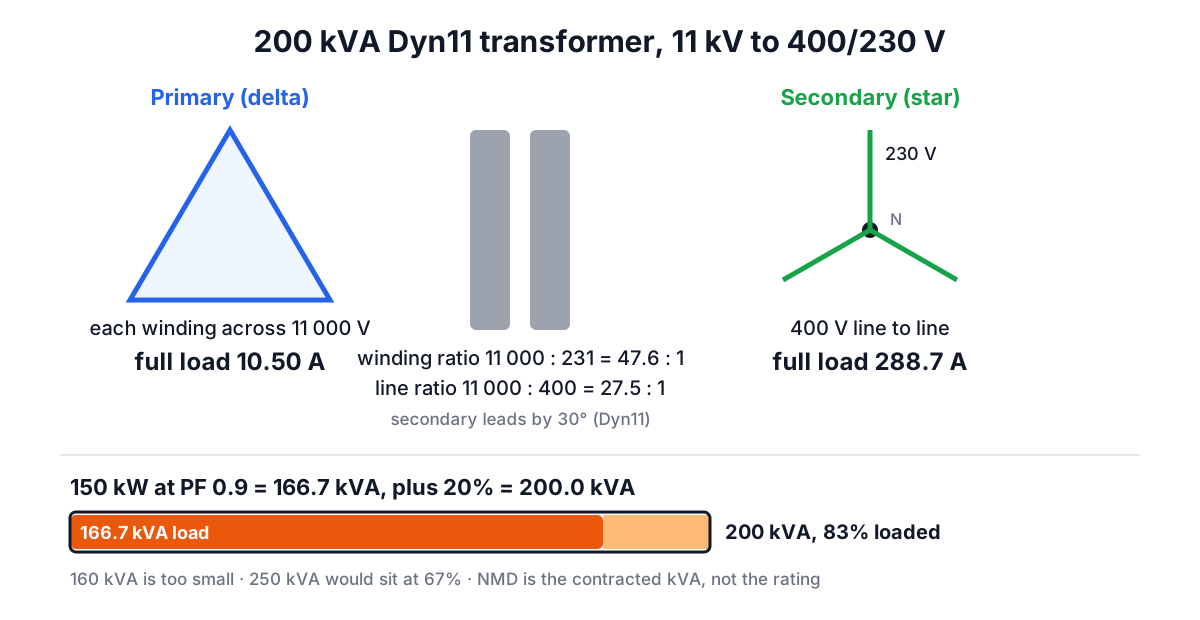
The required kVA lands exactly on a rating, so there is no slack beyond the 20%. The 160 kVA unit is too small; a 250 kVA unit would sit at 67% loading and leave room for another cold room. That choice is a cost question for the owner.
Step 3: full-load currents at 11 kV, 22 kV and 400 V
Full-load current is kVA × 1000 ÷ (√3 × V). The 400 V figure sizes the main LV breaker, the busbars and the cables to the main DB board; the primary figure sizes the MV switchgear and protection.
| Rating | 400 V | 11 kV | 22 kV |
|---|---|---|---|
| 100 kVA | 144.3 A | 5.25 A | 2.62 A |
| 160 kVA | 230.9 A | 8.40 A | 4.20 A |
| 200 kVA | 288.7 A | 10.50 A | 5.25 A |
| 315 kVA | 454.7 A | 16.53 A | 8.27 A |
| 400 kVA | 577.4 A | 20.99 A | 10.50 A |
| 500 kVA | 721.7 A | 26.24 A | 13.12 A |
| 630 kVA | 909.3 A | 33.07 A | 16.53 A |
| 800 kVA | 1 154.7 A | 41.99 A | 20.99 A |
| 1 000 kVA | 1 443.4 A | 52.49 A | 26.24 A |
At 22 kV the primary current is half the 11 kV figure for the same rating, which is why rural 22 kV lines can carry a farm transformer over long distances on light conductors. On the secondary side the current is large: an 800 kVA unit needs LV equipment for over 1 150 A.
On a Dyn11 unit, the delta primary windings each sit across the line voltage and the star secondary windings each give 231 V to neutral, so the winding ratio for 11 kV to 400 V is 11 000 ÷ 231 = 47.6 while the line ratio is 27.5. Quote the vector group and both voltages when ordering a replacement.
Power factor can save a size
The tariff booklet bills reactive energy above 30% of kWh, which it equates to a power factor of 0.96 or less, on its time-of-use tariffs. The Distribution Network Code, clause 6.3, separately requires customers with demand above 100 kVA to keep the power factor at no less than 0.9 lagging. Correcting to 0.96 also shrinks the kVA a transformer must carry.
Worked example: irrigation and grain plant on a 22 kV line. Maximum demand is 260 kW at PF 0.88, with 15% spare:
| Case | Load | Required | Rating | Loading | 400 V full load |
|---|---|---|---|---|---|
| PF 0.88, uncorrected | 295.5 kVA | 339.8 kVA | 400 kVA | 73.9% | 577.4 A |
| PF 0.96, corrected | 270.8 kVA | 311.5 kVA | 315 kVA | 86.0% | 454.7 A |
Correction drops the transformer one size, from 400 to 315 kVA, and the LV main switch from about 577 A to 455 A. The capacitor bank must sit on the secondary side, be switched so it never pushes the power factor leading (which the code also forbids unless agreed), and the distributor (Eskom or the municipality) must be told before shunt capacitors are installed. The power factor correction guide for South Africa sizes the bank.
NMD, the transformer and the bill
The NMD is the contracted maximum demand, in kVA, that you notify to Eskom per point of supply. On Miniflex and Megaflex, network capacity charges are levied on the annual utilised capacity, which the booklet defines as the higher of the NMD and the measured maximum demand. Two practical rules follow:
- Set the NMD from your real demand, not from the transformer rating. Contracting 400 kVA because you bought a 400 kVA unit means paying for capacity you do not use.
- Let the transformer carry the margin. The 20% spare belongs in the hardware; when growth arrives, apply to raise the NMD.
Supplies above 1 MVA count as "major works" in the connection procedure, which handles them as larger projects than a standard connection.
Other reasons to go up a size
- Large motor starts. A direct-on-line start draws several times running current; the transformer impedance sets the voltage dip. Soft starters or drives can be cheaper than a bigger unit.
- Drives, UPS and LED loads. Harmonic currents add winding losses. Use a transformer specified for the harmonic content, or derate.
- Hot plant rooms. Ratings assume normal ambient conditions; a sun-baked mini-sub enclosure or a hot plant room needs a margin or a supplier's derating figure.
- Unbalanced single-phase loads. The most heavily loaded phase limits the transformer.
Wiring rules on each side
The LV installation is designed and certified to SANS 10142-1, the wiring code for low-voltage installations, with a Certificate of Compliance issued by a registered person (an electrical tester for single phase, an installation electrician or a master installation electrician, depending on the work). Medium-voltage installations above 1 kV and up to 22 kV fall under SANS 10142-2. Have a registered professional design and sign off the installation; the calculator is for preliminary sizing.
Tools for this job
- Transformer sizing calculator for South Africa: kVA from kW, kVA or amps, IEC ratings and full-load current at 11, 22 kV and 400 V.
- Three-phase power calculator: turn each load into kVA and amps at 400 V.
- Power factor correction calculator: kVAr to reach 0.96 and the kVA it frees.
- Generator size calculator: a standby set sized for the same demand.
For the formula behind the full-load currents, read the three-phase power formula guide for South Africa.
Frequently asked questions
How many amps is a 315 kVA transformer at 400 V?
315 000 ÷ (√3 × 400) = 454.7 A on the secondary. On the primary it is 16.53 A at 11 kV or 8.27 A at 22 kV.
What size transformer do I need for 150 kW?
At PF 0.9 the load is 166.7 kVA. With 20% spare that is 200 kVA, which is an IEC rating, so a 200 kVA unit at 83% loading. With less margin you would still not fit a 160 kVA unit.
Should my NMD equal my transformer rating?
No. Network capacity charges use the higher of the NMD and the measured maximum demand, so set the NMD near your real 30-minute demand and keep the spare capacity in the transformer.
Does power factor change the transformer size?
Yes, because the rating is kVA. In the example above, correcting 260 kW from PF 0.88 to 0.96 takes the required size from 339.8 kVA to 311.5 kVA, one rating smaller.
Sources and further reading
- Connection charges for customers connected to Eskom's distribution network (procedure), Eskom Distribution. MV networks normally at 11 or 22 kV, designated 33 kV rural networks, LV at 400/230 V, NMD and major works above 1 MVA.
- Tariffs and Charges Booklet 2026/2027, Eskom. Supply sizes up to 100 kVA, Miniflex, Megaflex and Ruraflex eligibility, annual utilised capacity, maximum demand over 30 minutes and the reactive energy threshold.
- South African Distribution Network Code, version 6.2, NERSA and Eskom Distribution. Clause 6.3 on load power factor and shunt capacitors.
- Management of certificates of compliance for electrical installations, Eskom Distribution. SANS 10142-1, SANS 10142-2 and accredited persons.
- SANS 1019:2021 Standard voltages, currents and insulation levels for electricity supply, SABS. Standard voltages for 50 Hz systems.
- IEC 60076-1:2011 Power transformers: Part 1: General, International Electrotechnical Commission. General requirements for power transformers.
Open the Transformer Sizing Calculator
More Electrical
Every tool in the Electrical section, free and in your browser.