
Transformer Sizing in Canada: 600 V to 120/208 V Units
Sizing a 600 V to 120/208 V dry-type transformer in Canada: kVA from kW, full-load amps at 60 Hz, the 5:1 winding ratio, standard sizes and federal rules.
By Redbison Dev · · 10 min read
Canada edition. Starts from the 600 V to 120/208 V dry-type step-down used in Canadian buildings on a 347/600 V service, BC Hydro's primary voltages, and the dry-type transformer definition in the federal Energy Efficiency Regulations, 2016. US edition
A tenant floor in a building with a 347/600 V service needs receptacles and small equipment at 120/208 V, and that means a 600 V to 120/208 V dry-type transformer. If the floor's demand is 60 kW at power factor 0.9, the load is 66.7 kVA; add 20% for growth and you need 80 kVA, which rounds up to a 112.5 kVA unit carrying 108 A on its 600 V side and 312 A at 208 V. Trim the margin to 10% and a 75 kVA unit fits at 89%. This edition works through that choice for Canadian buildings and services. Every figure comes from the Canadian transformer sizing calculator.
Where transformers sit in a Canadian building
BC Hydro's standard secondary services include 347/600 V wye and 120/208 V wye, both three-phase, four-wire, and 120/240 V single-phase. A building on a 600 V service runs its lighting at 347 V and its larger motors at 600 V, then uses dry-type transformers to make 120/208 V where it is needed. The Canadian three-phase power guide explains why the 600 V feeders carry about a third of the current of 208 V ones.
Some larger sites take a primary service and supply their own transformer to step it down. BC Hydro's standard primary services are 2,400/4,160 V, 7,200/12,470 V, 14,400/24,940 V and 19,920/34,500 V wye, with the 35 kV class restricted to a number of rural circuits in the Central Interior. It lists 277/480 V wye and 240, 480 or 600 V delta as non-standard sub-services that require customer-supplied power transformers. Other utilities publish their own lists in their conditions of service.
Why kVA, and how to get there
A transformer is limited by heat, and its winding losses depend on current regardless of power factor. So the rating is apparent power, kVA. Convert first: 60 kW at 0.9 is 66.7 kVA. If you sized on 60 you would be 10% short before adding any growth.
Then work through four steps:
- Use the demand load, calculated under the Canadian Electrical Code as adopted in your province, or measured, not the sum of every nameplate.
- Convert to kVA at a realistic power factor.
- Add a growth margin, commonly 20 to 25%.
- Round up to a standard size. The calculator's North American three-phase list is 3, 6, 9, 15, 30, 45, 75, 112.5, 150, 225, 300, 500, 750, 1,000, 1,500, 2,000, 2,500, 3,750 and 5,000 kVA; single-phase sizes include 10, 15, 25, 37.5, 50, 75, 100 and 167 kVA.
Full-load currents at 600 V and 208 V
Three-phase: I = kVA × 1000 ÷ (√3 × V)
Single-phase: I = kVA × 1000 ÷ V
| Unit | Primary | Secondary |
|---|---|---|
| 75 kVA, 600 to 208 V | 72.2 A | 208.2 A |
| 112.5 kVA, 600 to 208 V | 108.3 A | 312.3 A |
| 37.5 kVA single-phase, 600 to 240 V | 62.5 A | 156.3 A |
| 1,500 kVA, 24,940 to 600 V | 34.7 A | 1,443.4 A |
The secondary conductors have to be sized for the secondary current, nearly three times the primary current on a 600 to 208 V unit. Overcurrent protection on both sides follows the Canadian Electrical Code, Part I.
The 5:1 that is not 2.88:1
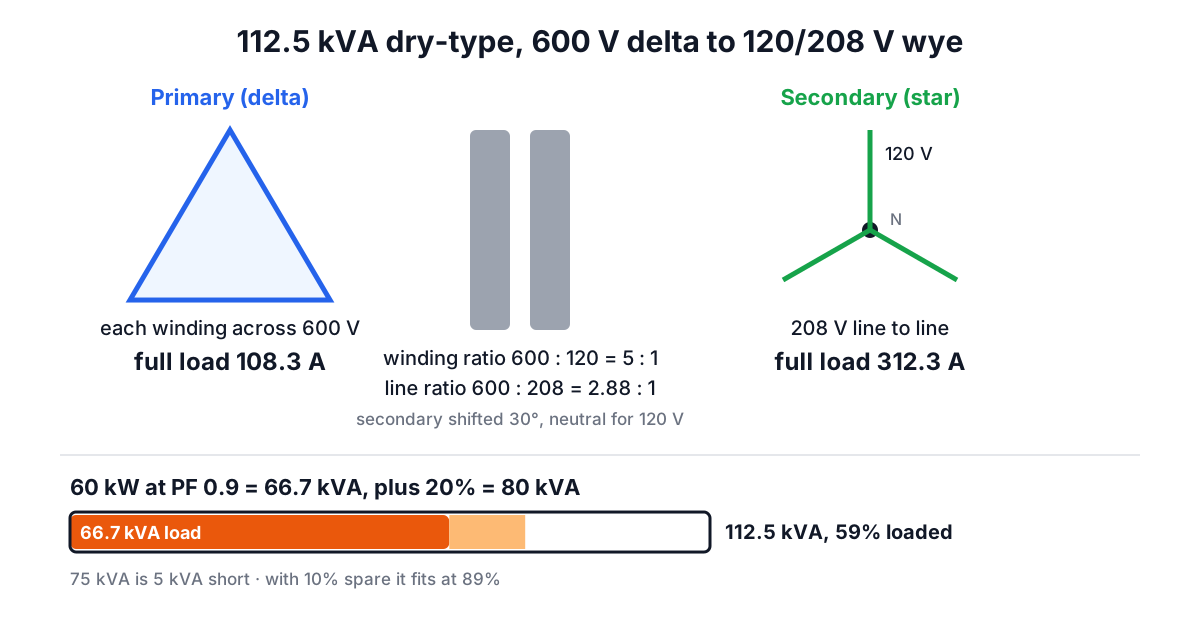
On a delta-wye unit each primary winding sits across 600 V and each secondary winding produces 120 V, so the windings are in a 5 to 1 ratio. The line voltages are in a 600 ÷ 208 = 2.88 to 1 ratio, which is what the calculator reports and what governs the currents. The wye secondary also provides the neutral for 120 V receptacles and shifts the secondary by 30°, which matters if two transformers are ever paralleled. Order replacements by the nameplate's connection and voltages, not by the line ratio alone.
Federal efficiency rules for dry-type units
Section 703 of the Energy Efficiency Regulations, 2016 defines a dry-type transformer as one whose core and windings are in a gaseous or dry compound insulating medium, either single-phase from 15 to 833 kVA or three-phase from 15 to 7,500 kVA, with a nominal frequency of 60 Hz and a high-voltage winding of 35 kV or less. The definition excludes, among others, autotransformers, grounding, rectifier, sealed, non-ventilated, testing, furnace and welding transformers, special impedance transformers, units with a nominal low-voltage line current of 4,000 A or more, and drive isolation transformers with two or more output windings or a low-voltage line current above 1,500 A. The regulations reference CSA C802.2, Minimum efficiency values for dry-type transformers.
In practice that means a 112.5 kVA, 600 to 208 V general-purpose ventilated unit falls within the definition, so its minimum efficiency is set by regulation rather than left to the catalogue. A 9 kVA unit is below the 15 kVA threshold.
Choosing between 75 and 112.5 kVA
| Margin on 66.7 kVA | Required | Size | Loading today |
|---|---|---|---|
| 10% | 73.3 kVA | 75 kVA | 89% |
| 20% | 80.0 kVA | 112.5 kVA | 59% |
The jump from 75 to 112.5 kVA is 50%, much coarser than the IEC series used elsewhere. If the tenant fit-out is known and stable, 75 kVA at 89% is defensible. If EV chargers, a server room or a kitchen may follow, 112.5 kVA leaves room. Either way, compare the no-load loss of the two on the data sheets: a dry-type unit stays energized around the clock, so an oversized unit carries its core loss every hour of the year.
Single-phase loads from a 600 V service
Where a building has only a 600 V service and needs a 120/240 V panel for a shop or a single-phase appliance, a single-phase transformer connected line to line on the 600 V system does the job. For 30 kVA of load with 20% margin, the requirement is 36 kVA and the next size is 37.5 kVA at 80% loading, with 62.5 A on the 600 V side and 156.3 A at 240 V.
Taking a primary service
A 1,200 kVA site on a 25 kV primary, with 20% margin, needs 1,440 kVA and therefore a 1,500 kVA unit at 80%. The primary current is only 34.7 A at 24.94 kV, while the 600 V side carries 1,443.4 A at full load, a figure that sets the main switchboard rating. Where the transformer is customer-owned, protection coordination with the utility and the inspection authority's requirements come in early.
When to go bigger
Large motor starts, harmonic-rich loads such as drives and LED drivers, hot electrical rooms and unbalanced single-phase loading on a three-phase unit all argue for more headroom than the plain arithmetic. Have the design checked by a qualified engineer.
Frequently asked questions
What size transformer do I need from 600 V to 208 V?
Convert the demand load to kVA, add 20 to 25% and pick the next standard size. A 60 kW load at power factor 0.9 with 20% margin needs 80 kVA, so a 112.5 kVA unit; with 10% margin a 75 kVA unit fits at 89%.
How many amps is a 75 kVA transformer at 600 V and 208 V?
72.2 A on the 600 V side and 208.2 A on the 208 V side at full load.
Why is a 600 to 120/208 V transformer's turns ratio 5:1?
In a delta-wye unit each primary winding sees the 600 V line voltage and each secondary winding produces the 120 V line-to-neutral voltage, so the windings are 5 to 1. The line voltages are 600 to 208, or 2.88 to 1.
Are dry-type transformers regulated for efficiency in Canada?
Yes, within the scope of section 703 of the Energy Efficiency Regulations, 2016: single-phase 15 to 833 kVA or three-phase 15 to 7,500 kVA, 60 Hz, with a high-voltage winding of 35 kV or less, excluding listed special types. The regulations reference CSA C802.2.
Which primary voltages will the utility supply?
It depends on the utility. BC Hydro's standard primary services are 2,400/4,160 V, 7,200/12,470 V, 14,400/24,940 V and 19,920/34,500 V wye, subject to the system configuration in the area.
Sources and further reading
- Energy Efficiency Regulations, 2016 (SOR/2016-311), section 703, Justice Laws Website, Government of Canada. Dry-type transformer definition, exclusions and CSA C802.2.
- Electrical service voltages, BC Hydro. Standard secondary and primary services and non-standard sub-services.
- CSA C22.1:24, Canadian Electrical Code, Part I, Standards Council of Canada catalogue entry.
- IEC 60076-1: Power transformers, General, International Electrotechnical Commission.
- Electric motors (1 to 500 HP/0.746 to 375 kW), Natural Resources Canada. Federal motor efficiency scope, useful when a transformer also feeds 600 V motors.
- Transformer sizing (US edition), for 480 V to 208Y/120 V units and the NEC.
Open the Transformer Sizing Calculator
More Electrical
Every tool in the Electrical section, free and in your browser.