
Concrete in cft, Cement Bags, Carpet Area and Tile Boxes
Slab volume in m³ and cft, cement bags for M20 and PCC, sand and aggregate by the brass, RERA carpet area, and how many 2x2 tile boxes a room needs.
By Redbison Dev · · 9 min read
India edition. Written for building and flooring in India, with m³ and cft, 50 kg cement bags and IS 456 nominal mixes, RMC by the cubic metre, carpet area under RERA in sq ft, and vitrified tiles sold by the box in sq ft, with prices in rupees. US edition
An Indian building estimate mixes units at every step. The drawing gives the slab in metres and millimetres, the contractor quotes in cft, the RMC plant prices per cubic metre, cement comes in 50 kg bags, sand and aggregate are often sold by the brass, the flat is sold per square foot of carpet area, and vitrified tiles are metric tiles sold in boxes labelled in sq ft. This guide walks through a roof slab, column footings, a PCC bed, a 2BHK's carpet area and a living room floor, with numbers you can reproduce in the Concrete Volume Calculator (India), the Concrete Mix Calculator, the Carpet Area Calculator and the Tile Calculator (India).
The conversions that run every site
| From | To | Factor |
|---|---|---|
| 1 m³ | cft | 35.31 |
| 1 brass | cft | 100 |
| 1 m³ | brass | about 0.35 |
| 1 m² | sq ft | 10.764 |
| 1 sq yd (gaj) | sq ft | 9 |
| 50 kg cement bag (loose, at 1,440 kg/m³) | m³ / cft | 0.0347 / about 1.23 |
The cft factor is the cube of 3.2808 feet to the metre, and the sq ft factor is its square. Mixing them up is the classic error: a contractor who divides 1.35 m³ by 10.764 instead of multiplying by 35.31 gets a figure nobody can pour.
The other slip is thickness. Slabs and PCC beds are drawn in millimetres (125, 150, 100) and must be turned into metres (0.125, 0.15, 0.1) before multiplying by lengths in metres.
Concrete: volume first, then RMC or site mix
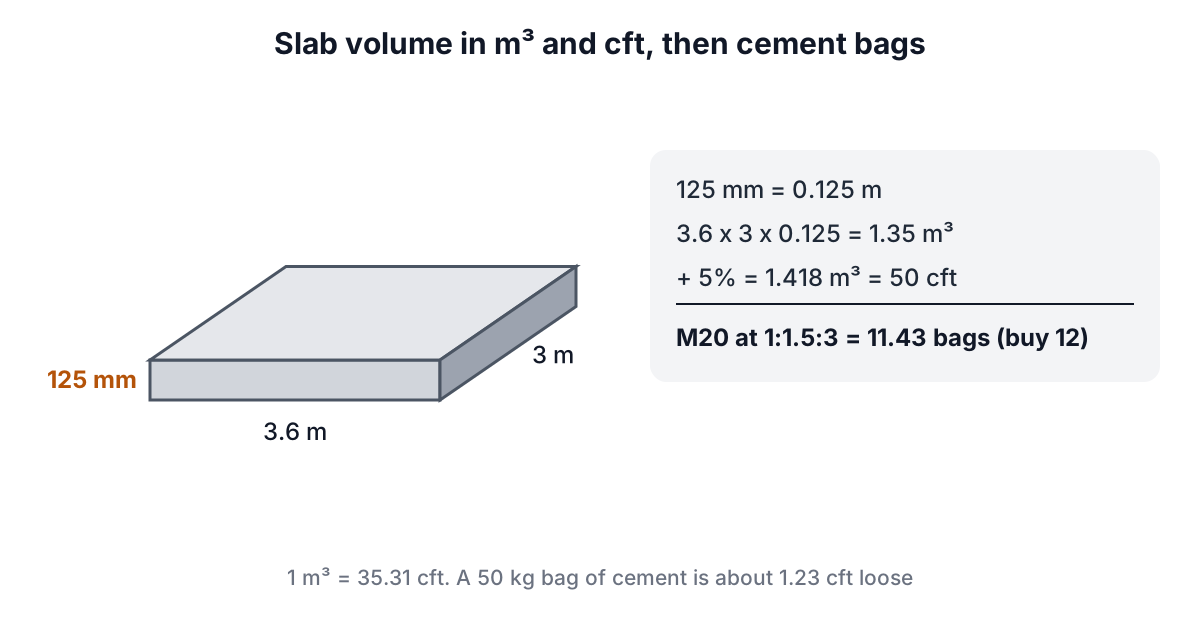
Volume is length x width x thickness for a slab, footing, PCC bed or beam, multiplied by the number of identical members. Add a wastage allowance: about 5% for a slab on shuttering, more for footings in an uneven pit, because excavations are rarely the size on the drawing.
| Member | Size | Volume with 5% | cft |
|---|---|---|---|
| Roof slab over a 12 x 10 ft room | 3.6 x 3 m x 125 mm | 1.418 m³ | 50 |
| Six isolated column footings | 1.2 x 1.2 m x 300 mm each | 2.722 m³ | 96 |
| PCC bed under a wall footing | 10 x 1 m x 100 mm | 1.05 m³ | 37 |
At this point you choose between ready-mix (RMC) and a site mix. RMC is always priced per cubic metre, and the plant will have a minimum order, so ask before you plan a small pour around it. Six footings at 2.7 m³ are worth pricing with a transit mixer; at a rate of ₹5,500 per m³ (the calculator's default, to be replaced with your quote) that load is about ₹14,970 before pumping. A single small slab is often cheaper to batch on site.
Cement, sand and aggregate for a site mix
IS 456 permits nominal mixes only up to M20 and sets M20 as the minimum grade for reinforced concrete in mild exposure (M25 in moderate exposure, which needs a design mix). The traditional volume ratios are 1:1.5:3 for M20, 1:2:4 for M15 and 1:4:8 for lean PCC. To turn wet volume into dry materials, site estimates multiply by 1.54, because loose cement, sand and aggregate have voids that close up when mixed. The calculators use that factor, cement at 1,440 kg/m³ and 50 kg bags:
| Member | Mix | Cement | Sand | Aggregate |
|---|---|---|---|---|
| Roof slab, 1.418 m³ | M20, 1:1.5:3 | 11.43 bags (buy 12) | 0.595 m³ (21 cft) | 1.191 m³ (42 cft) |
| Six footings, 2.722 m³ | M20, 1:1.5:3 | 21.95 bags (buy 22) | 1.143 m³ (40.4 cft) | 2.286 m³ (80.7 cft) |
| PCC bed, 1.05 m³ | 1:4:8 | 3.58 bags (buy 4) | 0.498 m³ (17.6 cft) | 0.995 m³ (35.1 cft) |
The PCC row shows why the ratio matters more than the volume for the cement order: three-quarters of the slab's volume needs less than a third of its cement. If aggregate is sold by the brass, the slab's 42 cft is 0.42 brass and the footings' 80.7 cft is about 0.81, so the two pours together need about 1.23 brass.
Two details from IS 456 change the order on site. Damp sand bulks, so a box or ghamela of moist sand holds less sand than a dry one; clause 10.2.4 allows volume batching only with an allowance for bulking and prefers batching by mass. And curing under clause 13.5.1 is at least 7 days of continuous wetting for ordinary Portland cement and at least 10 days for blended cements such as PPC, or in hot, dry weather, so plan water and labour for it.
The grade, thickness and steel all come from the structural drawing. These figures are for ordering materials once those are fixed, not for designing a slab.
Carpet area: what you are paying for
Flats in India are priced per square foot, and the figure that has a legal definition is the carpet area. Section 2(k) of the Real Estate (Regulation and Development) Act, 2016 defines it as the net usable floor area of an apartment, excluding the area under external walls, service shafts, exclusive balconies or verandahs and exclusive open terraces, but including internal partition walls. Built-up and super built-up area add walls, balconies and a share of common areas, so they are always larger, and only carpet area is defined in the Act.
You can check a builder's figure by measuring the rooms. A 2BHK with a 12 x 15 ft living room, bedrooms of 12 x 11 and 11 x 10 ft, an 8 x 10 ft kitchen and two 5 x 7 ft toilets has 572 sq ft of room area, which is 53.14 m². At ₹8,500 per sq ft that is ₹48,62,000, or ₹48.62 lakh. Because internal walls count in carpet area, the RERA figure should be a little more than your room total. If it is much less, ask how it was measured, and check the registered project details on your state RERA portal. Balconies are disclosed separately, so price them as a separate line.
Plots are a different unit again. A 30 x 40 ft site is 1,200 sq ft, which is 133.33 sq yd (gaj) or 111.48 m². State land units such as guntha, cent or bigha vary in size from state to state, so convert them with your state's definition rather than a general table.
Tiles: 2x2 is not two feet
Vitrified floor tiles are made in millimetres and sold as "2x2" (600 x 600 mm), "2x4" (600 x 1200 mm) and so on, while the shop quotes box coverage in sq ft and you measured the room in feet. A 600 mm tile is 23.62 inches, about 2% short of 2 ft each way, so a 600 x 600 tile covers 3.875 sq ft, not 4. A box of four covers 1.44 m², which is 15.5 sq ft.
That 2% is enough to change the order. A 15 x 12 ft living room laid in 600 x 600 mm tiles with a 2 mm joint and 10% wastage needs 51 tiles. Enter the tile as 24 in and the calculator says 50, one short before a single tile breaks. At four tiles a box, 51 tiles is 13 boxes. A 14 x 11 ft bedroom in the same tile needs 44 tiles, 11 boxes.
| Layout | Wastage to start from |
|---|---|
| Straight | 10% |
| Diagonal | 15% |
| Large slabs in a small room | more than 10% |
Skirting is usually cut from the same tiles and is easy to forget. For the living room, the perimeter is 54 ft; less a 3 ft door opening that leaves 51 ft, about 15.5 m. A 600 mm tile cut lengthways gives five or six strips of about 100 mm, so the skirting takes roughly 26 strips, five or six extra tiles. Add them before you round up to boxes.
Buy every box from one batch and check the shade and size code printed on each box, because a box from a later batch can show a visible difference in daylight. Tiles certified by BIS carry their group under IS 15622:2017, the standard for pressed ceramic tiles, on the box.
Grout for the living room, using the formula tile-adhesive makers publish, (A + B) / (A x B) x thickness x joint x 1.6 with sizes in millimetres, comes to about 1.8 kg for a 9 mm tile with a 2 mm joint. Epoxy grout in kitchens and bathrooms costs more per kilogram, so price it separately.
Before you place the order
- Convert every thickness to metres, and use 35.31 (not 10.764) for m³ to cft.
- Get the grade, thickness and steel from the structural drawing, then work out cement, sand and aggregate for that mix.
- Ask the RMC plant for its minimum order and rate per m³, including pump charges.
- Allow for bulking of damp sand, and for 7 to 10 days of curing water.
- Check carpet area against your own room measurements and the RERA registration.
- Enter tiles in their true size (23.62 in for 600 mm), add skirting, and buy from one batch.
Frequently asked questions
How do I convert concrete from cubic metres to cft?
Multiply by 35.31. A 3.6 x 3 m slab 125 mm thick is 1.35 m³, or 1.418 m³ with 5% extra, which is about 50 cft. To get brass, divide cft by 100, so 50 cft is half a brass.
How many cement bags does a 12 x 10 ft roof slab need?
For a 3.6 x 3 m slab 125 mm thick with 5% extra in a 1:1.5:3 M20 nominal mix, about 11.43 bags of 50 kg, so buy 12. It also needs about 21 cft of sand and 42 cft of 20 mm aggregate. The grade and thickness must come from your structural engineer.
Why is the carpet area in my agreement smaller than the super built-up area?
Because they measure different things. Carpet area under section 2(k) of the RERA Act is the net usable floor inside the external walls, including internal partitions but excluding exclusive balconies and terraces. Super built-up area adds walls, balconies and a share of lobbies, stairs and lifts.
How many 2x2 tiles do I need for 100 sq ft?
A 600 x 600 mm tile covers 3.875 sq ft, so about 26 tiles laid tight. With a 2 mm joint and 10% wastage the calculator gives 29 tiles, which is 8 boxes of four. Add more for skirting and for diagonal laying.
How much does one 50 kg cement bag measure in cft?
About 1.23 cft, taking loose cement at 1,440 kg/m³: 50 / 1,440 is 0.0347 m³, and 0.0347 x 35.31 is 1.23. That is why one bag is the "1" in a 1:1.5:3 volume mix measured with a box or ghamela.
Sources and further reading
- IS 456:2000 Plain and Reinforced Concrete: Code of Practice, Bureau of Indian Standards (public copy). Clause 9.3 and Table 9 nominal mixes, Table 5 minimum grades, 10.2.4 batching and bulking, 13.5.1 curing.
- The Real Estate (Regulation and Development) Act, 2016, India Code. Section 2(k), the definition of carpet area.
- Real Estate (Regulation and Development) Act, 2016, Ministry of Housing and Urban Affairs. The Act and links to state RERA authorities.
- Product manual for pressed ceramic tiles according to IS 15622:2017, Bureau of Indian Standards. The current tile standard used for BIS certification.
- National Building Code of India, Bureau of Indian Standards. The national model code for building construction.
- Handout on Indian Standards on Building Materials, Bureau of Indian Standards. Indian Standards for cement, aggregates and concrete.
More Construction & Home
Every tool in the Construction & Home section, free and in your browser.