
How Much Concrete, Tiles and Gravel? A UK Estimating Guide
Cubic metres to 25 kg bags or a ready-mix load, floor area in m² and sq ft, tiles by the box, and gravel by the tonne and bulk bag, with UK worked examples.
By Redbison Dev · · 9 min read

United Kingdom edition. Metric throughout, with 20 kg and 25 kg bags, BS 8500 designated mixes, ready-mix by the cubic metre, tiles sold by the m² per box, gravel in tonnes and bulk bags, and UK planning, HSE and RHS guidance. US edition
On a UK garden or flooring job the numbers come from three directions at once. The plan is drawn in millimetres, the merchant sells concrete by the cubic metre or the 25 kg sack, tiles by the square metre in a box, and gravel by the tonne in a bulk bag, while the estate agent's floor plan quotes square feet. Getting the order right is mostly a matter of moving between those units without slipping, then choosing a sensible allowance for waste. This guide does that for a patio, a shed base, fence posts, a kitchen-diner floor, a bathroom and a gravel drive, using the UK versions of the Concrete Calculator, the Square Footage Calculator, the Tile Calculator and the Gravel and Bark Calculator.
Millimetres, metres and the thousand-fold slip
Metric looks simpler than feet and yards, and it is, but it has its own trap. Drawings and product sheets give thicknesses in millimetres (a 100 mm slab, a 50 mm gravel topping, a 9 mm tile), while lengths are measured in metres. Multiply 3 m by 3 m by 100 and you get 900, a figure that looks like a volume until you notice it should be 0.9. Convert every dimension to metres first: 100 mm is 0.1 m, 75 mm is 0.075 m, 25 mm is 0.025 m.
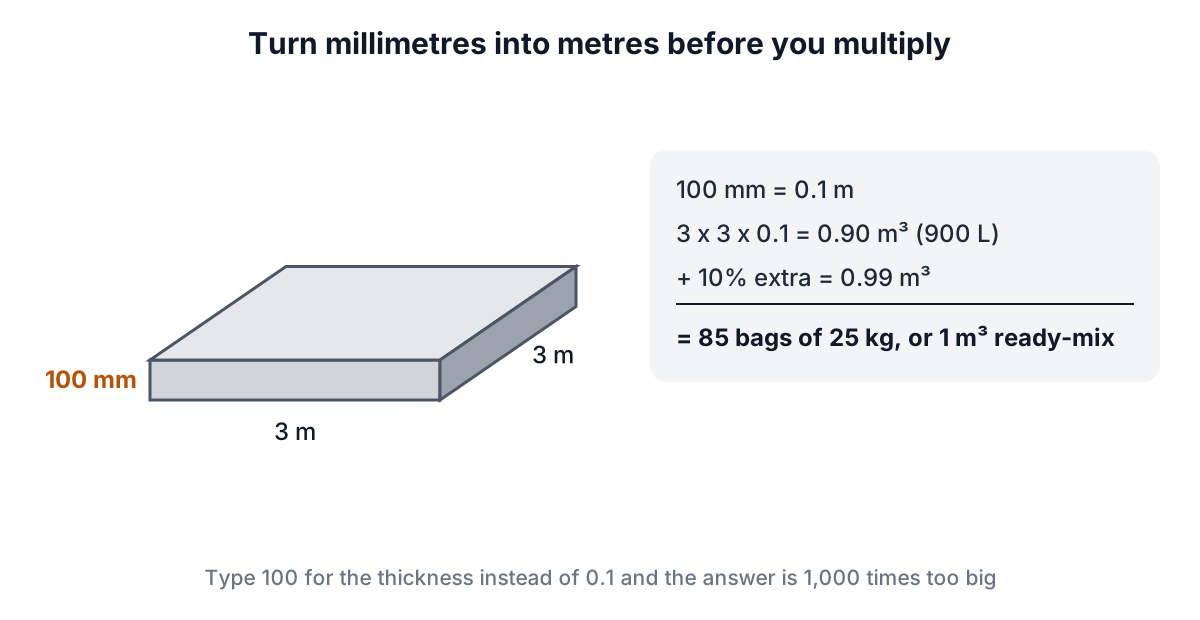
Two more facts carry most UK estimates. A cubic metre is 1,000 litres, which links concrete volumes to bark and compost sold in 60 or 70 litre bags. And a square metre is about 10.764 square feet, because a foot is exactly 0.3048 m and the area factor is that number squared. The Weights and Measures Act 1985 still lists both the square metre and the square foot, which is why both appear on British floor plans.
Concrete: cubic metres, sacks or a lorry
For a slab, a strip footing or a wall, volume is length x width x thickness. For round post holes it is π x radius² x depth. Steps poured solid on the ground are a stack of blocks: three steps with a 150 mm rise and a 300 mm going, 1 m wide, hold 0.27 m³, and half of that is in the top step alone.
Bagged concrete is sold by weight, so the bag count depends on yield. The UK concrete calculator works with about 11.7 litres of mixed concrete per 25 kg bag, scaled by weight from a published standard-mix yield, which is roughly 86 bags to the cubic metre (or 107 bags of 20 kg). Post-fix and rapid-set mixes yield differently, so read the sack.
| Job | Sizes | Volume with extra | 25 kg bags | 20 kg bags | Ready-mix order |
|---|---|---|---|---|---|
| Patio base | 3 x 3 m, 100 mm, 10% extra | 0.99 m³ | 85 | 106 | 1 m³ |
| Shed base | 2.4 x 1.8 m, 100 mm, 5% extra | 0.454 m³ | 39 | 49 | 0.5 m³ |
| Ten fence posts | 300 mm holes 600 mm deep, 10% extra | 0.467 m³ | 40 | 50 | 0.5 m³ |
| Three garden steps | 1 m wide, 150 mm rise, 300 mm going, 10% extra | 0.297 m³ | 26 | 32 | 0.5 m³ |
The ready-mix column rounds up to quarter cubic metres, the step the calculator uses by default; change it to whatever your supplier quotes in. The patio is where the decision flips. Eighty-five 25 kg sacks is over two tonnes of dry material to lift, tip and mix in batches before the first one stiffens, and the HSE manual handling guidance is to cut the load or the number of lifts where you can. A cubic metre from a ready-mix plant, or from a volumetric lorry that mixes on site and charges for what it pours, arrives in one go. Small loads often carry a part-load charge, so put both prices into the calculator's cost panel rather than assuming.
The allowance on top depends on the ground. A slab poured inside timber formwork on a level, compacted sub-base needs about 5%. Dug holes and trenches are never quite the size you meant, so allow 10% or more. Running short is worse than having a barrow left over: the joint between a batch that has started to set and fresh concrete is a weak line.
Which mix to ask for
Ready-mix in the UK is ordered by name under BS 8500. Heidelberg Materials' table of concrete types lists GEN1 for unreinforced domestic foundations, kerbing and haunching; ST3 and ST4 for shed and workshop bases; and PAV1 for domestic driveways, car ports, hard standings and patio paving where no de-icing salt is used. A driveway that will be salted, or anything reinforced, needs a different mix, and a structural design takes precedence over any table. For a hand mix, the Concrete Mix Ratio Calculator (UK) turns the volume into cement, sharp sand and ballast.
If the concrete is a front-garden hardstanding in England, check drainage before you order: covering more than 5 m² with an impermeable surface that runs off to the road needs planning permission, according to the government's permeable surfacing guidance.
Floor area: square metres, square feet and the EPC
Flooring in the UK is sold by the square metre, but houses are often advertised in square feet, and the Energy Performance Certificate gives a third number. Before comparing them, know what each one measured. An EPC on the government register states the total floor area used for the energy assessment. An agent's floor plan is drawn by whoever the agent employs, usually with a disclaimer. Adding up your own room sizes gives the smallest figure of the three, because walls, stairs and the landing drop out.
For a flooring order, measure each room wall to wall at skirting level and split awkward shapes into rectangles that do not overlap. An L-shaped kitchen-diner of 5.4 x 3.2 m plus a 2.4 x 2.0 m dining end is 17.28 + 4.80 = 22.08 m². With 10% for cuts on a straight lay that is 24.29 m² of LVT or laminate to buy, which you then divide by the m² printed on each pack and round up. A herringbone lay needs more.
Going the other way, the same 22.08 m² is 237.7 sq ft (multiply by 10.764). The common mistake is dividing an area by 3.28, the length factor, which makes 22 m² into "6.7" of something meaningless, or multiplying by it and calling 72 square feet a room that is really 238.
Tiles: boxes by the square metre
UK tile boxes say how many square metres they cover, so the job is area, joints, waste, then boxes. The joint matters more than people expect: a 600 x 300 mm tile with a 2 mm joint occupies 602 x 302 mm, so 9 m² of bathroom wall takes 49.5 tiles exactly rather than 50. Add the layout allowance and round up:
| Layout | Allowance the tool starts from |
|---|---|
| Straight grid | 10% |
| Brick bond or offset | 12% |
| Diagonal | 15% |
| Herringbone | 20% |
That 9 m² of wall in 600 x 300 mm tiles at 10% is 55 tiles, and at six tiles (1.08 m²) a box, 10 boxes. Keep the batch number from the label, because a box bought later may be a slightly different shade.
Grout follows the formula adhesive makers print: kg per m² = (A + B) / (A x B) x C x D x 1.6, with tile length A, width B, thickness C and joint D in millimetres. For those 9 mm tiles with a 2 mm joint it is 0.144 kg/m², about 1.4 kg for the whole wall with the 10% added. Narrow herringbone planks use several times as much grout per square metre as large-format tiles, so check the bag against your own tile.
Cutting porcelain or stone with a powered saw throws up silica dust. HSE's guidance on cutting paving and kerbs is water suppression or on-tool extraction plus a mask with a protection factor of 20, such as FFP3; a manual score-and-snap cutter avoids most of it on straight cuts.
Gravel, sub-base and bark: tonnes and bulk bags
Merchants sell stone by weight, so a volume has to become tonnes. The calculator's starting densities are about 1,661 kg/m³ for gravel and 1,602 kg/m³ for crushed stone, and they are editable because moisture, grading and compaction change them. Ask the merchant what figure they use.
| Job | Area and depth | Volume with 5% | Weight | What to order |
|---|---|---|---|---|
| Decorative gravel on a drive | 10 x 3 m at 50 mm | 1.58 m³ | 2.62 t | 4 bulk bags of 850 kg, or 105 bags of 25 kg |
| MOT Type 1 sub-base | 30 m² at 100 mm | 3.15 m³ | 5.05 t | 6 bulk bags of 1 tonne |
| Bark on borders | 12 m² at 75 mm | 0.945 m³ (945 L) | about 0.34 t | 14 bags of 70 L |
Bulk bags are listed at around 850 kg by some merchants and a full tonne by others, so the same drive can be four bags or three; check before you order. The bag also needs somewhere the crane lorry can reach. Sub-base is compacted with a plate compactor and loses volume when it is, so many people order more than the loose figure for a drive.
For bark, the RHS advice on mulch is a layer at least 5 cm thick and ideally 7.5 cm. Dropping from 7.5 to 5 cm takes the borders above from 14 bags to 9, so decide the depth before you count bags. Loose gravel lets rain through, so a gravel front drive in England is not the impermeable surface the 5 m² rule above is about.
Before you order
- Write every dimension in metres, including thicknesses, before multiplying.
- Split rooms and beds into rectangles that do not overlap, and take out what you will not cover.
- Count concrete bags from the yield on the sack, and price a ready-mix or volumetric load at the same time.
- Ask for the mix by name (GEN1, ST3, ST4, PAV1) and tell the supplier what it is for.
- Pick the waste allowance from the job: 5% for a formed slab, 10% or more for dug holes and straight tiling, more for diagonal and herringbone.
- Check the bulk bag weight, the density the merchant uses and where the lorry can drop.
This is for estimating materials. A structural engineer, building control or an experienced builder should settle anything that carries a load or sits on poor ground.
Frequently asked questions
How many 25 kg bags of concrete make a cubic metre?
About 86, at roughly 11.7 litres of mixed concrete per 25 kg bag, or 107 bags of 20 kg. That yield is scaled by weight from a manufacturer's figure for standard mix, so rapid-set and post-fix bags can differ; use the yield printed on the sack you buy.
What concrete mix should I order for a patio or shed base?
Heidelberg Materials lists PAV1 for domestic patios, driveways and hard standings where no de-icing salt is used, and ST3 or ST4 for shed and workshop bases. GEN1 is listed for unreinforced domestic foundations, kerbing and haunching. A design from an engineer or the building's maker overrides these general uses.
How many bulk bags of gravel do I need for a 10 by 3 metre drive?
At 50 mm deep with 5% extra it is 1.58 m³, about 2.62 tonnes at 1,661 kg/m³. That is four 850 kg bulk bags, or three if your merchant's bags hold a full tonne. The sub-base underneath is a separate order.
Why does my EPC floor area differ from the estate agent's floor plan?
They measure different things. The EPC gives the total floor area used in the energy assessment, while floor plans are drawn by different firms to their own conventions. A total of your own room measurements is usually smaller than both because it leaves out walls, stairs and landings.
How do I convert square metres to square feet?
Multiply by about 10.764, which is 1 / 0.3048 squared. A 22.08 m² kitchen-diner is about 237.7 sq ft. To go back, divide square feet by 10.764 or multiply by exactly 0.09290304.
Sources and further reading
- Types of concrete, Heidelberg Materials UK. Typical uses of the GEN, ST, RC and PAV mixes.
- Permeable surfacing of front gardens: guidance, Ministry of Housing, Communities and Local Government. The 5 m² rule for impermeable front-garden surfaces in England.
- Manual handling at work, Health and Safety Executive. Reducing heavy and repeated lifts such as 25 kg sacks.
- Construction dust: cutting paving blocks, kerbs and flags, Health and Safety Executive. Dust controls and respiratory protection for powered cutting.
- Find an energy certificate, GOV.UK. EPCs with total floor area in m² for homes in England, Wales and Northern Ireland.
- Mulch, Royal Horticultural Society. Mulch depth of at least 5 cm, ideally 7.5 cm.
- Weights and Measures Act 1985, Schedule 1, legislation.gov.uk. Definitions of metric and imperial units of area and volume.
More Construction & Home
Every tool in the Construction & Home section, free and in your browser.