
Expense Ratio, Direct Plans and Index Fund SIPs in India
What the TER, direct vs regular plans, step-up SIPs and inflation do to an Indian index fund or ETF SIP over 20 years, in rupees, with the tax on redemption.
By Redbison Dev · · 6 min read
India edition. Written for Indian investors: rupees in lakh and crore, the total expense ratio (TER) of direct and regular plans, growth options, step-up SIPs, 4% inflation, and the 12.5% and 20% rates on equity fund gains from 23 July 2024. US edition
A ₹10,000 monthly SIP for 20 years, at an assumed 11% a year before costs, would grow to ₹81,28,079 with no expenses at all. At a total expense ratio (TER) of 0.1% it reaches ₹80,31,553; at 1%, ₹72,16,650; at 1.8%, ₹65,67,564. The same ₹24 lakh goes in each time. The gap between the cheapest and dearest is ₹14.6 lakh, almost twice the ₹8.15 lakh the 1.8% plan actually charged.
That is why the TER, and the choice between a direct and a regular plan of the same scheme, matters so much over a long SIP. This edition works through costs, step-ups, inflation and tax with the India index fund and ETF calculator. Returns are steady assumptions to show the mechanics; equity returns in real life swing widely, and none of this is advice to pick a fund. A SEBI-registered investment adviser can look at your goals.
What the TER is, and why direct plans cost less
AMFI's TER disclosure page breaks a scheme's total expense ratio into a base expense ratio plus brokerage, transaction costs and statutory levies, all annualised. It is taken from the scheme's assets, so the NAV you see is already after it. You never get a bill.
A scheme's direct plan and regular plan invest in the same portfolio. AMFI's page explains why their TERs differ: the direct plan's base expense ratio is lower because it excludes distribution expenses and commission, and no commission is paid from direct plans. Compare the two TERs of the same scheme on the AMFI page or the fund's factsheet.
What 0.1% against 1.8% does over 20 years
Running the ₹10,000 SIP for 20 years at 11% before costs, growth option, with each TER:
| TER | Value after 20 years | Expenses deducted | Lost against no cost |
|---|---|---|---|
| 0% | ₹81,28,079 | ₹0 | ₹0 |
| 0.1% | ₹80,31,553 | ₹51,666 | ₹96,526 |
| 0.5% | ₹76,57,671 | ₹2,50,365 | ₹4,70,408 |
| 1.0% | ₹72,16,650 | ₹4,81,665 | ₹9,11,429 |
| 1.8% | ₹65,67,564 | ₹8,15,393 | ₹15,60,515 |
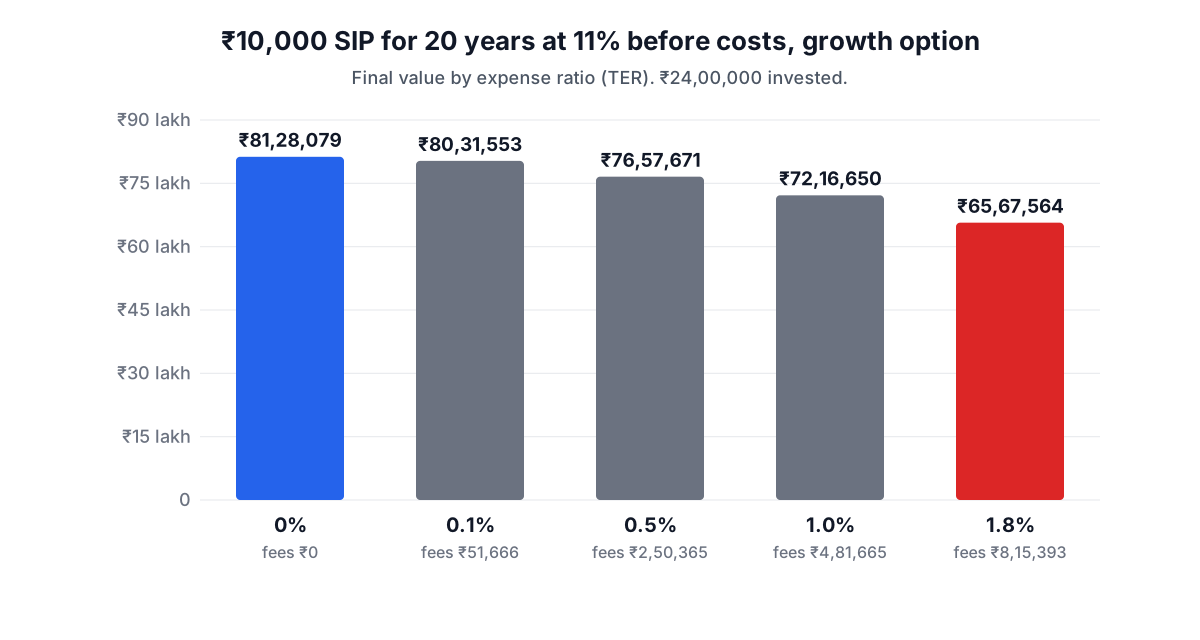
The lost value is roughly 1.9 times the expenses paid, because each rupee of expense also stops compounding. The calculator charges the TER on the average balance each year, so the cost grows with your fund.
A one-time investment shows the same thing more starkly. ₹5 lakh left for 20 years at 11% becomes ₹39,59,141 at a 0.1% TER and ₹33,63,750 at 1%, a ₹5.95 lakh difference on a ₹5 lakh investment.
Two cautions. First, past returns on a factsheet are already after the TER; if you use one as your assumption, enter 0 as the expense ratio or you count it twice. Second, two index funds on the same index can differ by more than their TERs because of tracking error, so check that too before switching.
Growth option or payout: the dividend question
The calculator's dividend yield splits the return into price growth and distributions. For an Indian equity index fund in the growth option nothing is paid out; all the return shows up in the NAV, which is why this version's default yield is 0%. A payout option sends distributions to your bank account, where they are added to your income and taxed at your slab rate. No TDS is deducted when a fund's income distributions to you in a financial year do not exceed ₹10,000 (the Budget 2025 memorandum raised the threshold from ₹5,000 from 1 April 2025); 4% cess applies to the tax at filing. For most SIP investors building wealth, the growth option avoids paying slab-rate tax every year. The India dividend yield guide shows what slab-rate tax does to reinvested dividends over 15 years.
Step-up SIPs: raising the amount each year
A step-up SIP raises the monthly amount by a percentage each year. Set the calculator's Annual Salary Growth slider to the step-up. With a 10% yearly step-up, the ₹10,000 SIP reaches about ₹61,159 a month in year 20 and puts in ₹68,73,000 in total:
| Step-up SIP, 20 years, 11% | Value | Expenses | At today's prices (4% inflation) |
|---|---|---|---|
| TER 0.1% | ₹1,67,42,385 | ₹90,545 | ₹76,41,006 |
| TER 1.0% | ₹1,54,12,091 | ₹8,53,909 | ₹70,33,877 |
The step-up makes the TER gap bigger in rupees, ₹13.3 lakh here, because a larger fund pays a larger charge.
Inflation: the crore that is not a crore
At 4% inflation, prices rise by a factor of 1.04^20, or 2.19, over 20 years. The ₹1.67 crore from the step-up plan buys about what ₹76.4 lakh buys today, and the flat ₹10,000 SIP's ₹80.3 lakh is about ₹36.7 lakh at today's prices. When you set a goal such as a child's education or retirement, inflate the goal or deflate the result, but compare both in the same terms.
Index fund or ETF for a SIP?
Both track the same indices. An index fund is bought from the fund house or a platform at the day's NAV, so an automatic monthly SIP is simple. An ETF trades on the exchange through a demat account at market price, in whole units, with brokerage on each purchase, which makes small monthly buys less convenient. If the TER, tracking and your costs are the same, the calculator gives the same answer for both; the practical difference is in how easily you can automate the SIP.
Tax when you redeem
AMFI's tax page sets out the rules for equity-oriented fund units transferred on or after 23 July 2024, the date the Budget 2024 changes took effect:
- Held more than 12 months: long-term gains above ₹1,25,000 in a year are taxed at 12.5%.
- Held 12 months or less: short-term gains are taxed at 20%.
- Cess: 4% on the tax.
In a SIP, each instalment is its own purchase with its own 12-month clock, so when you redeem, the last year's units are short-term. Suppose the 0.1% plan's ₹56,31,553 of gains were all long-term and redeemed in one year: tax would be 12.5% of ₹55,06,553 plus cess, about ₹7,15,852. Redeeming over several years uses the ₹1,25,000 exemption each year and keeps more. These rules are under the Income-tax Act, 1961 as AMFI states them; from tax year 2026-27 the Income-tax Act, 2025 applies, so check the rate and exemption for the year you redeem.
Common mistakes
- Comparing two schemes' returns without matching plans. A direct plan's return is higher than its own regular plan's by about the TER difference.
- Counting the TER twice by subtracting it from a past return that already includes it.
- Choosing a payout option for a long-term goal, then paying slab-rate tax on every distribution.
- Reading crores as crores. Always look at the inflation-adjusted figure.
Tools for this job
- The India index fund and ETF calculator runs the TER, step-up and inflation scenarios above.
- The India SIP calculator is the simpler tool for a plain or step-up SIP, compared with a lump sum in the India SIP vs lump sum guide.
- The India CAGR calculator turns a fund's start and end NAV into a yearly return.
- The India inflation calculator converts a future goal into today's rupees, and the India retirement calculator builds it into a plan.
Frequently asked questions
Why is a direct plan's NAV higher than the regular plan's?
Because the direct plan's TER is lower: AMFI's disclosure explains that it excludes distribution expenses and commission. Both plans hold the same portfolio, so the direct plan's NAV pulls ahead by about the TER difference every year.
How much does a 1% higher TER cost on a ₹10,000 SIP?
Over 20 years at 11% before costs, a 1% TER ends at ₹72,16,650 against ₹80,31,553 at 0.1%, a difference of about ₹8.15 lakh on ₹24 lakh invested.
How are equity index fund gains taxed?
For transfers on or after 23 July 2024, units held more than 12 months give long-term gains taxed at 12.5% above ₹1,25,000 a year, and units held 12 months or less give short-term gains taxed at 20%, plus 4% cess. Each SIP instalment has its own holding period.
Should I pick the growth or payout option?
For a long-term goal the growth option keeps all the return in the NAV and taxes it only when you redeem, at the capital gains rates. A payout option sends distributions that are taxed at your slab rate each year, which lowers what compounds.
Sources and further reading
- Total expense ratio of mutual fund schemes, Association of Mutual Funds in India. TER components and why direct plans cost less.
- Tax regime for mutual funds, Association of Mutual Funds in India. 12.5% and 20% rates, the ₹1,25,000 limit, holding period and cess.
- Explanatory Memorandum to the Finance (No. 2) Bill, 2024, Ministry of Finance. Rationalisation of capital gains: holding periods, the 12.5% and 20% rates and the ₹1.25 lakh exemption.
- Explanatory Memorandum to the Finance Bill, 2025, Ministry of Finance. Section 194K: TDS threshold on mutual fund income raised from ₹5,000 to ₹10,000 from 1 April 2025.
- Which ITR should I file?, Income Tax Department. Long-term gains under section 112A up to ₹1,25,000 and the 4% cess.
- SEBI investor education, Securities and Exchange Board of India. Investing basics and scams to avoid.
- Expense ratio, US Securities and Exchange Commission. How ongoing fund costs reduce returns.
Open the ETF Investment Simulator
More Analysis Tools
Every tool in the Analysis Tools section, free and in your browser.