
Heat Index in India: Feels Like °C and IMD Heatwaves
Work out the heat index in °C from temperature and humidity, read it against IMD's colour bands, and see why it can disagree with an IMD heatwave declaration.
By Redbison Dev · · 9 min read
India edition. Indian edition in °C, built on IMD's experimental heat index colours, IMD's heatwave, coastal and warm-night criteria, and the government's heat advisory with the 108 and 102 ambulance numbers. US edition
The heat index is how hot the air feels once humidity is counted. India Meteorological Department's experimental heat index uses an equation similar to the US National Weather Service one, and colours the result green below 35°C, yellow from 36 to 45°C, orange from 46 to 55°C and red above 55°C. A humid coastal afternoon at 36°C and 65% relative humidity has a heat index of about 51°C, orange. A dry 44°C afternoon in the plains comes out at about 46°C, the same colour with a much hotter thermometer.
The heat index and an IMD heatwave are different things, and they can point in opposite directions. This edition shows how each works with the Heat Index Calculator for India, where they disagree, and what to do when either says danger.
Why humid heat is harder to bear
Your body cools mainly by sweating, and sweat cools only when it evaporates. IMD's own heat wave FAQ puts it plainly: high relative humidity slows the evaporation of sweat and reduces the efficiency of the body's cooling. In dry heat sweat dries almost as fast as it forms. On a sticky pre-monsoon afternoon on the coast, it runs off without doing much.
The heat index turns that into a temperature. The NWS formula, which IMD describes its own equation as similar to, is a regression fitted to Steadman's apparent temperature data for an adult in the shade.
How the calculation works
The US National Weather Service publishes the exact procedure. It works in °F, so the calculator converts your °C reading first:
- Compute a simple estimate: HI = 0.5 x (T + 61 + (T - 68) x 1.2 + RH x 0.094). If it is below 80°F (about 27°C), use it.
- Otherwise use Rothfusz's regression, a nine-term equation in temperature and relative humidity.
- Apply small corrections: subtract a little when humidity is below 13% between 80 and 112°F, add a little when humidity is above 85% between 80 and 87°F.
The WPC page warns that the regression is not valid for extreme temperature and humidity. In practice that means Indian plains heat above about 43°C (110°F), where the calculator flags the result as an extrapolation. Use those numbers as a rough guide, not a precise reading.
If your forecast gives the dew point instead of humidity, the calculator converts it with the Magnus formula. At 33°C with a dew point of 27°C, relative humidity is 70.8% and the heat index is 43.8°C, yellow. One degree hotter and one degree more humid, 34°C with a dew point of 28°C, gives 71.0% and 47.3°C, orange. Near the band edges, small changes matter.
Worked examples in °C
Enter each in the Heat Index Calculator for India, with humidity as relative humidity:
| Conditions | Heat index | IMD colour | Dew point |
|---|---|---|---|
| Humid coast, 36°C, 65% | 51.0°C | Orange | 28.4°C |
| Humid coast, 35°C, 70% | 50.3°C | Orange | 28.7°C |
| Monsoon break inland, 34°C, 75% | 49.4°C | Orange | 28.9°C |
| Dry plains, 44°C, 20% | 45.5°C, rounds to 46 | Orange | 16.1°C |
| Dry plains, 44°C, 15% | 43.1°C | Yellow | 11.6°C |
| Dry plains, 47°C, 10% | 44.3°C | Yellow | 7.9°C |
| Humid night, 29°C, 90% | 37.2°C | Yellow | 27.2°C |
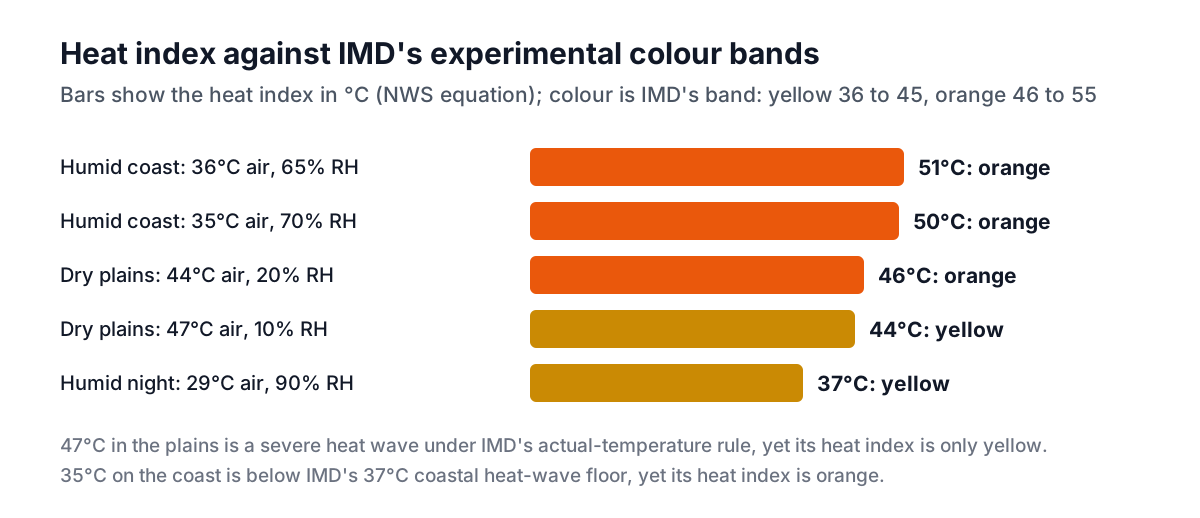
IMD's bands leave gaps between 35 and 36°C and between 45 and 46°C. The calculator rounds the heat index to the nearest whole degree before choosing a colour, so 45.5°C counts as 46, orange.
Heat index versus an IMD heatwave
An IMD heatwave is declared from the air temperature, not the heat index. The FAQ sets the rules:
- A heatwave is considered only once a station's maximum reaches at least 40°C in the plains or 30°C in hilly regions.
- By departure from normal: a heatwave at 4.5 to 6.4°C above normal; a severe heatwave above 6.4°C.
- By actual maximum: a heatwave at 45°C or more; a severe heatwave at 47°C or more.
- The criteria must be met at two or more stations in a meteorological sub-division for at least two consecutive days, and the heatwave is declared on the second day.
- At coastal stations, a heatwave may be described when the maximum is 4.5°C or more above normal, provided it is at least 37°C.
Now look back at the table. The dry 47°C day is a severe heatwave by IMD's actual-temperature rule, yet its heat index is yellow, because there is almost no humidity. The humid 35°C coastal afternoon is below the 37°C coastal floor, so it cannot be a heatwave, yet its heat index is orange.
Both readings are right; they measure different dangers. The dry day dehydrates you fast and stresses the body through sheer heat, and IMD's FAQ notes that hot winds add to that impact. The humid day stops sweat working. Read the IMD warning for your district, and the heat index for how hard the air will make it to cool down.
IMD also uses two terms worth knowing. Hot and humid weather is when a station's maximum stays 3°C above normal along with above-normal humidity. A warm night is declared when the maximum is 40°C or more and the minimum is 4.5 to 6.4°C above normal (a very warm night above 6.4°C). Nights that do not cool down give the body no chance to recover, which is why a humid 29°C night at 90% still reads 37°C on the heat index.
What the number leaves out
The heat index assumes shade and a light breeze, and an average adult doing light activity. Direct sun, heavy work, a tin-roofed room, older age, infancy, pregnancy and chronic illness all lower the point at which heat becomes dangerous. IMD's FAQ lists clothing, occupation, housing, health, fitness, age and acclimatisation among the factors that decide heat discomfort, alongside the weather itself.
The government's heat advisory, as reported by All India Radio News, advises avoiding direct sun at peak hours, drinking fluids regularly, and extra care for young children, pregnant women, older adults, outdoor workers and people with heart disease or hypertension. Dizziness, headache, nausea, confusion, high body temperature, seizures or fainting in the heat are warning signs. Heatstroke is a medical emergency: call 108 or 102 for an ambulance. This guide explains a number; it is not medical advice.
Wind chill in the hills
Wind chill is the cold-weather counterpart: moving air strips heat from exposed skin faster than still air. India rarely needs it outside the Himalaya, but it matters for treks, high passes and winters in Ladakh. The calculator uses the 2001 formula adopted by the US and Canadian weather services, WC = 13.12 + 0.6215T - 11.37V^0.16 + 0.3965T x V^0.16, with T in °C and V the wind in km/h at 10 m.
| Air | Wind | Wind chill | Environment Canada risk |
|---|---|---|---|
| 2°C | 15 km/h | -2.0°C | Low |
| -2°C | 30 km/h | -9.1°C | Low |
| -10°C | 20 km/h | -17.9°C | Moderate |
| -20°C | 30 km/h | -32.6°C | High: skin may freeze in 10 to 30 minutes |
The risk bands come from Environment and Climate Change Canada, which also notes that wind chill cannot make an object colder than the air, and that in sustained winds over 50 km/h frostbite can come faster than the bands suggest. Environment Canada itself reports wind chill when it is 0°C or colder with wind of 5 km/h or more. The Wind Chill Calculator applies the formula up to 10°C with wind above 4.8 km/h, and outside that returns the air temperature and says why.
Tools for this job
- Heat Index Calculator for India: heat index in °C from temperature and humidity or dew point, with the IMD colour and the US category.
- Wind Chill Calculator: feels-like temperature and frostbite risk for cold, windy conditions.
- Related reading: the US heat index and wind chill guide covers the °F charts and the history of both indices.
Frequently asked questions
Why does 36°C feel like 51°C?
At 65% relative humidity the dew point is about 28°C, so the air is so moist that sweat barely evaporates. The NWS heat index equation, which IMD describes its experimental index as similar to, puts that combination at about 51°C, in IMD's orange band.
Is the IMD heat index the same as a heatwave warning?
No. A heatwave is declared from the maximum air temperature and its departure from normal, at two or more stations over two days. The heat index adds humidity. A dry 47°C day is a severe heatwave but only yellow on the heat index; a humid 35°C coastal day is orange but not a heatwave.
What is IMD's heatwave criterion for coastal stations?
A heatwave may be described at a coastal station when the maximum temperature is 4.5°C or more above normal, provided the actual maximum is at least 37°C. In the plains the station must reach at least 40°C, and in hilly regions at least 30°C.
Can I use the heat index for outdoor work planning?
Only as a first look. It assumes shade, a light breeze and light activity. Work in direct sun, in protective clothing or near hot machinery is far more stressful than the number suggests, so plan rest, water and shade breaks with that in mind.
Sources and further reading
- FAQ on heat wave, India Meteorological Department. Heatwave criteria for plains, hills and coastal stations, warm nights, hot and humid weather, and the heat index.
- Shri Kiren Rijiju says IMD has launched Heat Index, Press Information Bureau, 20 July 2023. The experimental heat index, its NWS-like equation and the green to red colour bands.
- Govt issues advisory on how to protect yourself amid extreme heat wave conditions, All India Radio News. Vulnerable groups, warning signs and the 108 and 102 ambulance numbers.
- The heat index equation, US National Weather Service (NOAA). The simple formula, Rothfusz regression and adjustments.
- Wind chill and the Wind Chill Index, Environment and Climate Change Canada. Wind chill risk categories and frostbite times.
Open the Heat Index Calculator
More Everyday Calculators
Every tool in the Everyday Calculators section, free and in your browser.
- Age Calculator
- Time Card Calculator
- Time Calculator
- GPA Calculator
- Final Grade Calculator
- Fuel Cost Calculator
- Tire Size Calculator
- Ring Size Converter
- Shoe Size Converter
- Cooking Measurement Converter
- Heat Index Calculator
- Wind Chill Calculator
- Week Number Calculator
- Day of the Week Calculator
- Recipe Scaler
- Unit Price Calculator