
How BoM's Feels Like Temperature Works, Heat and Cold
How the Bureau of Meteorology's feels like temperature combines heat, humidity and wind, why it differs from US heat index and wind chill, with °C examples.
By Redbison Dev · · 9 min read
Australia edition. Australian edition in °C built on the Bureau of Meteorology's apparent ("feels like") temperature, which counts wind as well as humidity, with healthdirect's heatstroke advice and triple zero. US edition
The "feels like" figure in Bureau of Meteorology observations and forecasts is the apparent temperature: what the air would have to be, at a reference humidity and without wind, to feel the same as current conditions. It uses Steadman's model of an adult walking outdoors in the shade and combines air temperature, humidity and wind. That last input is what sets it apart from the US heat index and makes it work in winter too: a humid 32°C afternoon with a 15 km/h breeze feels like 36°C on the Bureau's measure but 40°C on the US heat index, and a windy alpine day at -1°C can feel like -15°C.
This edition explains the calculation with the Feels Like Temperature Calculator for Australia, shows where the Bureau's figure and the US indices part ways, and covers what neither number tells you.
What the Bureau's feels like measures
The Bureau's explainer on apparent temperature sets out the essentials:
- It is based on a mathematical model of an adult walking outdoors, in the shade.
- The inputs are temperature, humidity and wind; forecasts use the forecast values of all three.
- It does not include the sun. Midday sun in Australia can raise the apparent temperature by about 8°C.
- It assumes appropriate clothing. Wet clothing makes wind chill worse than the figure suggests.
The Bureau's own examples show the range: about -1°C in the alpine country feeling like -15°C, a windy 22°C day near sea level feeling like 15°C, and tropical air at 29°C feeling like 38°C.
The formula the calculator uses
The calculator uses Steadman's apparent temperature for shade, the form without a radiation term that the Bureau's Thermal Comfort observations page publishes and uses on its own site:
AT = Ta + 0.33e - 0.70ws - 4.00
where Ta is the air temperature in °C, ws the wind speed in m/s at 10 m, and e the water vapour pressure in hPa, worked out from temperature and relative humidity:
e = (RH / 100) x 6.105 x exp(17.27Ta / (237.7 + Ta))
Each hPa of vapour pressure adds 0.33°C; each metre per second of wind, 3.6 km/h, takes off 0.7°C; and the constant takes off 4°C. Work through the humid afternoon: at 32°C and 70% the vapour pressure is 33.2 hPa, and 15 km/h is 4.17 m/s, so AT = 32 + 10.9 - 2.9 - 4.0 = 36.0°C.
The Bureau does not give the humidity or wind behind its examples, but plausible values land close: -1°C, 80% humidity and a 60 km/h wind give -15.2°C, and 22°C, 60% and 40 km/h give 15.4°C.
Feels like versus the US heat index
The US heat index, from the US National Weather Service's heat index equation, is a regression fitted to Steadman's data at a light breeze. It has no wind input. On a still day the two broadly agree; on a breezy one the Bureau's figure is lower.
| Conditions | BoM apparent temperature | US heat index |
|---|---|---|
| Humid afternoon: 32°C, 70%, 15 km/h | 36.0°C | 40.4°C |
| Tropical build-up: 33°C, 70%, 10 km/h | 38.6°C | 43.5°C |
| Same build-up, calm | 40.6°C | 43.5°C |
| Dry northerly: 42°C, 15%, 30 km/h | 36.2°C | 40.5°C |
| Same northerly, calm | 42.0°C | 40.5°C |
| Hot, dry and gusty: 40°C, 20%, 40 km/h | 33.1°C | 39.4°C |
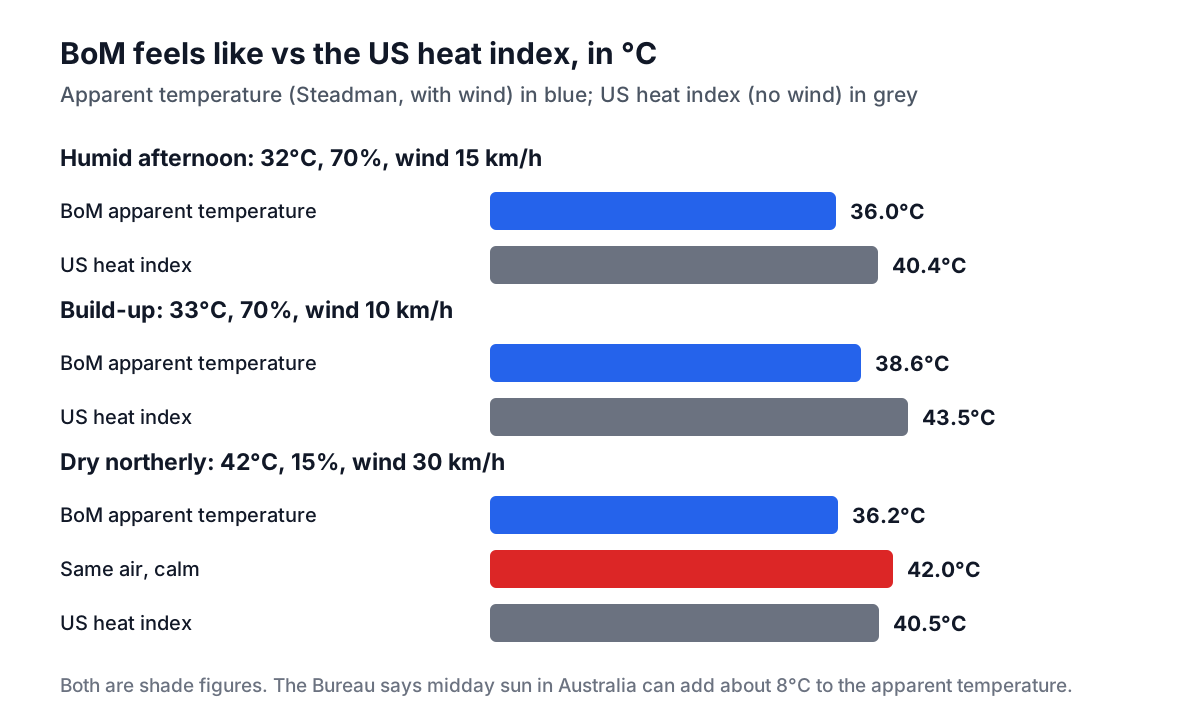
The dry rows need care. In a hot, dry northerly the formula subtracts for wind, so a 42°C day with a 30 km/h wind "feels like" 36°C. That is a statement about evaporative cooling of a sweating person in the shade, not about safety. A hot wind dries you out fast, and the shade assumption is doing a lot of work on a day like that. Treat a low feels-like figure on a scorching day as no reason to skip water, shade or rest.
A website or app that shows a "heat index" is likely using the US formula, and for the same Australian afternoon it can read several degrees above the Bureau's figure. Neither is wrong; they answer different questions. The calculator shows both side by side.
Feels like in the cold
Because it includes wind, the Bureau's apparent temperature is also its cold-weather measure. North America uses a separate wind chill index, adopted in 2001 by the US and Canadian weather services. The two disagree in strong wind:
| Conditions | BoM apparent temperature | North American wind chill |
|---|---|---|
| -1°C, 80%, 30 km/h | -9.3°C | -7.8°C |
| -1°C, 80%, 60 km/h | -15.2°C | -10.2°C |
| 2°C, 80%, 30 km/h | -6.0°C | -3.9°C |
The two come from different models of heat loss. In strong alpine wind the Bureau's figure is the colder one. For bushwalkers in Tasmania or the Australian Alps, read it as a warning about the whole body: wet clothing and wind together are how hypothermia happens. Frostbite bands are a North American tool: Environment and Climate Change Canada starts its moderate risk at a wind chill of -10°C and only reaches "skin may freeze in 10 to 30 minutes" at -28°C. The Wind Chill Calculator gives the North American figure if you need it.
What neither number tells you
- Sun. Both are shade figures; the Bureau says midday sun can add about 8°C.
- Work and fitness. The model is an adult walking. Heavy labour, protective clothing, old age, infancy, pregnancy and some medicines all lower the point at which heat becomes dangerous.
- Heatwaves. A single hot afternoon is not a heatwave, and the feels like figure is not a warning. When a hot spell is forecast, check the Bureau's warnings for your area.
Know the signs of heatstroke. healthdirect lists a body temperature of 40°C or more with changes in brain function, hot red or dry skin with little or no sweating, nausea or vomiting, poor coordination or confusion, and seizures or fainting. Heatstroke is a medical emergency: call triple zero (000) and ask for an ambulance. While waiting, move the person somewhere cool, remove unnecessary clothing and cool them with water and fanning; healthdirect advises against giving fever medicines such as paracetamol, which will not lower the temperature in heatstroke. This guide explains a number; it is not medical advice.
Tools for this job
- Feels Like Temperature Calculator for Australia: the Bureau-style apparent temperature from temperature, humidity and wind, with the US heat index alongside.
- Wind Chill Calculator: the North American wind chill and Environment Canada frostbite bands.
- Related reading: the US heat index and wind chill guide covers the °F charts and the US heat categories.
Frequently asked questions
Why is the BoM feels like lower than the temperature on a hot windy day?
The formula subtracts 0.7°C for every metre per second of wind, because moving air helps sweat evaporate. On a dry 42°C day with a 30 km/h wind, that gives 36.2°C. It is a shade figure for a sweating adult; a hot wind still dehydrates you quickly.
Why do overseas weather sites show a higher feels like temperature?
If they show a heat index, it is likely the US formula, which has no wind input. For a humid 32°C afternoon at 70% with a 15 km/h breeze, the US heat index is 40.4°C and the Bureau-style apparent temperature is 36.0°C.
Does the feels like temperature include sunshine?
No. It is calculated for the shade. The Bureau says midday sun in Australia can raise the apparent temperature by about 8°C, so in the open it will feel much hotter than the forecast figure.
Is the Bureau's feels like the same as wind chill?
In the cold it plays the same role, but it is a different model. In strong wind it reads colder: at -1°C and 60 km/h the apparent temperature is about -15°C, while the North American wind chill index gives about -10°C.
Sources and further reading
- Apparent ("feels like") temperature, Bureau of Meteorology. The Steadman model, its inputs, the shade assumption, the 8°C sun effect and the alpine, coastal and tropical examples.
- Thermal Comfort observations, Bureau of Meteorology. The apparent temperature formula without radiation, AT = Ta + 0.33e - 0.70ws - 4.00, and the vapour pressure equation, from Steadman (1994).
- Heatstroke, healthdirect Australia. Symptoms, first aid and calling triple zero (000).
- The heat index equation, US National Weather Service (NOAA). The US heat index regression and its limits.
- Wind chill and the Wind Chill Index, Environment and Climate Change Canada. Wind chill risk categories and frostbite times.
- FAQ on heat wave, India Meteorological Department. How humidity and hot wind each add to heat stress, a useful comparison for dry and humid Australian heat.
Open the Heat Index Calculator
More Everyday Calculators
Every tool in the Everyday Calculators section, free and in your browser.
- Age Calculator
- Time Card Calculator
- Time Calculator
- GPA Calculator
- Final Grade Calculator
- Fuel Cost Calculator
- Tire Size Calculator
- Ring Size Converter
- Shoe Size Converter
- Cooking Measurement Converter
- Heat Index Calculator
- Wind Chill Calculator
- Week Number Calculator
- Day of the Week Calculator
- Recipe Scaler
- Unit Price Calculator