
Heat Index Philippines: PAGASA Levels and How to Compute
Compute the heat index in °C from temperature and humidity, read it against PAGASA's Caution to Extreme Danger levels, and see why your school or site differs.
By Redbison Dev · · 9 min read
Philippines edition. Philippine edition in °C built around PAGASA's heat index categories (Caution 27 to 32°C up to Extreme Danger 52°C and above), the hot dry season bulletins, and worked examples for a Metro Manila afternoon, a classroom and a dew point reading. US edition
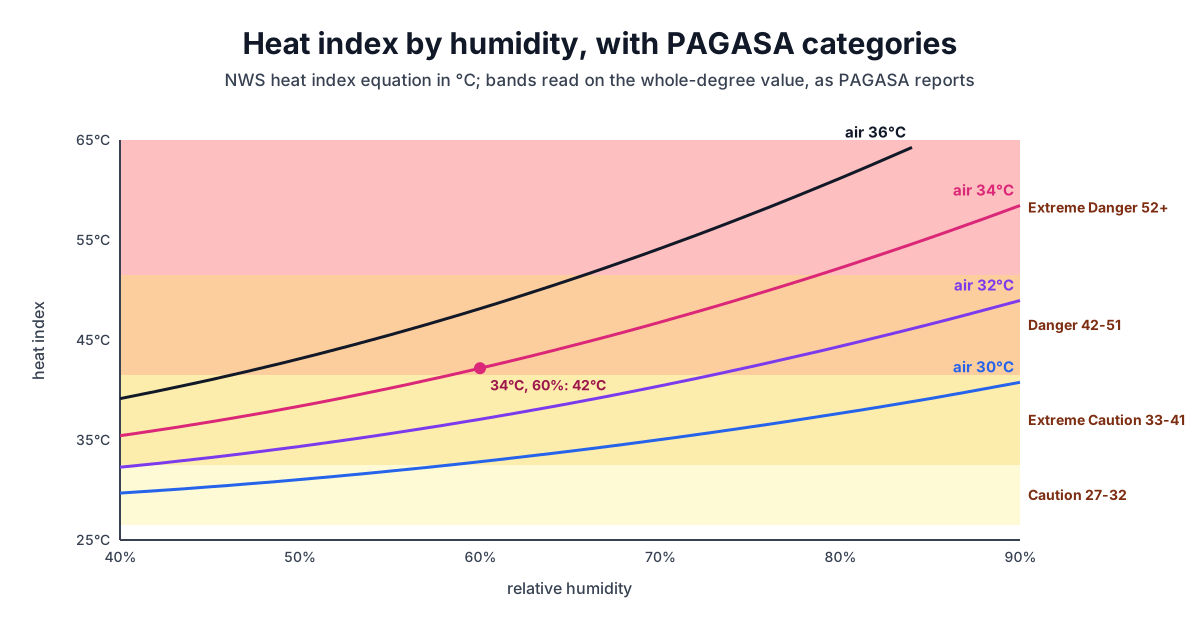
The heat index is the temperature the air feels like on your skin once humidity is counted. At 34°C and 60% relative humidity, a hot Metro Manila afternoon in April or May, the heat index is 42.18°C, which PAGASA reports as 42°C and classifies as Danger. Drop the humidity to 55% and it falls to 40°C, Extreme Caution. Those two readings sit on either side of the line where PAGASA warns that heat cramps, heat exhaustion and, with continued exposure, heat stroke can happen.
This edition shows how the number is computed with the Heat Index Calculator, how to read it against PAGASA's four categories, and why the value for your classroom, jobsite or barangay can be higher than the one in the bulletin.
PAGASA's four categories
PAGASA publishes a daily heat index for its synoptic stations on its heat index page and a municipal forecast on iHeatMAP. Its heat index infographic groups the values into four levels:
| Heat index | PAGASA category | Possible effect |
|---|---|---|
| 27 to 32°C | Caution | Fatigue with prolonged exposure and activity; continuing could lead to heat cramps |
| 33 to 41°C | Extreme Caution | Heat cramps and heat exhaustion possible; continuing could lead to heat stroke |
| 42 to 51°C | Danger | Heat cramps and heat exhaustion possible; continued exposure could lead to heat stroke |
| 52°C and above | Extreme Danger | Heat stroke is possible |
PAGASA states that its values are adapted from Steadman's 1979 work and its thresholds from the US National Weather Service. They are not identical to the US labels: the NWS heat index table starts "Danger" at 103°F, about 39.4°C, while PAGASA keeps 40 and 41°C in Extreme Caution. When you compare a PAGASA bulletin with an American app, the category names may disagree for the same number.
PAGASA's bulletins show whole degrees, so the calculator rounds to the nearest degree before it picks the category: a computed 41.4°C shows as 41°C (Extreme Caution) and 41.6°C as 42°C (Danger).
How the number is computed
The calculator uses the formula published by the US National Weather Service's Weather Prediction Center, a regression fitted to Steadman's tables. The equation works in °F, so the calculator converts your °C reading, applies it, and converts back:
- Convert the air temperature to °F: 34°C is 93.2°F.
- Try the simple formula. If the result averaged with the temperature is below 80°F, that is the heat index. On a Philippine summer afternoon it almost never is.
- Otherwise use the full regression with temperature and relative humidity, plus a small correction at very low or very high humidity.
- Convert back to °C: at 34°C and 60%, 107.9°F, or 42.18°C.
Because the regression smooths Steadman's table, the result can differ by about a degree from a cell in PAGASA's printed chart. That is a property of the method, not a mistake in either.
Worked examples for Philippine conditions
| Situation | Air | Humidity | Heat index | PAGASA category |
|---|---|---|---|---|
| Metro Manila, 2 pm in May | 34°C | 60% | 42.18°C, reported 42 | Danger |
| Same, a drier afternoon | 34°C | 55% | 40.18°C, reported 40 | Extreme Caution |
| Classroom with fans, 1 pm | 32°C | 75% | 42.31°C, reported 42 | Danger |
| Evening after rain | 29°C | 85% | 35.87°C, reported 36 | Extreme Caution |
| Very hot, drier day | 36°C | 45% | 41.01°C, reported 41 | Extreme Caution |
| Baguio, humid morning | 24°C | 90% | 24.81°C | Below Caution |
Two of these surprise people. The classroom at 32°C reaches Danger if a full room with poor ventilation holds the humidity at 75%: the air is two degrees cooler than outside, but the heat index is the same. And the 36°C day at 45% stays a notch below the 34°C day at 60%, because dry air lets sweat evaporate. In the calculator, enter the reading from a thermometer and hygrometer in the shade where people actually are.
Same moisture, different hours: use the dew point
Relative humidity falls through the afternoon as the air warms, even when the amount of water vapor in the air does not change. The dew point stays put, so it is the steadier measure. With a dew point of 25°C all day:
| Time of day | Air | Relative humidity | Heat index | Category |
|---|---|---|---|---|
| 6 am | 27°C | 88.8% | 30.89°C | Caution |
| 8 am | 28°C | 83.8% | 32.7°C, reported 33 | Extreme Caution |
| 10 am | 30°C | 74.6% | 36.2°C | Extreme Caution |
| Noon | 32°C | 66.6% | 39.2°C | Extreme Caution |
| 2 pm | 34°C | 59.5% | 41.97°C, reported 42 | Danger |
| 3 pm | 35°C | 56.3% | 43.32°C | Danger |
The humidity reading drops from about 89% to 56%, yet the heat index rises by more than 12 degrees, because the temperature rise outweighs the falling humidity. A morning flag ceremony at 7 am and a 2 pm PE class on the same day can fall two categories apart. Switch the calculator to dew point mode when your weather app gives it.
Why your reading can be higher than PAGASA's
- Shade versus sun. The heat index assumes shade and light wind. A concrete schoolyard, a jeepney terminal or a roof under direct sun can feel several degrees hotter than the number suggests.
- Station location. Synoptic stations stand on open, grassed sites. A crowded street, a factory floor or a market under a metal roof can be hotter and more humid.
- Effort and clothing. Construction work, delivery riding or sports in uniform add heat the formula does not include.
- Data updates. PAGASA notes that its synoptic values can change when erroneous data are found in the next day's update.
So treat the bulletin as the general level for your area and your own shade reading as the level for your site.
What PAGASA advises at these levels
PAGASA's infographic lists the basics: limit time outdoors, drink plenty of water, avoid tea, coffee, soft drinks and alcohol, use an umbrella or hat and light sleeved clothing, and schedule heavy activity for the cooler hours. For someone showing signs of heat illness it advises moving them to the shade, laying them down with legs raised, giving cool water if they are conscious, removing excess clothing, wetting the skin and fanning, applying ice to the armpits, wrists, ankles and groin, and taking them to a hospital. Heat stroke is a medical emergency; call for help early. For how much to drink on those days, see the Philippine edition of the hydration guide.
The WHO fact sheet on heat and health names who is most at risk: people over 65 and those with heart, lung or kidney conditions, a disability or living alone; outdoor and manual workers and athletes; and the urban and rural poor. Take extra care for them before the heat index reaches Danger.
What about wind chill?
The original version of this guide also covers wind chill, the cold-weather counterpart. It applies at 10°C and below with wind, which lowland Philippine weather does not reach; only the coldest highland mornings, such as in Baguio, come near it. For Filipinos travelling to cold countries, the Wind Chill Calculator and the US heat index and wind chill guide explain it.
Tools for this job
- Heat Index Calculator: heat index in °C from temperature and humidity or dew point, with the PAGASA category and the NWS label for comparison.
- Hydration Calculator: how much water to drink on a hot day or a long shift.
- Wind Chill Calculator: for cold-weather travel.
Frequently asked questions
Paano malalaman ang heat index ngayon?
PAGASA posts the observed and forecast heat index for its stations every day on its heat index page, and a municipal forecast on iHeatMAP, especially during the hot dry season. For the value where you are, enter a shade thermometer and humidity reading into the calculator.
What heat index is dangerous?
PAGASA's Danger level starts at 42°C, when heat cramps and heat exhaustion are possible and continued exposure can lead to heat stroke. Extreme Danger is 52°C and above. Older people, people with chronic illness and outdoor workers can be affected at lower values.
Why does my weather app show a different category from PAGASA?
Many apps use the US National Weather Service labels, which start "Danger" at 103°F, about 39.4°C. PAGASA classifies the same values as Extreme Caution and starts Danger at 42°C. The number may also differ because the app uses a different station or a forecast.
Is 40°C heat index Extreme Caution or Danger?
Under PAGASA's scale it is Extreme Caution, which runs from 33 to 41°C. Under the US NWS scale the same 40°C would be Danger. At 34°C air temperature, a rise in humidity from 55% to 60% is enough to cross into PAGASA's Danger level.
Does a fan lower the heat index?
No. The heat index depends only on air temperature and humidity. A fan helps sweat evaporate and can make you feel cooler, but it does not change the reading. Shade, rest and water matter more as the category rises.
Sources and further reading
- Heat index, DOST-PAGASA. Daily synoptic station heat index and forecasts.
- iHeatMAP, DOST-PAGASA. Municipal heat index forecast with the four-category legend.
- Heat days survival: heat index infographic, DOST-PAGASA. Categories, effects, prevention and first aid; values adapted from Steadman (1979).
- The heat index equation, US National Weather Service Weather Prediction Center. The Rothfusz regression and its adjustments.
- Heat index, US National Weather Service. The US categories that PAGASA's thresholds are drawn from.
- Heat Index, US National Weather Service, Amarillo office. The classification table, with Danger at 103°F to 124°F.
- Heat and health, World Health Organization. Health effects of heat and the groups most at risk.
Open the Heat Index Calculator
More Everyday Calculators
Every tool in the Everyday Calculators section, free and in your browser.
- Age Calculator
- Time Card Calculator
- Time Calculator
- GPA Calculator
- Final Grade Calculator
- Fuel Cost Calculator
- Tire Size Calculator
- Ring Size Converter
- Shoe Size Converter
- Cooking Measurement Converter
- Heat Index Calculator
- Wind Chill Calculator
- Week Number Calculator
- Day of the Week Calculator
- Recipe Scaler
- Unit Price Calculator