
How to Calculate CGPA in Nigeria, and What a 2:1 Takes
Work out your GPA and CGPA on the NUC 5-point scale, see what one carry-over costs, and find the exam mark you need after your CA for an A or a pass.
By Redbison Dev · · 9 min read
Nigeria edition. Nigerian edition on the NUC 5-point scale from the CCMAS, with course units, carry-overs counted at every attempt, the class of degree bands and CA of 30% or 40% against the semester examination. US edition
In a Nigerian university your semester GPA is the total of course units times grade points, divided by the total units you registered, and your CGPA is the same sum over every semester so far. On the National Universities Commission (NUC) 5-point scale, a semester of B in a 3-unit course, A in another 3-unit course, B in a third, C in a 2-unit course, E in a 3-unit course and F in a 2-unit course gives 48 grade points over 16 units: a GPA of 3.00. The F adds nothing to the points but still adds its 2 units to the total.
This edition works through the rules in the NUC's Core Curriculum and Minimum Academic Standards (CCMAS) with the CGPA Calculator and the CA and Exam Score Calculator, using the numbers students actually ask about: carry-overs, the 2:1 line and the exam mark needed after CA.
The grade point table
The CCMAS documents for Computing, Arts and Education all carry the same Table 1.2:
| Mark (%) | Grade | Grade point |
|---|---|---|
| 70 to 100 | A | 5 |
| 60 to 69 | B | 4 |
| 50 to 59 | C | 3 |
| 45 to 49 | D | 2 |
| 40 to 44 | E | 1 |
| 0 to 39 | F | 0 |
Each course is marked out of 100, so the step from 69 to 70 is worth a whole grade point times the units. On a 3-unit course that single mark moves your semester total by 3 points.
One semester, step by step
| Course | Units | Mark or grade | Grade point | Units x GP |
|---|---|---|---|---|
| MTH 201 | 3 | 68 | B, 4 | 12 |
| CSC 201 | 3 | 71 | A, 5 | 15 |
| STA 201 | 3 | B | 4 | 12 |
| GST 201 | 2 | 59 | C, 3 | 6 |
| PHY 201 | 3 | 44 | E, 1 | 3 |
| CHM 201 | 2 | 35 | F, 0 | 0 |
| Total | 16 | 48 |
GPA = 48 / 16 = 3.00. The CCMAS says the GPA is computed "for all the courses taken (whether passed or failed) in the semester", so the 2-unit F stays in the 16. You can type marks, letters or grade points into the calculator; it converts 68 to B and 35 to F for you.
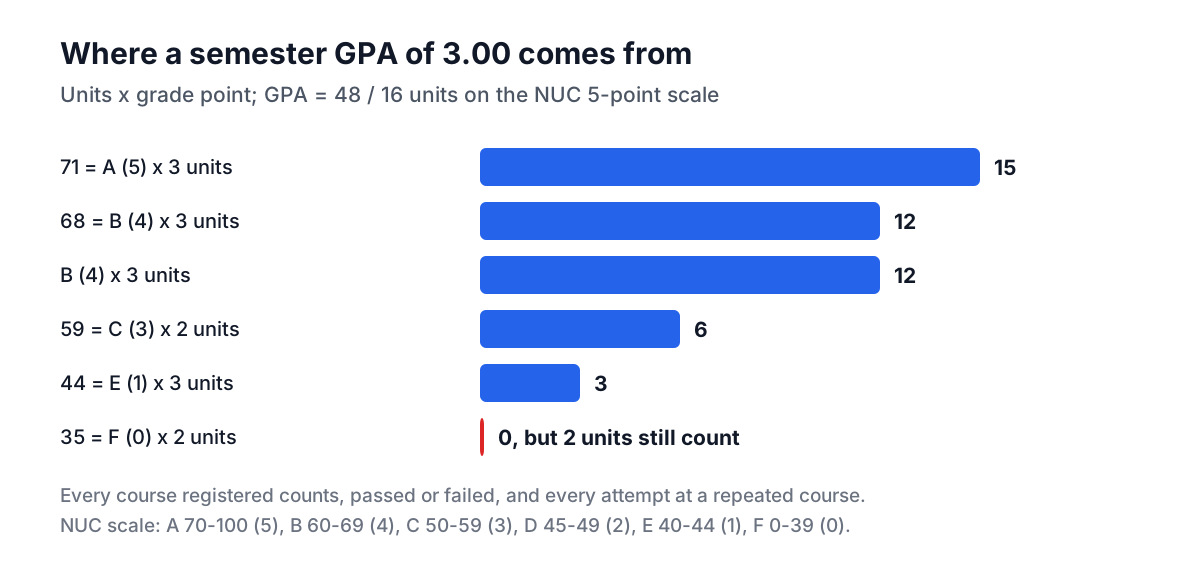
Notice the near-misses: the 68 was two marks short of an A (3 more points), and the 44 one mark short of a D. Those small gaps matter more than one more A in a 2-unit course.
Carry-overs count twice
A rule that catches students out is what happens after you pass a failed course. The CCMAS is explicit: when a student repeats a course once or more before passing it, "grades scored at each and all attempts shall be included in the computation of the GPA." There are no special re-sit examinations in the course credit system; you register the course again.
Take a student with a CGPA of 3.60 over 60 units who fails a 3-unit course:
| Point in time | Units counted | CGPA |
|---|---|---|
| Before the failed course | 60 | 3.60 |
| After the F (0 points, 3 units) | 63 | 3.43 |
| After passing it next session with 55 (C) | 66 | 3.41 |
The pass adds 3 more units at 3 grade points, but the 3 units of F stay in the total, so the CGPA does not recover to where it would have been with a C the first time ((3.60 x 60 + 9) / 63 = 3.57). Here a single carry-over drops this student from the Second Class Upper band to Second Class Lower, and passing the resit does not bring them back. Enter both attempts as separate rows in the calculator.
The class of degree
Table 1.4 of the CCMAS sets the class from the final CGPA, which "shall be calculated and expressed correctly to two decimal places":
| CGPA | Class of degree |
|---|---|
| 4.50 to 5.00 | First Class Honours |
| 3.50 to 4.49 | Second Class Honours (Upper Division) |
| 2.40 to 3.49 | Second Class Honours (Lower Division) |
| 1.50 to 2.39 | Third Class Honours |
| 1.00 to 1.49 | Pass |
The two-decimal rule matters right at the boundaries. A CGPA of 4.4951 shows as 4.50 when rounded, a first, but 4.49 if your university truncates. The calculator rounds; if you are that close, ask your faculty officer how your Senate applies it.
The same CCMAS sets the frame around it: at least 120 credit units for a degree, at least 15 units a semester, and normally 30 to 48 units a session. A CGPA below 1.00 at the end of a year puts a student on probation for one session, and below 1.00 at the end of the probation year leads to withdrawal.
A year that moves you into the 2:1
A CGPA builds slowly once units pile up. With a CGPA of 3.42 over 76 units after three semesters, a strong fourth semester of 4.39 over 18 units (A, A, B, A, C, A, B in 3, 3, 3, 2, 3, 2 and 2-unit courses: 79 points) lifts the CGPA to 3.61 over 94 units. That crosses into the Second Class Upper band.
Planning works backwards. With a CGPA of 3.45 over 92 units and 60 units to go:
| Target CGPA | GPA needed on the last 60 units | Verdict |
|---|---|---|
| 3.50, Second Class Upper | 3.58 | A mix of mostly B with some A |
| 4.50, First Class | 6.11 | Impossible: the scale stops at 5.00 |
If the planner shows more than 5.00, the class is out of reach in the units you have left. It is better to know in second year than in final year, because each new unit has less pull on the average.
What you need in the exam after your CA
Under the CCMAS, continuous assessment (tests, assignments, homework, practicals) is normally 30% of the marks for a mainly theoretical course and may be 40% for one that is partly practical; the semester examination is 60% to 70%. A course that is entirely practical can be 100% CA.
Your CA is often known before the exam, so the question is how many of the exam marks you still need. With 21 out of 30 in CA (70%) and an exam worth 70:
| Grade you want | Course mark needed | Exam marks needed out of 70 | Exam score needed |
|---|---|---|---|
| A | 70 | 49 | 70.00% |
| B | 60 | 39 | 55.71% |
| C | 50 | 29 | 41.43% |
| D | 45 | 24 | 34.29% |
| E (pass) | 40 | 19 | 27.14% |
Scoring 55% in that exam gives 21 + 0.7 x 55 = 59.5, a C, half a mark below a B. For a practical course where CA is 40% and you scored 30 of 40 (75%), an A needs 66.67% in the exam and a C needs 33.33%. The CA and Exam Score Calculator does these sums for any weight, or from each test and assignment in its weighted categories mode.
Tools for this job
- CGPA Calculator: semester GPA and CGPA on the NUC 5-point scale from marks or grades, with the class of degree and a target planner.
- CA and Exam Score Calculator: the exam score you need after CA for any grade.
- Percentage Calculator: turning a CA score such as 21 out of 30 into a percentage.
- The US GPA and final grades guide explains the 4.0 scale, useful when you apply abroad.
Frequently asked questions
How do I calculate my CGPA from my results?
Multiply each course's grade point by its units, add the totals for every semester, and divide by all the units you registered, including failed courses. In the example semester, 48 points over 16 units is a GPA of 3.00. Your CGPA uses the same sum across all semesters.
Does a carry-over affect my CGPA after I pass it?
Yes. The CCMAS includes the grades from every attempt at a repeated course, so the F and the later pass both count. A 3-unit F took a 3.60 CGPA over 60 units down to 3.43, and passing it with a C afterwards only reached 3.41.
What CGPA is second class upper?
From 3.50 to 4.49 on the 5-point scale. First Class is 4.50 to 5.00, Second Class Lower 2.40 to 3.49, Third Class 1.50 to 2.39 and Pass 1.00 to 1.49. The CGPA is expressed to two decimal places.
What is the pass mark in Nigerian universities?
40 out of 100, which is an E worth 1 grade point. Below 40 is F. With 21 out of 30 in CA, you need 19 of the 70 exam marks, 27.14%, to reach 40.
Is CA always 30% of the course?
Normally 30% for theory courses under the CCMAS, up to 40% for courses that are partly practical, and 100% for courses that are entirely practical. Your department can set the split within those norms, so check the course outline.
Sources and further reading
- CCMAS: Computing, National Universities Commission. Tables 1.2 to 1.4, all attempts counted, 120-unit minimum, probation, withdrawal and CA weights.
- CCMAS: Arts, National Universities Commission. The same grade point table and degree classes in another discipline.
- CCMAS: Education, National Universities Commission. The same rules for education programmes.
- CCMAS documents by discipline, National Universities Commission. Find the standards for your own programme.
- Weighted mean, US National Institute of Standards and Technology. The unit-weighted average behind GPA and CGPA.
More Everyday Calculators
Every tool in the Everyday Calculators section, free and in your browser.
- Age Calculator
- Time Card Calculator
- Time Calculator
- GPA Calculator
- Final Grade Calculator
- Fuel Cost Calculator
- Tire Size Calculator
- Ring Size Converter
- Shoe Size Converter
- Cooking Measurement Converter
- Heat Index Calculator
- Wind Chill Calculator
- Week Number Calculator
- Day of the Week Calculator
- Recipe Scaler
- Unit Price Calculator