
How to Compute Your GWA, and What It Means for Latin Honors
Compute your General Weighted Average on the 1.00 to 5.00 scale, see what INC, 4.00 and P grades do to it, and check how far you are from cum laude.
By Redbison Dev · · 9 min read

Philippines edition. Philippine edition on the 1.00 to 5.00 scale where 1.00 is highest, weighted by units, using University of the Philippines rules for 4.00 conditional grades, the GWA and the separate average used for Latin honors. US edition
Your General Weighted Average (GWA) is every numerical grade multiplied by the subject's units, added up, and divided by the total units. On the scale many Philippine universities use, 1.00 is the best grade and 3.00 is the lowest passing grade, so a lower GWA is better. A term of 1.50 in a 4-unit lab subject, 2.25 in another 4-unit subject, 1.75 and 1.25 in two 3-unit subjects and a 4.00 in a fifth 3-unit subject comes to 36 weighted points over 17 units, a GWA of 2.12. Pass that 4.00 at removal and the same term becomes 1.94.
This edition works through the Philippine rules with the GWA Calculator: which grades count, what a conditional 4.00 does, and why the average used for Latin honors is not always your GWA.
The scale
The University of the Philippines rates course work under Article 369 of the Revised UP Code, as listed by the UP Diliman Office of the University Registrar:
| Grade | Meaning | In the calculator's GWA? |
|---|---|---|
| 1.00, 1.25 | Excellent | Yes |
| 1.50, 1.75 | Very good | Yes |
| 2.00, 2.25 | Good | Yes |
| 2.50, 2.75 | Satisfactory | Yes |
| 3.00 | Pass | Yes |
| 4.00 | Conditional | Yes, at face value until removed |
| INC | Incomplete | No, until a grade is posted |
| 5.00 | Fail | Yes |
| P, F, S, U | Qualitative grades | No |
UP says qualitative grades are not used in computing the GWA and serve only to break a tie in the ranking of students. Other schools may use the same 1.00 to 5.00 numbers but convert percentages to them with their own tables, so the same 92% is a 1.50 at many schools but a 1.75 on UP's table. Enter the numerical grade on your class card, not the percentage.
Step by step: one term
Take the term from the opening:
| Subject | Units | Grade | Grade x units |
|---|---|---|---|
| Physics with lab | 4 | 1.50 | 6.00 |
| Calculus II | 4 | 2.25 | 9.00 |
| Ethics | 3 | 1.75 | 5.25 |
| Readings in Philippine History | 3 | 1.25 | 3.75 |
| Chemistry for Engineers | 3 | 4.00 | 12.00 |
| PE (Pass/Fail) | 2 | P | not counted |
| Total | 17 counted | 36.00 |
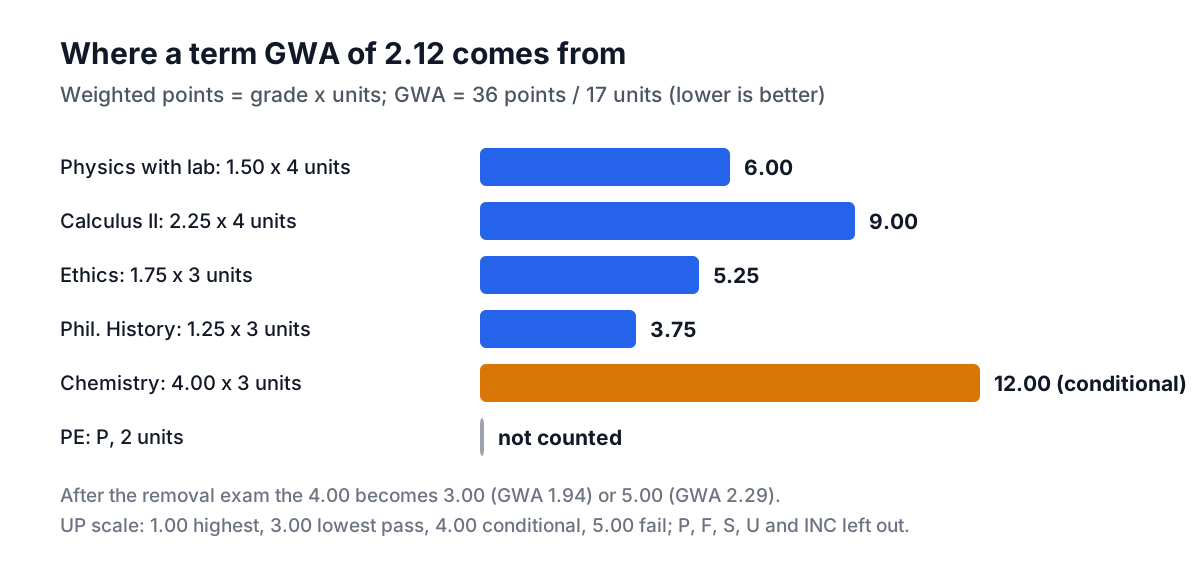
GWA = 36 / 17 = 2.12. The 2-unit PE subject graded P is listed but kept out of both the points and the units.
Units matter more than the grade count. The 4-unit Calculus 2.25 contributes 9 points; a 2.25 in a 3-unit subject would add only 6.75. When you plan where to spend review time, the heavy subjects move your GWA most.
What a 4.00 does, and why to remove it fast
A 4.00 is not a failing grade yet. UP's rule on the grade of 4.00 allows one re-examination within one academic year: pass it and the grade becomes 3.00, fail it and it becomes 5.00. If you do not take the removal in time, the 4.00 turns into 5.00 and the only way to earn credit is to repeat the subject.
For the term above:
| Outcome of the removal exam | Chemistry grade | Term GWA |
|---|---|---|
| Not yet taken | 4.00 | 2.12 |
| Passed | 3.00 | 1.94 |
| Failed, or not taken in time | 5.00 | 2.29 |
That is a swing of 0.35 in the term average from one 3-unit subject. Recompute in the calculator as soon as the removal result is posted, and before any scholarship or Dean's List deadline.
GWA is not always the average used for honors
UP distinguishes several averages in its note on grade averages:
- GWA covers all subjects taken at that level, including subjects from a previous program after shifting and subjects taken outside the curriculum for enrichment.
- Weighted Average Grade (WAG) is the one used for graduation with honors. It counts all subjects prescribed in the curriculum plus subjects that qualify as electives.
- Curriculum Weighted Average (CWA) is used when you shift programs, and counts only subjects that will be credited in the new program.
The difference can decide your honor. Say your curriculum subjects average 1.44 over 120 units, and you also took 6 units of enrichment subjects outside your program at 2.75:
WAG = 1.44 over 120 units (curriculum only)        -> magna cum laude range
GWA = (1.44 x 120 + 2.75 x 6) / 126 = 1.50          -> cum laude range
Under the UP rules the honor follows the WAG, so this student is in the magna range even though the transcript GWA says 1.50. When you check honors in the calculator, leave out subjects that are not part of your program. If you took more electives than the program requires, UP counts the required number in chronological order, so the first electives you took are the ones that count.
Latin honors at UP
The Revised UP Code, Article 410, sets absolute minimum weighted averages:
| Honor | WAG of at least |
|---|---|
| Summa cum laude | 1.20 |
| Magna cum laude | 1.45 |
| Cum laude | 1.75 |
The grades are not the only condition. Candidates must have completed at least 75% of their academic units at the University, been in residence for at least two years immediately before graduation, and carried at least 15 units or the normal load each semester unless a lighter load was justified by health, unavailable subjects or work, with sworn documents submitted during that semester. Only resident credit counts, and a finding of cheating bars a student from honors. Other universities set their own cut-offs, often close to these, so read your student handbook before you plan around them.
Planning: is cum laude still in reach?
The planner rearranges the same weighted average. With a WAG of 1.52 over 96 units and 48 units left:
| Target | Average needed on the last 48 units | Verdict |
|---|---|---|
| Cum laude, 1.75 | 2.21 | Safe: any average of 2.21 or better keeps it |
| Magna cum laude, 1.45 | 1.31 | Possible, needs mostly 1.25 and 1.00 |
| Summa cum laude, 1.20 | 0.56 | Out of reach: no grade is better than 1.00 |
On this scale the result reads backwards from a US GPA planner. A required average above 1.00 is achievable; one below 1.00 is impossible however hard you study. The earlier you check, the more units are left to spread the improvement over.
What you need in the finals
Inside a subject, many teachers compute a percentage first and convert it to the 1.00 to 5.00 grade at the end, so the Final Grade Calculator works in percent. Suppose your class standing (quizzes, recitation, projects and midterms) is 84% and the final exam is 40% of the grade:
| Target percentage | Score needed in the final exam |
|---|---|
| 90 | 99% |
| 85 | 86.5% |
| 75 | 61.5% |
Scoring 70% instead gives 84 x 0.6 + 70 x 0.4 = 78.4%. Which numerical grade that becomes depends on your school's conversion table, so look up where 78.4% falls in your syllabus before deciding whether the target is a 2.25 or a 2.50. Some schools also average a midterm grade and a final term grade rather than weighting a single final exam; in that case enter each term as a category in the weighted categories mode.
Tools for this job
- GWA Calculator: term and cumulative GWA on the 1.00 to 5.00 scale, INC and P/F left out, Latin honors cut-offs and a target planner.
- Final Grade Calculator: the final exam score you need for a target percentage, or what a given score does to your grade.
- Percentage Calculator: turning raw scores into percentages before you convert them.
- The US GPA and final grades guide covers the 4.0 scale, useful if you apply to schools abroad.
Frequently asked questions
Paano mag-compute ng GWA?
Multiply each subject's grade by its units, add the results, then divide by the total units. In the example, 36 weighted points over 17 units gives a GWA of 2.12. Leave out subjects graded P, F, S or U, as UP does, and leave INC or DRP out until a numerical grade is posted.
Is a GWA of 1.75 good?
Yes. At UP a 1.75 is "very good," and a weighted average of 1.75 or better over your curriculum subjects meets the cum laude minimum, subject to the residence and unit-load rules. Scholarships set their own minimum GWA, so check the terms of the one you hold.
Does a 4.00 count in the GWA?
The calculator counts it at 4.00 until it is removed; check how your registrar treats it in the meantime. Passing the removal exam turns it into 3.00, failing turns it into 5.00, and not taking the exam within one academic year also makes it 5.00. In this guide's example that is the difference between a 1.94 and a 2.29 term.
Why is my GWA different from my honors average?
UP uses the GWA for overall standing, counting every subject at that level, and a separate Weighted Average Grade for honors, counting only curriculum subjects and qualifying electives. Extra subjects outside your program can pull the GWA down without affecting the honors average.
Can I graduate with honors if I underloaded?
Under UP rules you need at least 15 units or the normal load each semester, unless the lighter load was due to health, unavailable subjects or employment and you submitted sworn proof during that semester. Other schools have their own load rules.
Sources and further reading
- Grades: grading system, UP Diliman Office of the University Registrar. The 1.00 to 5.00 scale, INC, and qualitative grades (P, F, S, U) left out of the GWA.
- Grade of 4.00, UP Diliman Office of the University Registrar. Removal within one academic year, 3.00 if passed and 5.00 if failed or not removed.
- Grade averages, UP Diliman Office of the University Registrar. GWA, CWA, CWAG and the Weighted Average Grade used for honors.
- Graduation with honors, UP Diliman Office of the University Registrar. Summa 1.20, magna 1.45, cum laude 1.75, residence and load rules.
- Academic grading in the Philippines, Wikipedia. How grading scales differ between Philippine schools.
- Weighted mean, US National Institute of Standards and Technology. The unit-weighted average behind the GWA.
More Everyday Calculators
Every tool in the Everyday Calculators section, free and in your browser.
- Age Calculator
- Time Card Calculator
- Time Calculator
- GPA Calculator
- Final Grade Calculator
- Fuel Cost Calculator
- Tire Size Calculator
- Ring Size Converter
- Shoe Size Converter
- Cooking Measurement Converter
- Heat Index Calculator
- Wind Chill Calculator
- Week Number Calculator
- Day of the Week Calculator
- Recipe Scaler
- Unit Price Calculator