
How to Calculate CGPA on the HEC Scale, and Convert It to %
Calculate semester GPA and CGPA from marks and credit hours on the HEC 4.0 scale, convert CGPA to percentage, and see how repeating a course lifts it.
By Redbison Dev · · 9 min read
Pakistan edition. Pakistani edition on the HEC fractionalized 4.0 scale, with credit hours written as 3(3+0) and 4(3+1), the HEC rules for W, F and repeated courses, CGPA to percentage, probation and the 2.00 BS and 2.50 MS minimums. US edition
Under the Higher Education Commission's semester policy, your semester GPA is the sum of credit hours times grade points for every course, divided by the semester's credit hours. CGPA is the same sum over all semesters. A semester of 83%, 76% and 69% in three 3-credit-hour courses, 62% in a 4(3+1) course with a lab and 55% in another 3-credit-hour course comes to 40.85 quality points over 16 credit hours, a GPA of 2.55. A course withdrawn in the fifth week does not appear in the sum at all.
This edition works through the HEC rules with the CGPA Calculator: the fractionalized table, how marks become grade points, what repeating a course does, and how universities turn a CGPA back into a percentage.
The HEC fractionalized table
Section 13.1 of the HEC's Policy Guidelines for Implementation of Uniform Semester System links percentage, grade and grade-point range:
| Percentage | Grade | Grade points |
|---|---|---|
| 85 and above | A | 3.67 to 4.00 |
| 80 to 84 | A- | 3.34 to 3.66 |
| 75 to 79 | B+ | 3.01 to 3.33 |
| 71 to 74 | B | 2.67 to 3.00 |
| 68 to 70 | B- | 2.34 to 2.66 |
| 64 to 67 | C+ | 2.01 to 2.33 |
| 61 to 63 | C | 1.67 to 2.00 |
| 58 to 60 | C- | 1.31 to 1.66 |
| 54 to 57 | D+ | 1.01 to 1.30 |
| 50 to 53 | D | 0.10 to 1.00 |
| below 50 | F | 0.00 |
Each letter covers a range of grade points, and universities apply it differently. Some award the top of the band for the letter, others a fraction inside it. The calculator gives a letter the top of its band (A- is 3.66, B+ 3.33); if your transcript shows a value such as 3.47 for an A-, type that number instead and it is used as it is.
Credit hours as they appear on your scheme of studies
HEC writes credit hours with the theory and practical split in brackets. A 3(3+0) course is three credit hours of theory. A 4(3+1) course is four credit hours, three of theory and one of lab, and one lab credit hour means three contact hours a week. Enter the total, 3 or 4, as the credit hours: the 4(3+1) course moves your GPA a third more than a 3-credit-hour course with the same grade.
One semester, step by step
| Course | Credit hours | Marks | Grade | Grade points | Quality points |
|---|---|---|---|---|---|
| Linear Algebra | 3(3+0) | 83 | A- | 3.66 | 10.98 |
| Data Structures | 3(3+0) | 76 | B+ | 3.33 | 9.99 |
| Pakistan Studies | 3(3+0) | 69 | B- | 2.66 | 7.98 |
| Digital Logic Design | 4(3+1) | 62 | C | 2.00 | 8.00 |
| Probability and Statistics | 3(3+0) | 55 | D+ | 1.30 | 3.90 |
| Technical Writing | 3 | W | not counted | ||
| Total | 16 | 40.85 |
GPA = 40.85 / 16 = 2.55.
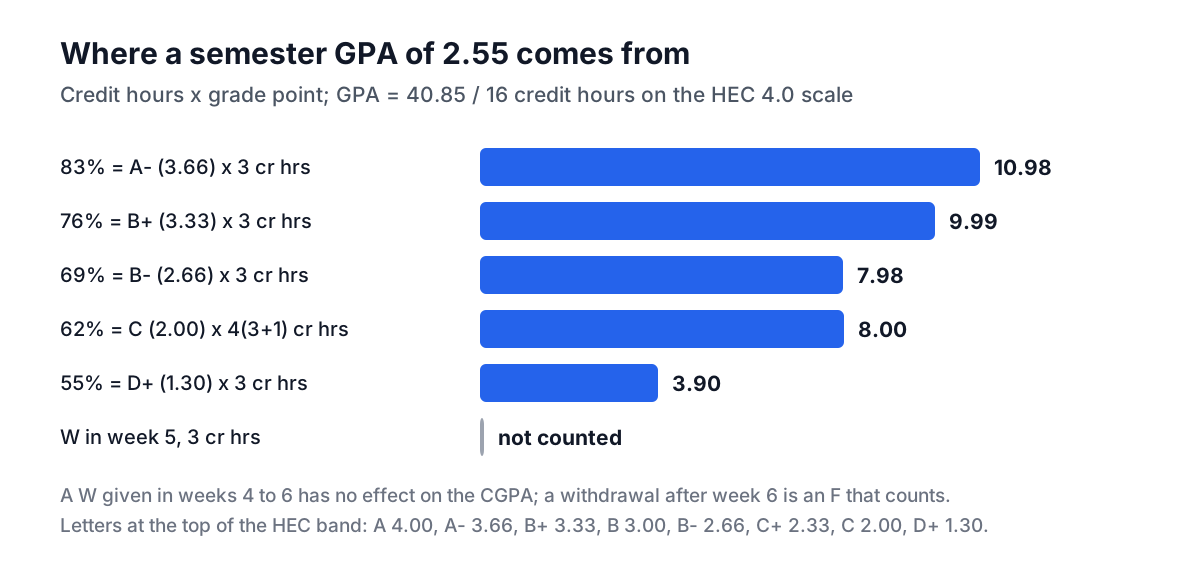
The W matters. Under section 8.4 of the policy, a student who withdraws in weeks 4 to 6 receives a W, "which shall have no impact on the calculation of the CGPA". Withdraw after the sixth week and the course is graded F, which counts in the GPA and stays on the transcript. Courses taken on a pass/fail basis, up to 9 credit hours of electives at undergraduate level, are also left out of the GPA.
Building a CGPA, and why it moves slowly
With a CGPA of 2.62 over 66 credit hours, a good semester of A, B+, a transcript value of 3.40, C in a 4(3+1) course and B- (16 credit hours, 48.17 quality points, a semester GPA of 3.01) lifts the CGPA only to 2.70 over 82 credit hours. HEC's formula for CGPA uses "all taken courses in all semesters", so the 66 earlier credit hours weigh against each new semester.
Repeating a course: the better grade replaces the old one
This is where Pakistan differs from systems that count every attempt. Under section 9.2, an undergraduate may repeat a course graded below C; both grades stay on the transcript, but "only the better grade shall be used in the calculation of CGPA". Your university can cap the number of repeats at fewer than six in an eight-semester programme, and the improvement is marked (Imp) on the transcript.
Take a CGPA of 2.10 over 60 credit hours that includes a 3-credit-hour F. Repeat that course in a summer semester and earn a B (3.00):
before:  2.10 x 60 = 126 quality points over 60 credit hours (the F adds 0)
after:   126 - 0 + 3 x 3.00 = 135 over the same 60 credit hours
CGPA:    135 / 60 = 2.25
The credit hours do not increase, because the old attempt drops out of the average. That makes repeating a low grade the quickest way to lift a CGPA near the 2.00 line. The summer semester allows up to 8 credit hours of remedial work, usually one or two courses.
Minimum CGPA, probation and the planner
Section 15.1 sets the minimum qualifying CGPA at 2.00 for a BS and 2.50 for MS/MPhil. The probation rules in section 26 bite earlier:
- a semester GPA below 2.00 with every paper passed puts you on probation for the next semester;
- a GPA of 1.7 or above with a failed paper means probation and a summer semester to improve the grade;
- a GPA below 1.7 in two consecutive semesters with failed papers, even after summer, means removal from the rolls, with re-admission allowed once.
The planner rearranges the CGPA formula. With 2.40 over 105 credit hours and 31 left in a 136-credit-hour BS:
| Target CGPA | GPA needed on the last 31 credit hours |
|---|---|
| 2.50 | 2.84, a B average across those courses |
| 3.00 | 5.03, impossible on a 4.00 scale |
For an MS student at 2.80 over 18 credit hours with 12 left, reaching 3.00 needs 3.30, about a B+ in every remaining course.
Converting CGPA to percentage
The note under the HEC table says a student "will be given the minimum of the corresponding percentage". A CGPA of 3.00 sits in the B band (2.67 to 3.00), so it corresponds to 71%. On the examples above:
| CGPA | Band | Percentage under the HEC note |
|---|---|---|
| 2.55 | B- (2.34 to 2.66) | 68% |
| 2.70 | B (2.67 to 3.00) | 71% |
| 3.40 | A- (3.34 to 3.66) | 80% |
Use this only where an application asks for an HEC-based percentage. Degrees from the old annual system convert on a different HEC table (85% and above A, 70 to 84% A-, 55 to 69% B and so on), and some employers and universities abroad have their own rules.
What you need in the final exam
HEC's section 11.1 gives the usual weightage of each assessment: quizzes 5 to 10%, mid-semester examination 20 to 25%, assignments, presentations and practicals 5 to 25%, sessional examination 10 to 15% and the final examination 35 to 40%. Your teacher sets the exact split in the course outline.
Say quizzes (10%) are at 70, assignments (10%) at 80, the sessional (15%) at 55 and the midterm (25%) at 58, with a final worth 40%. That is 37.75 marks banked out of 60, an average of 62.92%. In the Final Grade Calculator's weighted categories mode:
| Course mark you want | Grade | Final exam score needed |
|---|---|---|
| 50 | D | 30.63% |
| 61 | C | 58.13% |
| 71 | B | 83.13% |
| 85 | A | 118.13%, out of reach |
The policy's probation section also requires at least 50% marks in practicals, projects, theses, assignments, tests and the theory paper, "separately/aggregate", so check whether your university applies the 50% to each component or only to the total.
Tools for this job
- CGPA Calculator: semester GPA and CGPA on the HEC 4.0 scale from marks, letters or transcript grade points, with a target planner.
- Final Grade Calculator: the final exam score needed from quizzes, sessionals and midterms.
- Percentage Calculator: marks out of any total as a percentage.
- The US GPA and final grades guide explains weighted US GPAs, useful for applications to American universities.
Frequently asked questions
How do I calculate CGPA from marks in Pakistan?
Convert each course's marks to a grade point on the HEC table, multiply by the credit hours, add the results for all semesters and divide by the total credit hours. In the example semester, 40.85 quality points over 16 credit hours gives 2.55.
How do I convert CGPA to percentage under HEC rules?
Find the band your CGPA falls in and take the lowest percentage of that band. A CGPA of 3.00 is in the B band, 2.67 to 3.00, so it corresponds to 71%. A 2.55 is in the B- band and corresponds to 68%.
Does repeating a course improve my CGPA?
Yes. An undergraduate can repeat a course graded below C, and only the better grade counts in the CGPA. Replacing a 3-credit-hour F with a B lifts a 2.10 CGPA over 60 credit hours to 2.25.
What is the minimum CGPA to get a BS degree?
2.00 out of 4.00 for a BS and 2.50 for MS/MPhil, under section 15.1 of the HEC semester policy. Universities may set higher standards for their own programmes.
Does a W grade affect my CGPA?
A W for withdrawing in weeks 4 to 6 has no effect on the CGPA. If you withdraw after the sixth week the course is graded F, which counts in the GPA and stays on the transcript.
Sources and further reading
- Policy Guidelines for Implementation of Uniform Semester System in HEIs of Pakistan, Higher Education Commission. Sections 8.4 and 8.5 (W and F), 9 (repeating courses), 11.1 (assessment weightage), 13 (fractionalized grading and annual system conversion), 14 (GPA and CGPA), 15 (minimum CGPA), 20 (pass/fail) and 26 (probation).
- Undergraduate Education Policy, Higher Education Commission. Credit hours for undergraduate degrees and the Associate Degree minimum.
- Academic grading in Pakistan, Wikipedia. Overview of grading at school, intermediate and university level.
- Weighted mean, US National Institute of Standards and Technology. The credit-weighted average behind GPA and CGPA.
- How to calculate your GPA on a 4.0 scale, College Board. The US conversion that HEC's scale differs from.
More Everyday Calculators
Every tool in the Everyday Calculators section, free and in your browser.
- Age Calculator
- Time Card Calculator
- Time Calculator
- GPA Calculator
- Final Grade Calculator
- Fuel Cost Calculator
- Tire Size Calculator
- Ring Size Converter
- Shoe Size Converter
- Cooking Measurement Converter
- Heat Index Calculator
- Wind Chill Calculator
- Week Number Calculator
- Day of the Week Calculator
- Recipe Scaler
- Unit Price Calculator