
SGPA, CGPA and Board Marks: How the Maths Works in India
Calculate SGPA and CGPA on the UGC 10-point scale, convert CGPA to percentage the right way, and find the board paper marks you need after internals.
By Redbison Dev · · 9 min read

India edition. Indian edition built on the UGC 10-point grading scale (O to P), SGPA and CGPA with credits, CBSE's CGPA x 9.5 rule and its limits, and the CBSE 80 plus 20 marks pattern. US edition
Your SGPA is a credit-weighted average of the grade points on your marksheet, and your CGPA is the same average taken over every semester so far. Multiply each course's grade point by its credits, add the results, and divide by the total credits. A first-semester B.Tech student with an A+ in a 4-credit maths paper and an O in a 1.5-credit workshop ends up with an SGPA of 8.39, not the 8.43 you get by averaging the seven grade points, because credits decide how much each grade counts.
This edition works through the sums Indian students actually face: SGPA and CGPA on the UGC 10-point scale, the target CGPA for a placement cut-off, the CGPA to percentage question, and the board exam marks you need once internal assessment is in. Use the SGPA and CGPA Calculator and the Board Exam Marks Needed Calculator alongside it.
The UGC 10-point scale
The University Grants Commission recommends the same letter grades in its Choice Based Credit System guidelines and in the newer Curriculum and Credit Framework for Undergraduate Programmes:
| Letter grade | Grade point |
|---|---|
| O (Outstanding) | 10 |
| A+ (Excellent) | 9 |
| A (Very Good) | 8 |
| B+ (Good) | 7 |
| B (Above Average) | 6 |
| C (Average) | 5 |
| P (Pass) | 4 |
| F (Fail) and Ab (Absent) | 0 |
Three rules from the UGC's CBCS guidelines matter when you calculate:
- An F counts as 0 over its full credits, and the student has to reappear in that examination.
- Non-credit courses are marked Satisfactory or Unsatisfactory and are left out of SGPA and CGPA.
- Each university decides the marks needed for each grade and the CGPA needed for a degree. The UGC only recommends that the cut-off for B should not be below 50% and for B+ not below 55%.
That third point is why the calculator asks for the letter or grade point printed on your marksheet, not your raw marks. A 78 in one university's system can be an A+ and in another's an A.
SGPA: a worked semester
Here is an example first semester of B.Tech, as entered in the SGPA and CGPA Calculator:
| Course | Credits | Grade | Grade point | Credit points |
|---|---|---|---|---|
| Engineering Mathematics | 4 | A+ | 9 | 36 |
| Physics | 4 | A | 8 | 32 |
| Basic Electrical | 3 | B+ | 7 | 21 |
| Programming in C | 3 | O | 10 | 30 |
| Physics Lab | 1.5 | A+ | 9 | 13.5 |
| Workshop | 1.5 | O | 10 | 15 |
| English | 2 | B | 6 | 12 |
| Total | 19 | 159.5 |
SGPA = 159.5 / 19 = 8.39.
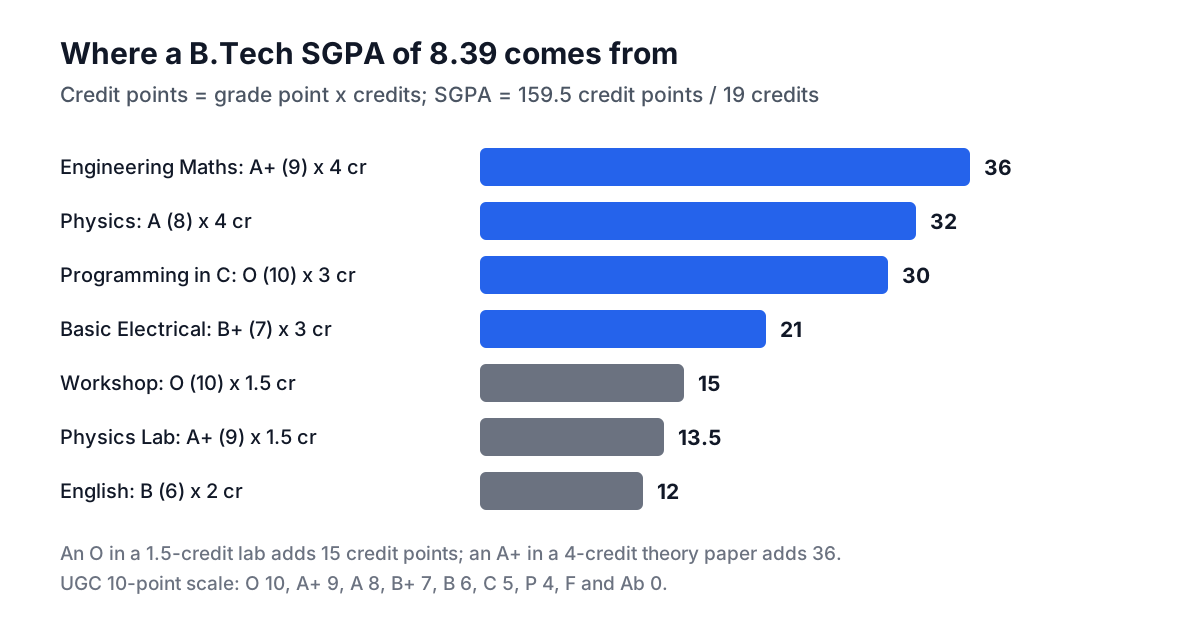
The plain average of the seven grade points is 8.43. It runs higher than the SGPA because the O in the workshop and the A+ in the lab sit in light courses. An O in the 1.5-credit workshop adds 15 credit points; an A+ in the 4-credit maths paper adds 36. When you plan revision, the heavy theory papers are where the SGPA moves.
Check the calculator against the UGC. The UGC's own illustration for a B.Sc./B.Com./B.A. Honours first semester has four courses: 6 credits at A, 6 at B+, 2 at B and 6 at B. That is 48 + 42 + 12 + 36 = 138 credit points over 20 credits, an SGPA of 6.9. The framework document for four-year degrees gives a second check: six courses worth 139 credit points over 20 credits, an SGPA of 6.95. Enter either and you should see the same answer.
CGPA: weighting semesters by credits
CGPA is not the average of your SGPAs unless every semester carries the same credits. The UGC formula weights each SGPA by that semester's credits:
CGPA = (credits in sem 1 x SGPA 1 + credits in sem 2 x SGPA 2 + ...) / total credits
The UGC's six-semester Honours illustration has semesters of 20, 20, 26, 26, 24 and 24 credits with SGPAs of 6.9, 6.7, 9.15, 7.38, 7.75 and 8.0, giving a CGPA of 7.71 over 140 credits. The printed working shows "1080/144", but the credits add to 140 and 1080 / 140 is the figure that gives 7.71. The UGC Curriculum and Credit Framework adds that SGPA and CGPA are rounded to two decimal places on the transcript.
In the calculator you do not need every old semester. Enter your CGPA so far and the credits behind it, then this semester's courses. With a CGPA of 7.9 over 60 credits and the B.Tech semester above, the new CGPA is (7.9 x 60 + 159.5) / 79 = 8.02.
The target planner and placement cut-offs
Companies visiting campus often state a CGPA cut-off. The planner rearranges the same formula to give the SGPA you need on the credits you have left. With 8.12 over 80 credits and 80 credits to go, reaching 8.5 needs an average of 8.88 from here on. Lifting a CGPA by 0.38 halfway through a degree means averaging 8.88 over every remaining semester, which is why the first two years matter so much.
What one F does
A semester of A (4 credits), F (4 credits) and B+ (3 credits) gives an SGPA of 4.82, because the F contributes 0 over 4 credits. Clearing the paper later with a P lifts the same semester to 6.27, and with a B to 7.00. How a cleared paper appears on the transcript is set by each university, so check your regulations before you plan around it.
CGPA to percentage: which formula applies
The multiplier of 9.5 comes from CBSE Circular 24 of 2010, issued when CBSE introduced grading for Classes IX and X. It says the subject-wise indicative percentage is 9.5 times the grade point, and the overall indicative percentage is 9.5 times the CGPA. On that rule a CGPA of 8.4 is about 79.8%.
That rule belongs to CBSE's school grading scheme. It is not a national rule for university CGPAs. The UGC leaves grade boundaries to each university, and the four-year framework lets institutions print marks and a weighted average of marks on the transcript as well. So for a degree CGPA:
- use the conversion printed on your marksheet or in your university's regulations;
- if an employer or a foreign university asks for a percentage, give the university's formula and say which one you used;
- do not apply 9.5 to a degree CGPA unless your university says to.
The calculator shows the CBSE figure because many people ask for it, labelled as CBSE's indicative rule.
Board exams: marks needed after internals
For CBSE Class X, the Secondary School Curriculum 2025-26 sets an 80-mark board examination and a 20-mark internal assessment in each main subject. Its rule is that students have to secure 33 percent in each of these components, and it adds that CBSE has relaxed this condition by a later notification. Because the pass rule depends on that relaxation, check the current pass criteria in your school's circular before you work out a pass mark. For a target score the question is simple arithmetic: with your internal marks already in, what do you need out of 80?
The Board Exam Marks Needed Calculator treats internals as your current percentage and the board paper as an 80% final, and works out the paper marks for an overall score out of 100:
| Internal marks | Target | Needed in the paper | Out of 80 |
|---|---|---|---|
| 18 / 20 | 90 | 90% | 72 |
| 18 / 20 | 95 | 96.25% | 77 |
| 15 / 20 | 90 | 93.75% | 75 |
| 15 / 20 | 95 | 100% | 80 |
Each internal mark is worth exactly one mark in the total, so three internal marks lost at 15 out of 20 have to be found in the paper. For a 95 that means a perfect paper.
Running it forwards, 18 internal marks and 56 out of 80 in the paper give 74 out of 100. On the Class IX scale in the same curriculum document (91 to 100 A1 down to 33 to 40 D) that would be B1. Class X board grades are different: CBSE ranks all students who pass and gives each grade to one-eighth of them (in subjects where more than 500 candidates pass; ties share a grade), so your Class X grade depends on how others scored.
The same method works for college papers split into internal and end-semester marks. With 32 out of 40 internal marks and a 60-mark end-semester paper, you need 46.67%, or 28 out of 60, for 60% overall. Check whether your university also sets a separate minimum in the end-semester exam, which the overall calculation does not test.
Tools for this job
- SGPA and CGPA Calculator: SGPA from grades and credits, CGPA from your CGPA so far, the target planner and CBSE's indicative percentage.
- Board Exam Marks Needed Calculator: marks needed in the board or end-semester paper after internals, and the result for any paper score.
- Percentage Calculator: quick conversions such as 56 out of 80 to 70%.
- Related reading: the US GPA and final grades guide explains the 4.0 scale, useful if you are applying to universities abroad.
Frequently asked questions
Is CGPA the average of all my SGPAs?
Only when every semester has the same credits. Otherwise each SGPA is weighted by that semester's credits. In the UGC's illustration, semesters of 20, 20, 26, 26, 24 and 24 credits give a CGPA of 7.71, while the plain average of the six SGPAs is 7.65.
Can I multiply my university CGPA by 9.5 to get a percentage?
Only if your university says so. The 9.5 multiplier comes from CBSE's 2010 circular for Class IX and X grading. Universities set their own grade boundaries and conversions, so use the formula printed on your marksheet or in your regulations, and state it when you quote a percentage.
How many marks do I need in the board paper to pass?
Check your school's current circular. The 2025-26 curriculum states the rule as 33 percent in each component, the 80-mark board paper and the 20-mark internal assessment, and notes that CBSE has relaxed this condition. Confirm how the pass mark applies to your subjects with your school before relying on a figure. For any overall target, such as 90 out of 100, the calculator gives the paper marks you need after your internals.
What SGPA do I need to reach an 8.5 CGPA?
It depends on your current CGPA and how many credits remain. With 8.12 over 80 credits and 80 credits left, you need an average SGPA of 8.88 on the remaining credits. The planner in the SGPA and CGPA Calculator gives the figure for your own numbers.
Sources and further reading
- Minimum course curriculum for undergraduate courses under Choice Based Credit System, University Grants Commission. Letter grades and grade points, the F and non-credit rules, B and B+ cut-offs, and the SGPA and CGPA illustrations.
- Curriculum and Credit Framework for Undergraduate Programmes, University Grants Commission. SGPA and CGPA formulas, the 6.95 SGPA example and rounding to two decimals.
- Circular No. 24/2010: admission of CBSE students in Class XI after grading, Central Board of Secondary Education. Indicative percentage = 9.5 x grade point or CGPA.
- Secondary School Curriculum 2025-26, Central Board of Secondary Education. Section 4: the 80-mark board paper, 20-mark internal assessment, 33 percent in each component and the note that this condition has been relaxed, positional grading for Class X (where more than 500 candidates pass) and the Class IX scale.
- Weighted mean, US National Institute of Standards and Technology. The weighted mean behind SGPA, CGPA and weighted marks.
More Everyday Calculators
Every tool in the Everyday Calculators section, free and in your browser.
- Age Calculator
- Time Card Calculator
- Time Calculator
- GPA Calculator
- Final Grade Calculator
- Fuel Cost Calculator
- Tire Size Calculator
- Ring Size Converter
- Shoe Size Converter
- Cooking Measurement Converter
- Heat Index Calculator
- Wind Chill Calculator
- Week Number Calculator
- Day of the Week Calculator
- Recipe Scaler
- Unit Price Calculator