
How Many Decking Boards, Joists and Piles? A NZ Guide
Count decking boards by the length, joists at 450 mm, bearers, piles and screws for a NZ deck, then check the 1 m barrier and 1.5 m consent rules.
By Redbison Dev · · 10 min read
New Zealand edition. Metric throughout for a New Zealand deck: boards bought by the length, joists on bearers and piles, H3.2 and H5 timber, NZS 3604, the clause F4 barrier at 1 metre and the 1.5 metre limit of the building consent exemption. US edition
A New Zealand deck is built from the ground up as piles, bearers, joists and boards, and the order you estimate it in is the reverse: count the boards and joists from the deck size, then let the design fix the bearers and piles. Before any of that, measure one number at the outside edge of the deck: how far someone could fall. It decides whether you need a barrier and whether you need a building consent. This guide works through a 4.8 x 3.0 m deck off a living room with the NZ decking calculator, then the height rules and the timber treatment that go with it.
Height first: barrier and consent
Two thresholds in the Building Act and Building Code shape most domestic decks:
| Possible fall from the deck | Barrier (clause F4) | Building consent |
|---|---|---|
| Less than 1 m | Not required | Not required under exemption 24 |
| 1 m to 1.5 m | Required | Not required under exemption 24 |
| More than 1.5 m | Required | Required, unless another exemption applies |
Clause F4 of the Building Code requires a barrier where people could fall 1 metre or more, and Acceptable Solution F4/AS1 gives the heights and openings that satisfy it; the baluster spacing calculator lays the balusters out. Separately, exemption 24 in Schedule 1 of the Building Act lets you build a deck, platform or boardwalk without consent as long as it is not possible to fall more than 1.5 metres from it. As the Licensed Building Practitioners' Codewords series points out, exempt work still has to comply with the Building Code; the exemption only removes the consent.
Measure on the lowest side. A deck that is 600 mm off the lawn at the house can be well over 1 m at its outer edge on a sloping section.
Name the directions
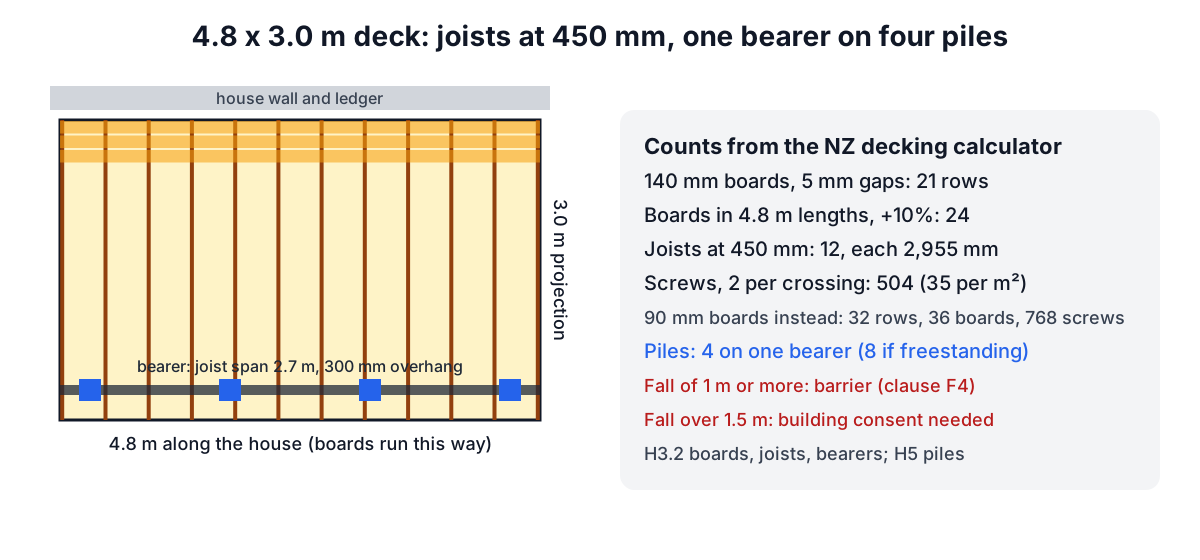
The side against the house is the length; the distance the deck projects into the section is the projection. Joists run in the projection direction, from a ledger fixed to the house frame out over a bearer, and are spaced along the length. Boards usually run along the length, square to the joists. The 4.8 x 3.0 m deck therefore has joists about 3 m long spaced along 4.8 m, and boards 4.8 m long laid in rows across 3 m.
Joists
Joists follow the fence-post count: the length divided by the spacing, rounded up, plus one. At 450 mm centres, 4,800 / 450 rounds up to 11, so the deck has 12 joists. Butted against a 45 mm boundary joist at the outer edge, each is 3,000 - 45 = 2,955 mm.
Closing up to 400 mm centres gives 13 joists. The spacing a board can bridge depends on its thickness, species and grade, so take it from the board supplier or the span tables you are working to, not from the calculator.
Boards: width, gap and length
Each row covers the board width plus the gap. With 140 mm boards and 5 mm gaps a row covers 145 mm, and 3,000 / 145 = 20.7, so 21 rows. With 90 mm boards a row covers 95 mm and the deck takes 32 rows.
That choice flows through to the fixings, because every row is screwed at every joist:
| 4.8 x 3.0 m deck, 10% extra | 140 mm boards | 90 mm boards |
|---|---|---|
| Rows | 21 | 32 |
| Boards to buy (4.8 m lengths) | 24 | 36 |
| Joists at 450 mm | 12 | 12 |
| Decking screws, two per crossing | 504 | 768 |
| Screws per m² | 35.0 | 53.3 |
| Hidden clips, one per crossing | 252 | 384 |
The narrower board adds 11 rows and 264 screws to the same 14.4 m². At 400 mm centres the 140 mm deck needs 546 screws, about 37.9 per m².
Length matters as much as width. Timber merchants stock decking in a range of lengths, and when the deck is longer than the board each row needs two pieces with a join over a joist. A 6.0 x 3.6 m deck in 140 mm boards has 25 rows; bought in 6.0 m lengths that is 28 boards, but in 4.8 m lengths it is 55, with an offcut and an end join in every row. If 6.0 m lengths are available, they halve the count.
Bearers and piles
Bearers carry the joists and piles carry the bearers. The calculator does not size them; it counts what the design calls for. On the example, a ledger takes the house end of the joists and one bearer sits 2.7 m out, leaving a 300 mm overhang to the edge. With four piles under that bearer the deck has four piles.
Make the same deck freestanding, with a second bearer near the house instead of a ledger, and the pile count doubles to eight while the joist hangers on the ledger disappear. Freestanding decks avoid fixing into the house, which removes one of the trickiest weathertightness details, at the cost of more piles and footings.
Sizes and spacings for piles, bearers and joists come from NZS 3604:2011 Timber-framed buildings, which Acceptable Solution B1/AS1 cites and marks as a sponsored standard, or from an engineer's design. Check your joist span, here 2.7 m from ledger to bearer, against the table for the timber size and grade you can actually buy.
Treatment class for each part
The NZ Timber Preservation Council's guide to hazard classes gives:
- H3.2 for decking boards and for the joists and bearers of decks and walkways, which are exposed to the weather but not in ground contact.
- H4 for timber in ground contact, such as fence posts.
- H5 for house piles and poles.
Check the brand stamp on the timber for the hazard class before it goes in. Fixings matter too: treated timber and coastal air are hard on plain steel, so use decking screws suited to the treatment and the exposure of your site.
Allowances and checks
- Extra: 10% on boards for a straight deck covers split ends, bowed lengths and the last ripped row; allow more for a picture-frame border or diagonal boards.
- Screws: sold in boxes, often of 500. The 140 mm deck's 504 screws is two boxes; the 90 mm deck's 768 is also two boxes.
- Ledger: fixing a ledger to the house affects the cladding and the weathertightness of the wall, so follow the deck design and the cladding manufacturer's details.
- Steps: if the deck needs steps down to the lawn, the Stair Calculator works out risers and goings.
Tools for this job
The NZ decking calculator counts boards, joists, bearers, piles and screws. The baluster spacing calculator and the guide to baluster spacing and the sphere rule cover the barrier, the Concrete Calculator estimates pile footings, and How to Calculate Board Feet explains volume-based timber pricing if a merchant quotes that way.
Frequently asked questions
Do I need a building consent for a deck in NZ?
Not if it is not possible to fall more than 1.5 metres from the deck; that is exemption 24 in Schedule 1 of the Building Act. The work must still comply with the Building Code, including a barrier where the fall is 1 metre or more.
How many decking boards for a 4.8 x 3.0 m deck?
In 140 mm boards with 5 mm gaps the 3.0 m projection takes 21 rows. Bought in 4.8 m lengths, one board per row plus 10% gives 24 boards. In 90 mm boards it is 32 rows and 36 boards.
How many screws per square metre of decking?
With two screws at every joist crossing and joists at 450 mm, 140 mm boards take about 35 screws per m² and 90 mm boards about 53. At 400 mm centres the 140 mm figure rises to about 38.
What treatment do deck piles need compared with joists?
The NZ Timber Preservation Council lists H5 for house piles and poles and H3.2 for decking and the joists and bearers of decks. Ground-contact timber that is not a pile, such as a fence post, is H4.
Sources and further reading
- Know your stuff: Exempt Building Work, Part 1, Licensed Building Practitioners (MBIE). Exemption 24 and the 1.5 metre fall limit; barriers at 1 metre; exempt work must comply with the Building Code.
- Acceptable Solution F4/AS1, Building CodeHub (MBIE). Barriers where people could fall 1 metre or more.
- Acceptable Solution B1/AS1, Building CodeHub (MBIE). Cites NZS 3604:2011 Timber-framed buildings as a sponsored standard.
- Choosing the Right Timber, NZ Timber Preservation Council. Hazard classes H3.2, H4 and H5.
- DCA 6: Prescriptive Residential Wood Deck Construction Guide, American Wood Council. A US comparison for the same counting method.
More Carpentry & Woodworking
Every tool in the Carpentry & Woodworking section, free and in your browser.